
Key Takeaways
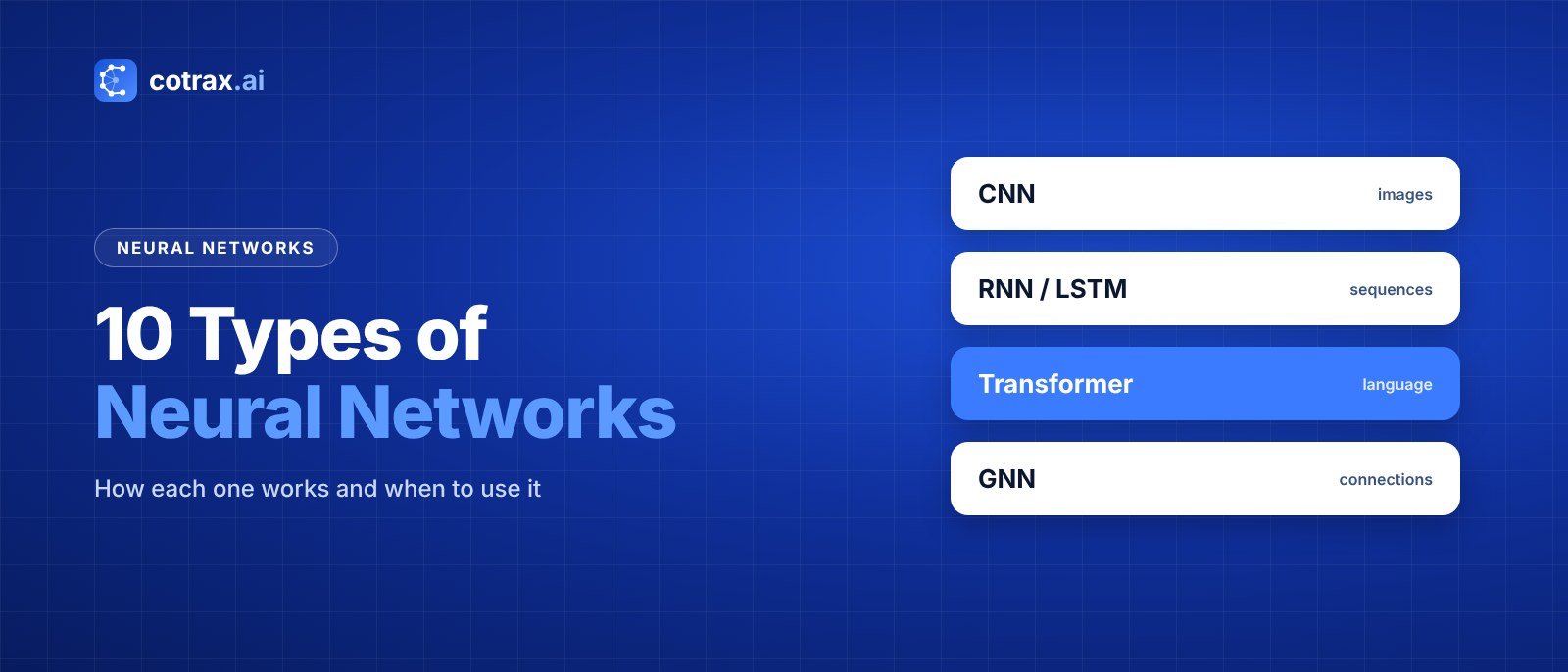
- There are many types of neural networks, and each is wired for a certain kind of data.
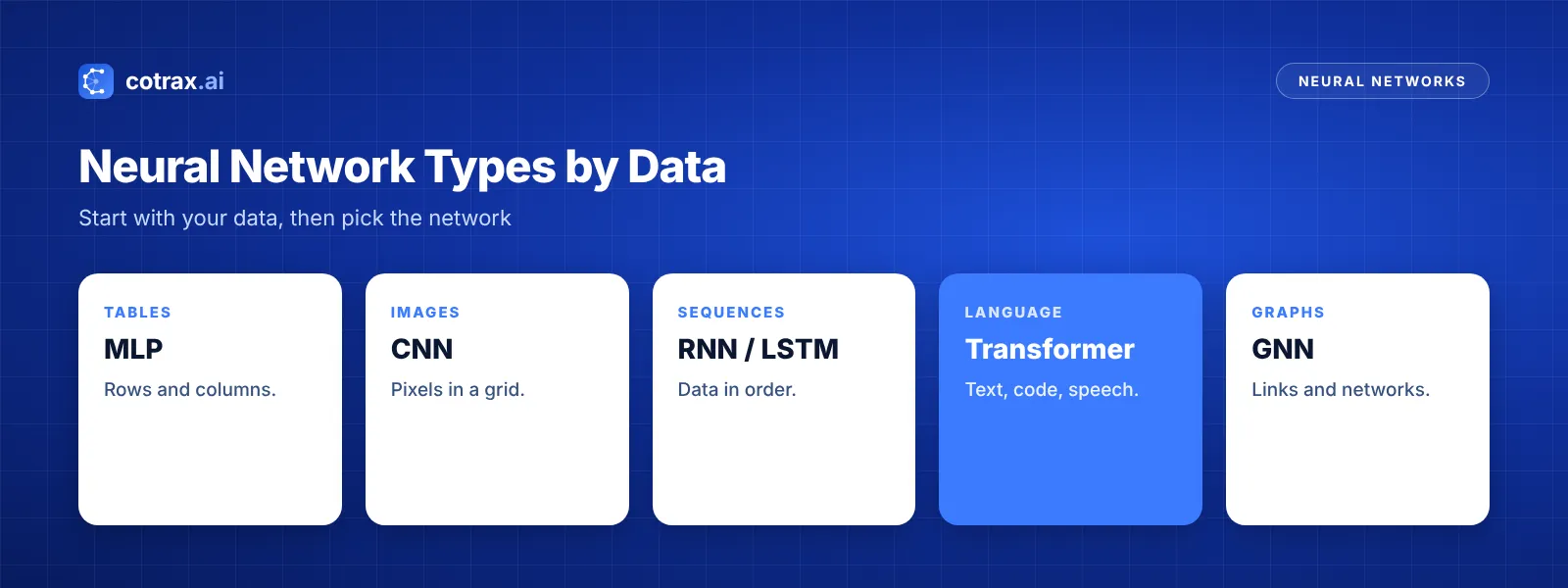
- Feedforward networks and MLPs handle tables, while CNNs handle images.
- RNNs, LSTMs and GRUs work with sequences, but transformers now lead in language.
- Autoencoders and GANs learn to compress or create data; GNNs learn from connections.
- Newer designs like liquid networks adapt over time and run with very few neurons.
A neural network that reads X-rays looks very different from one that writes emails. That’s because there are many types of neural networks, and each one is wired for a specific kind of data. So picking the right type can make or break your project.
Fortunately, you don’t need to memorize dozens of designs. Instead, about ten types cover nearly every real-world use case.
In this guide, the cotrax.ai team explains each one in plain English. You’ll see how it works, where it’s used, and when you should choose it.
What Are the Main Types of Neural Networks?
The main types of neural networks are perceptrons, feedforward networks (MLPs), convolutional networks (CNNs), recurrent networks (RNNs), LSTMs and GRUs, transformers, autoencoders, GANs, graph neural networks (GNNs) and liquid neural networks. They differ in how their neurons connect and how data flows through them, which makes each one suited to certain tasks.
If you’re new to the basics, first read our guide on what neural networks are. Then come back to compare the types.
Quick Comparison of Neural Network Types
| Type | Best for | Real example |
|---|---|---|
| Perceptron | Simple yes/no splits | Teaching and basics |
| MLP (feedforward) | Table data | Credit scoring |
| CNN | Images and video | Face unlock |
| RNN | Short sequences | Simple text tasks |
| LSTM / GRU | Longer sequences | Demand forecasting |
| Transformer | Language, code, vision | Chatbots |
| Autoencoder | Compression, anomalies | Fraud alerts |
| GAN | Creating images | Synthetic photos |
| GNN | Connected data | Drug discovery |
| Liquid network | Changing time-series data | Drone navigation |
Basic Types of Neural Networks
1. Perceptron
The perceptron is the simplest neural network: a single neuron that makes a yes-or-no decision. Frank Rosenblatt introduced it in 1958. Although it can only draw straight-line boundaries, it laid the foundation for everything that followed.
2. Feedforward network (MLP)
A feedforward network stacks several layers of neurons, and data flows in one direction only. The most common version is the multilayer perceptron. Because every neuron connects to every neuron in the next layer, it’s great for table data. Learn more in our guide to the multilayer perceptron (MLP).
Networks for Images and Sequences
3. Convolutional neural network (CNN)
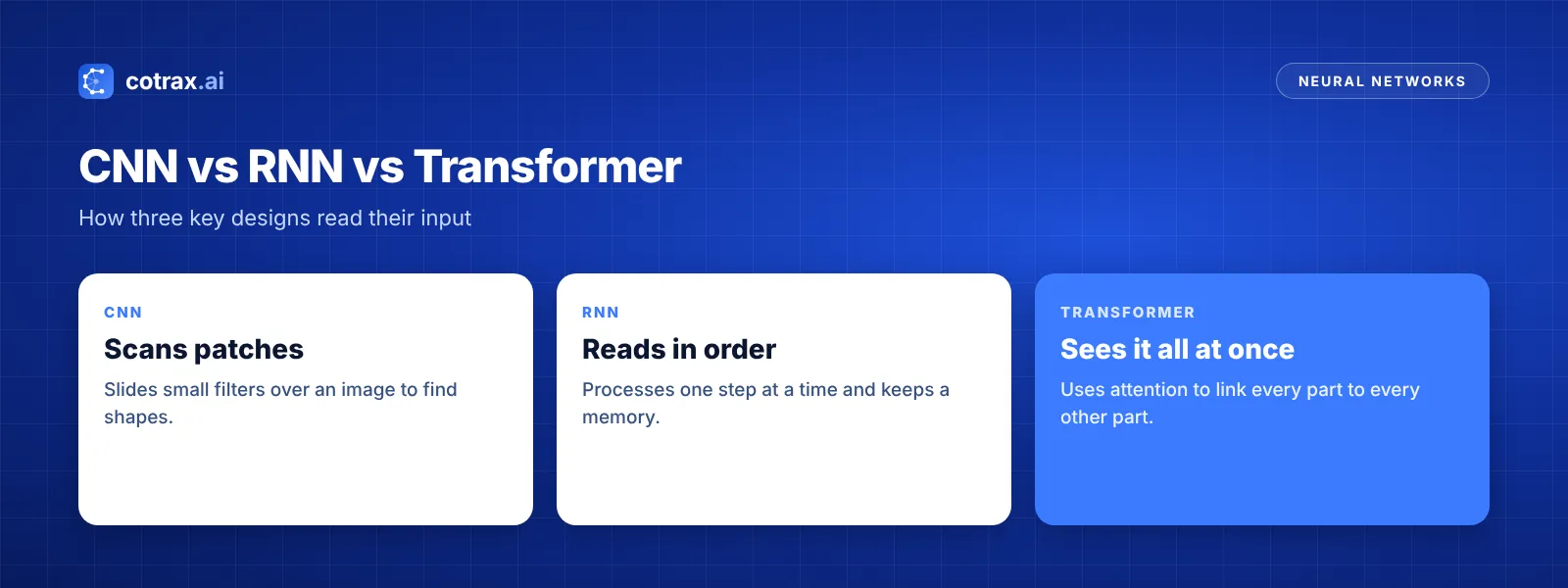
CNNs slide small filters over an image to spot edges, then textures, then whole objects. As a result, they need far fewer weights than an MLP would for the same image. They power photo tagging, medical imaging and quality checks in factories.
4. Recurrent neural network (RNN)
RNNs read data one step at a time and pass a “memory” forward. That makes them a natural fit for sequences, such as words or sensor readings. However, basic RNNs forget information from many steps back.
5. LSTM and GRU
Long short-term memory networks (LSTMs) fix that forgetting problem. They use gates that decide what to keep, update or drop. GRUs are a lighter version with fewer gates. Both are still useful for forecasting and signal data.
Not sure which network fits your data?
Share your use case with the cotrax team and get a clear, simple recommendation.
Transformers: Today’s Leading Neural Network
6. Transformer
Transformers, introduced in the paper “Attention Is All You Need”, read the whole input at once. Their attention mechanism lets every word “look at” every other word. Because of this, they train fast on huge datasets. Today, they power large language models, translation tools and many vision systems.
Generative and Specialized Neural Networks
7. Autoencoder
An autoencoder compresses data into a small code and then rebuilds it. If it can’t rebuild an example well, that example is likely unusual. Therefore, autoencoders are popular for spotting fraud and machine faults.
8. Generative adversarial network (GAN)
A GAN pairs two networks. One creates fake data, while the other tries to catch the fakes. Over time, both improve, and the fakes become highly realistic.
9. Graph neural network (GNN)
GNNs learn from data made of links, such as social networks, road maps or molecules. Each node shares information with its neighbors. For example, banks use GNNs to detect fraud rings, and researchers use them to predict how molecules behave.
10. Liquid neural network
Liquid neural networks are a newer, brain-inspired design from MIT researchers. Their neurons change behavior over time, so they adapt to shifting conditions. Remarkably, they can steer a car or drone with only a handful of neurons. Read more in our guide to liquid neural networks.
Don’t pick a network because it’s trendy. Instead, pick the one whose structure matches the shape of your data.
cotrax.ai Editorial Team
Get practical AI guides every week
Join the cotrax newsletter for simple, no-jargon lessons on neural networks and AI.
Recurrent vs Recursive Neural Networks
These two names sound alike, but they’re different. A recurrent network works along a sequence, step by step. A recursive network, by contrast, applies the same weights over a tree, such as the grammar tree of a sentence. Recursive networks appeared in early language research, although transformers have largely replaced them.
How to Choose the Right Type of Neural Network
- Start with your data. Images point to CNNs, text points to transformers, and tables point to MLPs or tree models.
- Check your data size. With little data, fine-tune a pretrained model instead.
- Think about time. If order matters, use an LSTM, transformer or time-aware model.
- Consider your hardware. Small CNNs and liquid networks suit phones and edge devices.
- Test a simple baseline. Finally, compare your network against a simpler model.
For tools to build these networks, see our list of the best deep learning tools. In addition, our guide to deep learning models covers the generative side in more depth.
Conclusion
The many types of neural networks exist because data comes in many shapes. MLPs handle tables, CNNs handle images, and LSTMs handle sequences. Meanwhile, transformers lead in language, GNNs learn from connections, and liquid networks adapt over time.
So match the network to your data, start with a pretrained model when you can, and always test against a simple baseline. For more clear AI guides, keep exploring cotrax.ai.
Build smarter with AI
Share your idea with the cotrax team and get a clear, simple plan to start.
Sources
- Vaswani et al., Attention Is All You Need (2017)
- Hasani et al., Liquid Time-constant Networks (2020)
Frequently asked questions
What are the main types of neural networks?
Which type of neural network is best for images?
What is the difference between RNN and CNN?
What is a recursive neural network?
Are transformers neural networks?
Want more guides like this?
Get clear, practical AI explainers from Cotrax AI in your inbox every Friday.