Key Takeaways
- Deep learning models are neural network designs built for specific kinds of data and tasks.
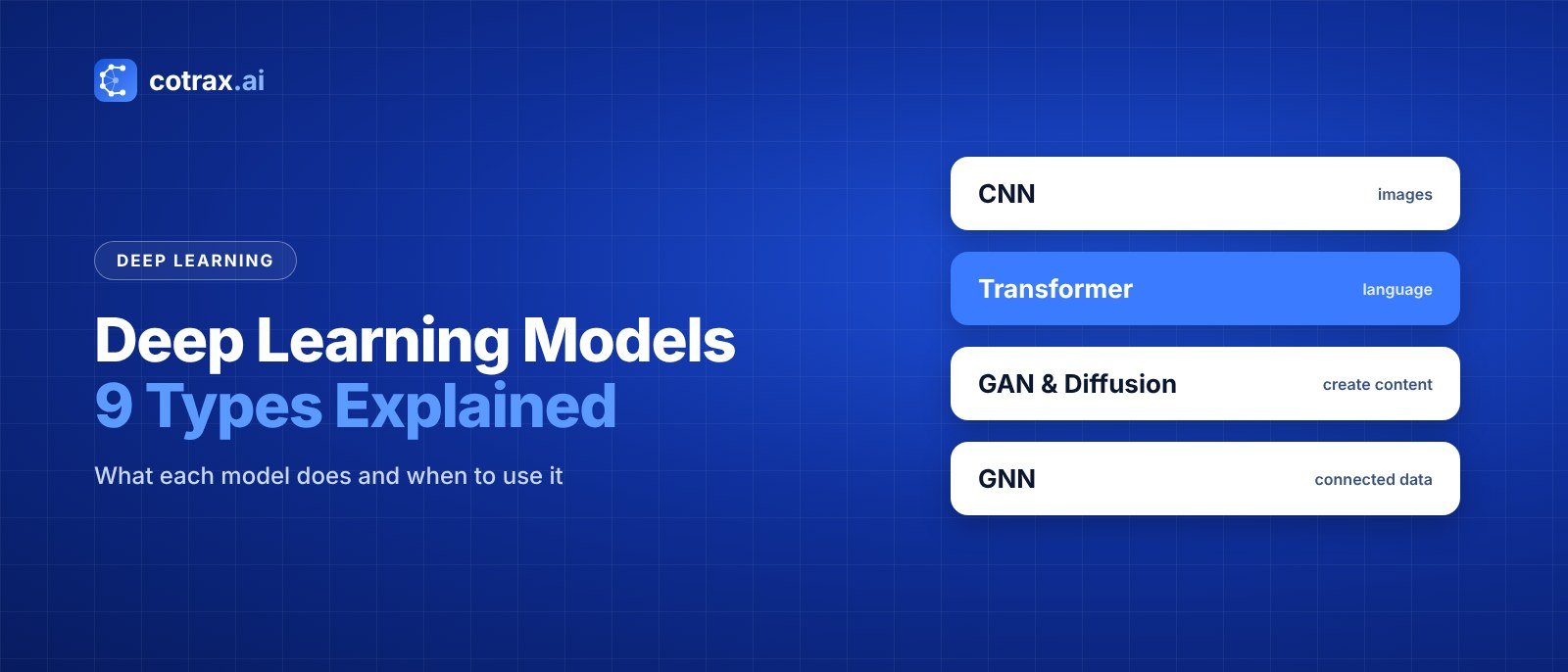
- CNNs handle images, RNNs and LSTMs handle sequences, and transformers lead in language.
- Autoencoders, GANs and diffusion models learn to compress or create new data.
- Graph neural networks work with connected data like social networks and molecules.
- Pick a model by your data type first, then by your accuracy, speed and budget needs.
Not all neural networks are built the same. The model that reads an X-ray is very different from the one that writes an email. That’s why choosing between deep learning models can feel confusing at first.
However, once you see what each model was designed for, the choice gets much easier. Most of the time, your type of data points you straight to the right one.
In this guide, the cotrax.ai team walks through the 9 main types. For each one, you’ll learn how it works in simple terms, where it’s used, and when to pick it.
What Are Deep Learning Models?
Deep learning models are neural network architectures with many layers, each designed to learn patterns from a certain kind of data, such as images, text, sound or tables. The architecture decides how information flows through the network, while training adjusts its weights so it can make accurate predictions.
People often call these “deep learning algorithms,” too. Strictly, the model is the structure, and the algorithm is how you train it. For the big picture, start with our guide on what deep learning is.
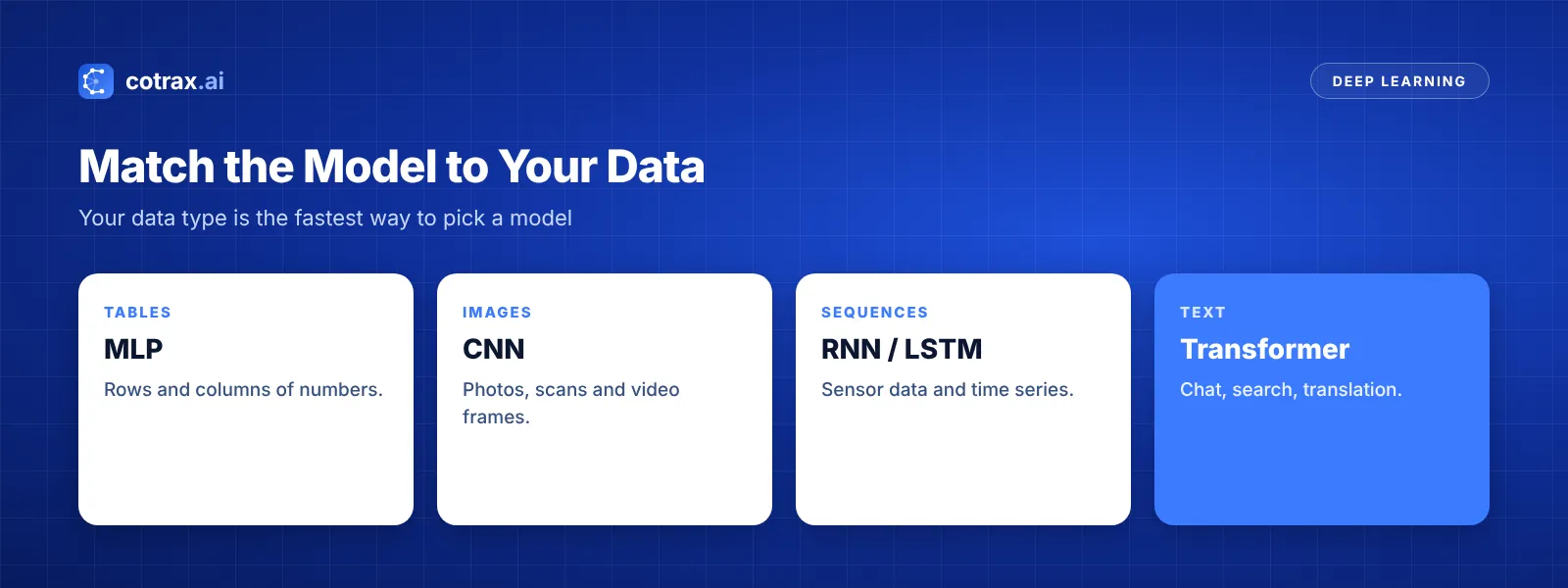
Quick Comparison of Deep Learning Models
| Model | Best data type | Common use |
|---|---|---|
| MLP | Tables | Scoring, simple predictions |
| CNN | Images | Face unlock, medical scans |
| RNN | Sequences | Simple time series |
| LSTM / GRU | Longer sequences | Forecasting, sensor data |
| Transformer | Text, images, audio | Chatbots, translation, search |
| Autoencoder | Any | Compression, anomaly detection |
| GAN | Images | Realistic image generation |
| Diffusion model | Images, audio, video | Text-to-image tools |
| GNN | Graphs | Fraud rings, molecules, maps |
Models for Tables, Images and Sequences
1. Multilayer perceptron (MLP)
An MLP is the simplest deep model. It stacks fully connected layers, so every neuron links to every neuron in the next layer. It’s a good fit for structured data, such as customer records. Still, for many table tasks, tree-based models like XGBoost often do just as well.
2. Convolutional neural network (CNN)
CNNs slide small filters across an image to detect edges, textures and shapes. Then deeper layers combine those into whole objects. As a result, CNNs became the classic choice for computer vision, from photo tagging to defect detection in factories.
3. Recurrent neural network (RNN)
RNNs read data one step at a time and keep a small memory of what came before. That makes them useful for sequences like sensor readings. However, basic RNNs struggle to remember long-range patterns.
4. LSTM and GRU
LSTMs (long short-term memory networks) fix that memory problem with “gates” that decide what to keep and what to forget. GRUs are a lighter version. Both are still popular for forecasting and signal data.
Not sure which model fits your data?
Share your use case with the cotrax team and get a simple recommendation.
Transformer Models: Today’s Leading Architecture
5. Transformer
Transformers were introduced in the 2017 paper “Attention Is All You Need.” Their key idea is attention, which lets the model look at every part of the input at once and decide what matters most.
Because of this, transformers train well on huge datasets. They now power large language models like GPT, Claude and Gemini. In addition, vision transformers handle images, and audio transformers power speech tools.
Generative Deep Learning Models
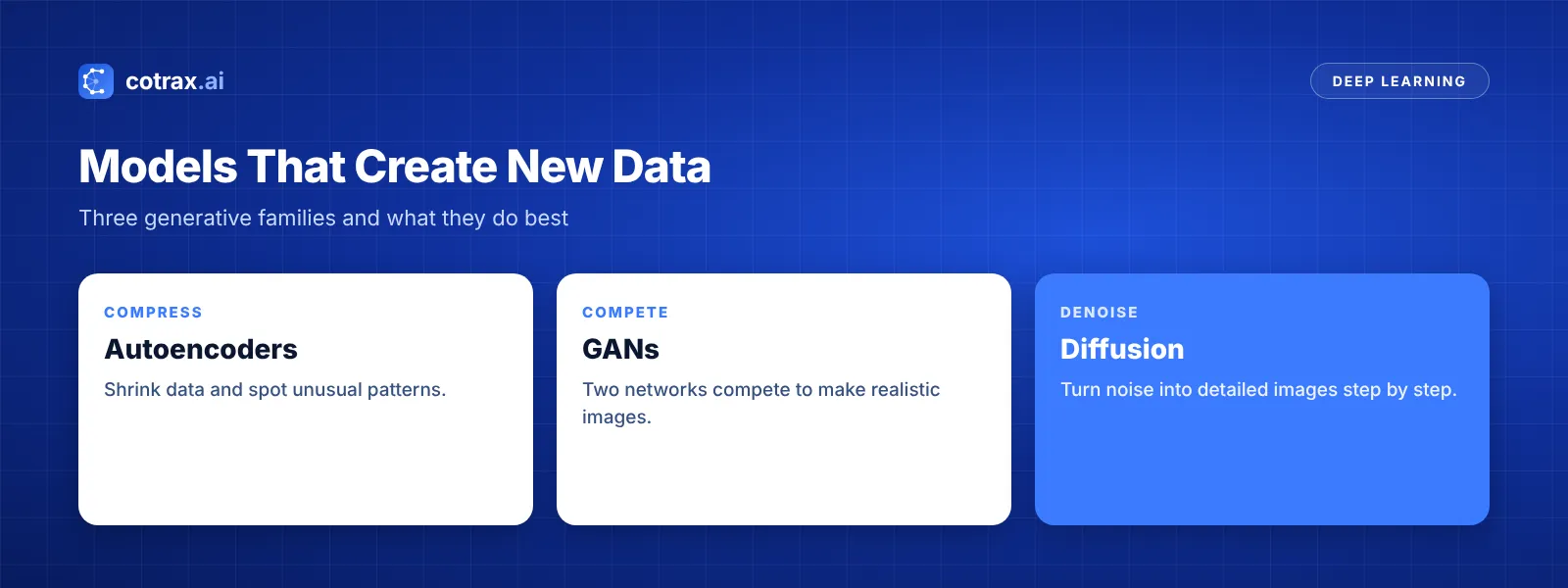
These models don’t just label data. Instead, they learn to compress it or create brand-new content.
6. Autoencoder
An autoencoder squeezes data into a small code and then rebuilds it. If it can’t rebuild an input well, that input is probably unusual. So autoencoders are handy for spotting fraud or machine faults.
7. Generative adversarial network (GAN)
A GAN pits two networks against each other. The generator creates fake images, while the discriminator tries to spot them. Over time, the fakes become very realistic.
8. Diffusion model
Diffusion models learn to remove noise from an image step by step. To generate, they start from pure noise and slowly “clean” it into a picture that matches your prompt. Most popular text-to-image tools use this approach today.
Models for Connected Data
9. Graph neural network (GNN)
Some data is all about connections, such as friends in a social network or atoms in a molecule. GNNs pass messages between connected points to learn from those links. For example, banks use them to detect fraud rings, and drug researchers use them to predict molecule properties.
Start with the simplest model that could work. You can always move to a bigger architecture once you know the simple one isn’t enough.
cotrax.ai Editorial Team
Get practical AI guides every week
Join the cotrax newsletter for simple, no-jargon lessons on deep learning models and AI.
Pretrained Deep Learning Models: The Smart Shortcut
Training a large model from scratch takes huge datasets and a lot of computing power. Luckily, you rarely need to do that. Instead, you can start from a pretrained model and fine-tune it on your own data.
This approach is called transfer learning. The model has already learned general patterns, such as edges in images or grammar in text. So you only need to teach it your specific task.
Where to find pretrained models
- Hugging Face Hub: thousands of language, vision and audio models.
- TorchVision: classic image models like ResNet and EfficientNet.
- Keras Hub: ready-made models for TensorFlow, JAX and PyTorch users.
Why it matters for small teams
Fine-tuning can turn a project that needs millions of examples into one that needs only a few hundred. As a result, even a small business can build a useful image classifier or text tool in days. For example, a retailer could fine-tune a vision model to sort product photos by category.
How to Choose the Right Deep Learning Model
Use this simple checklist to narrow your options:
- Look at your data type. Images point to CNNs or vision transformers, while text points to transformers.
- Check your data size. With little data, fine-tune a pretrained model instead of training from scratch.
- Think about speed. Smaller CNNs and MLPs run faster on phones and edge devices.
- Consider explainability. If you must explain decisions, simpler models may be safer.
- Test a baseline first. Then compare your deep model against a simple one.
Also, keep in mind that deep models aren’t always the answer. Our guide to the types of machine learning explains other options. And for coding, see the best deep learning tools to build these models.
Costs keep falling as well. The Stanford AI Index 2025 found that the cost of GPT-3.5-level performance dropped more than 280-fold in about two years. That makes powerful models far easier to use.
Conclusion
Deep learning models come in many shapes, but each was built for a reason. MLPs fit tables, CNNs fit images, and LSTMs fit sequences. Meanwhile, transformers lead in language, and GANs and diffusion models create new content.
The fastest way to choose is to start with your data type. Then test a simple baseline and fine-tune a pretrained model when you can.
Want more clear AI guides like this one? Keep exploring cotrax.ai, or contact our team to plan your next project.
Build smarter with AI
Share your idea with the cotrax team and get a clear, simple plan to start.
Sources
Frequently asked questions
What are the main types of deep learning models?
Which deep learning model is best?
Is a transformer a deep learning model?
What is the difference between a model and an algorithm in deep learning?
Can I use pretrained deep learning models?
Want more guides like this?
Get clear, practical AI explainers from Cotrax AI in your inbox every Friday.