Key Takeaways
- Machine learning is a way for computers to learn patterns from data and use them to make predictions or decisions.
- The four main types of machine learning are supervised, unsupervised, semi-supervised and reinforcement learning. Self-supervised learning is a fast-growing fifth approach.
- The type you choose depends on your data (labeled or not) and your goal (predict, group, or act).
- Every ML project follows a similar process: define the problem, collect data, prepare it, train, evaluate, deploy and monitor.
- Under the hood, models learn by making guesses, measuring errors and adjusting to reduce those errors.
- Good data matters more than fancy algorithms.
Today, machine learning powers the apps you use every day, from video recommendations to fraud alerts. But how does a computer actually “learn”? Also, why do people keep talking about different types of machine learning, like supervised, unsupervised and reinforcement learning?
Fortunately, this guide answers both questions. First, you’ll learn the main types of machine learning, with clear examples and common algorithms for each. Then, you’ll see how machine learning works step by step, from raw data to a model that makes real predictions.
No math degree needed. Instead, the cotrax team keeps it simple, practical and beginner-friendly.
What Is Machine Learning?
Machine learning (ML) is a branch of artificial intelligence that lets computers learn from examples instead of following fixed, hand-written rules.
In traditional programming, a developer writes rules: if the email contains “free money”, mark it as spam. In contrast, in machine learning you give the computer thousands of example emails marked spam or not spam. The computer then works out the rules by itself, often finding patterns no human would think of.
Back in 1959, Arthur Samuel, an early AI pioneer at IBM, popularized the term “machine learning” and described it as giving computers the ability to learn without being explicitly programmed. Even so, that idea still sums it up well today.
Traditional software follows rules. Machine learning discovers them.
cotrax.ai Editorial Team
The Main Types of Machine Learning
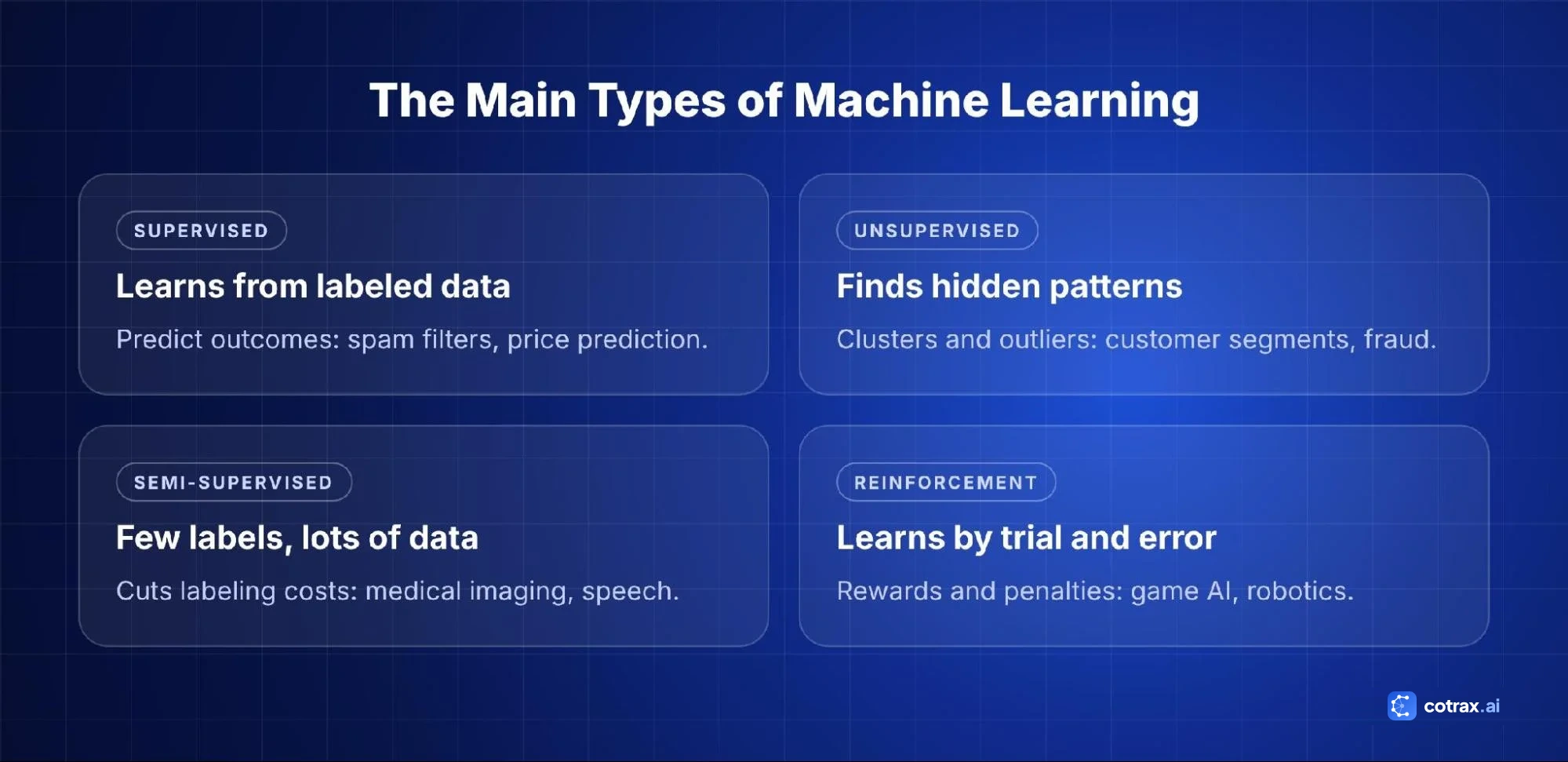
Machine learning methods are grouped by how they learn, mainly by what kind of data and feedback they get. Here are the main types.
1. Supervised Learning
Supervised learning uses labeled data, meaning every training example comes with the correct answer. In other words, the model learns to map inputs to outputs, like a student learning from an answer key.
Two main tasks:
- Classification: predict a category (spam or not spam, approved or rejected, cat or dog).
- Regression: predict a number (house price, temperature, monthly sales).
Common algorithms: linear regression, logistic regression, decision trees, random forests, gradient boosting (XGBoost, LightGBM), support vector machines and neural networks.
Real examples: email spam filters, credit scoring, medical image diagnosis, price prediction and sentiment analysis.
Best when: you have plenty of good labeled data and a clear outcome to predict.
2. Unsupervised Learning
On the other hand, unsupervised learning works with unlabeled data. There is no answer key. Instead, the model explores the data and finds hidden structure on its own.
Main tasks:
- Clustering: group similar items (customer segments, similar news articles).
- Dimensionality reduction: compress many features into fewer while keeping key information.
- Anomaly detection: find unusual data points (fraud, faulty sensors, cyberattacks).
- Association rules: find items that often go together (market basket analysis).
Common algorithms: k-means, hierarchical clustering, DBSCAN, PCA, Isolation Forest and autoencoders.
Best when: you want to explore data, find groups or spot outliers, and you don’t have labels.
3. Semi-Supervised Learning
Meanwhile, semi-supervised learning combines a small labeled dataset with a large unlabeled dataset. It’s useful when labels are expensive, such as medical scans that need a doctor’s review.
Common techniques: self-training (pseudo-labeling), label propagation and consistency regularization.
Real examples: medical image classification, speech recognition and web page categorization.
For a full side-by-side comparison of these first three types, read Supervised vs Unsupervised vs Semi-Supervised Learning.
4. Reinforcement Learning
In contrast, reinforcement learning (RL) is learning by trial and error. An agent takes actions in an environment, receives rewards or penalties, and gradually learns which actions lead to the best long-term results.
For example, think of training a dog with treats, or learning a video game by playing it many times. However, nobody gives the agent the right answer for each move. Instead, it discovers good strategies through experience.
Key terms:
- Agent: the learner or decision-maker.
- Environment: the world the agent interacts with.
- Action: a choice the agent makes.
- Reward: feedback telling the agent how good the action was.
- Policy: the strategy the agent learns for choosing actions.
Common algorithms: Q-learning, Deep Q-Networks (DQN), policy gradients and Proximal Policy Optimization (PPO).
Real examples: DeepMind’s AlphaGo, robotics, game AI and reinforcement learning from human feedback (RLHF), which is used to fine-tune chatbots.
5. Self-Supervised Learning (the Modern Bonus Type)
Finally, self-supervised learning creates its own labels from raw data. For example, a language model hides a word in a sentence and learns to predict it, or predicts the next word in a passage. No human labeling is needed, so models can learn from enormous amounts of text, images or audio.
This approach is how large language models like GPT and Claude are pre-trained, before being fine-tuned with supervised examples and reinforcement learning.
Learning machine learning from scratch?
Get the free cotrax beginner roadmap with the exact topics and tools to learn, in order.
Types of Machine Learning: Comparison Table
| Type | Data | Goal | Example algorithms | Example use |
|---|---|---|---|---|
| Supervised | Labeled | Predict outcomes | Random forest, XGBoost, logistic regression | Spam filtering |
| Unsupervised | Unlabeled | Find patterns and groups | k-means, PCA, DBSCAN | Customer segmentation |
| Semi-supervised | Few labels + many unlabeled | Predict with fewer labels | Self-training, label propagation | Medical imaging |
| Reinforcement | Rewards from actions | Learn the best actions | Q-learning, PPO | Game AI, robotics |
| Self-supervised | Raw data with auto-made labels | Learn general representations | Transformers, contrastive learning | Large language models |
How Machine Learning Works: Step by Step
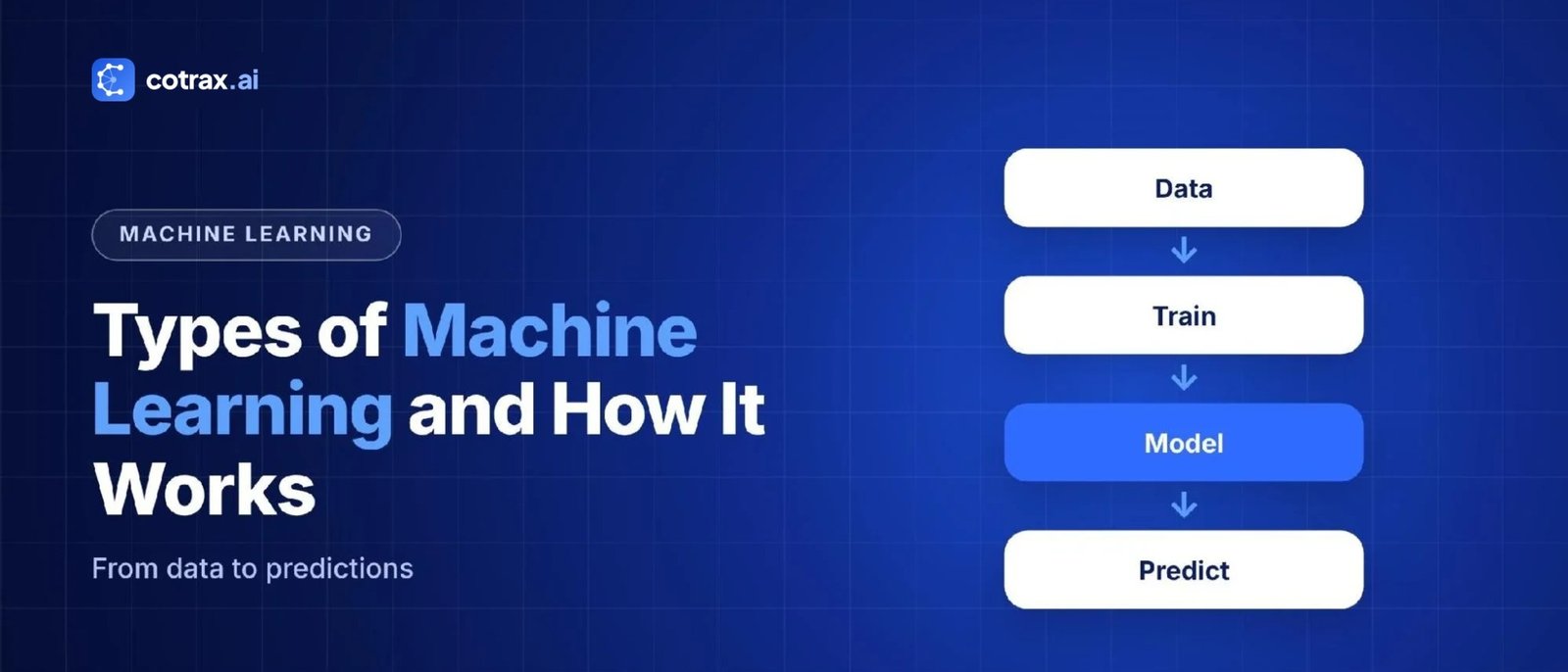
Now that you know the types of machine learning, let’s look at how a typical project goes from idea to working model. In general, most teams follow these steps, often called the machine learning lifecycle.
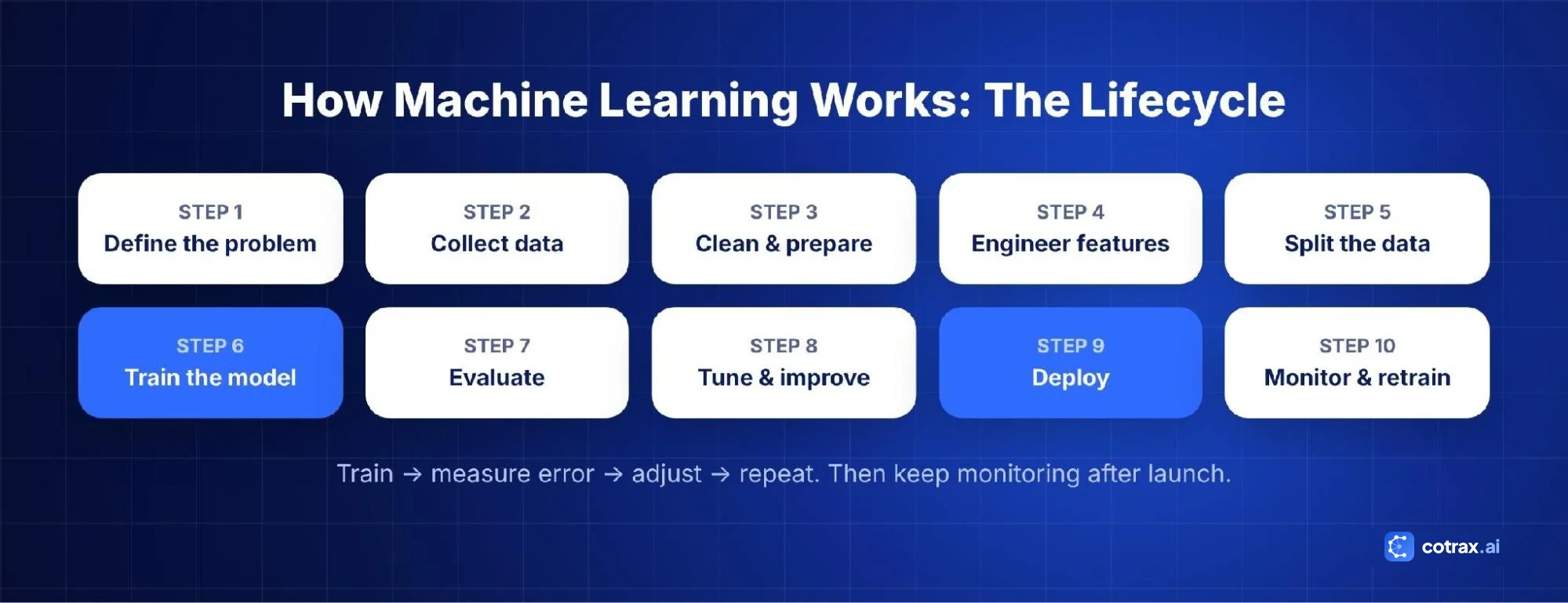
Step 1: Define the problem
First, start with a clear question. “Which customers are likely to cancel next month?” is much better than “Let’s use AI.” Then decide what you’ll predict, how you’ll measure success and what action you’ll take with the result.
Step 2: Collect data
Next, gather the data that can answer your question. For example, this might be sales records, sensor readings, images, text or user activity logs. As a rule, more relevant, high-quality data usually means a better model.
Step 3: Clean and prepare the data
In reality, data is messy. In this step, you fix missing values, remove duplicates, correct errors and convert text or categories into numbers the model can use. As a result, this step often takes the majority of a data scientist’s time.
Step 4: Feature engineering
Simply put, features are the inputs the model learns from. Also, good features make learning easier. For example, turning a raw date into “day of the week” or “days since last purchase” can make a big difference. Deep learning models can learn many features automatically, but classic ML still benefits from smart feature design.
Step 5: Split the data
Then divide your data into a training set (to learn from), a validation set (to tune settings) and a test set (to check final performance). However, the test set must stay unseen until the end, or your results will look better than they really are.
Step 6: Choose and train a model
First, pick an algorithm that fits your data and goal. Then train it. In short, training is where the actual “learning” happens:
- The model makes a prediction for each training example.
- A loss function measures how wrong each prediction is.
- An optimizer, often a method called gradient descent, adjusts the model’s internal parameters to reduce the error.
- This repeats many times until the error stops improving.
For example, imagine walking downhill in fog. You can’t see the bottom, but you can feel which way the ground slopes. So each small step downhill reduces the error. That’s gradient descent in a nutshell.
Step 7: Evaluate the model
Next, test the trained model on data it has never seen. Common metrics include:
- Accuracy, precision, recall and F1 score for classification.
- Mean absolute error (MAE) and root mean squared error (RMSE) for regression.
- Silhouette score and human review for clustering.
Also, watch out for overfitting, when a model memorizes the training data but performs poorly on new data, and underfitting, when it’s too simple to capture the pattern.
Step 8: Tune and improve
Adjust settings called hyperparameters (like tree depth or learning rate), try new features or test other algorithms. Also, tools like cross-validation and automated tuning help find the best version.
Step 9: Deploy the model
After that, put the model to work in a real app, website or business process, usually through an API. From then on, it can make predictions on live data.
Step 10: Monitor and retrain
Over time, the world changes, and so does data. For example, customer behavior shifts, new products launch and fraudsters change tactics. This is called data drift. Therefore, monitor performance and retrain the model regularly. Overall, this ongoing work is the heart of MLOps. Some teams go further with continual learning, where models keep learning from new data without forgetting old skills.
A model isn’t finished when it’s deployed. That’s when the real work of keeping it accurate begins.
cotrax.ai Editorial Team
A Simple Example: Predicting House Prices
To illustrate, let’s walk through how machine learning works with one easy example.
- Problem: predict the sale price of a house.
- Data: 10,000 past sales with size, bedrooms, location, age and final price.
- Prepare: fill missing values, convert location names into numbers.
- Features: add “average price per square foot in the area” and “years since renovation”.
- Train: fit a gradient boosting model on 80% of the data.
- Evaluate: check the error on the remaining 20%, for example an average error of around 5% of the sale price.
- Deploy: real estate agents enter details of a new listing and get an instant price estimate.
- Monitor: retrain every few months as the market changes.
In this case, this is supervised learning (regression), because every past sale has a known price label.
Key Machine Learning Terms in Plain English
Also, these terms come up again and again. Here is what each one means.
- Dataset: the collection of examples the model learns from.
- Feature: one input the model uses, such as age, price or number of logins.
- Label: the correct answer for an example in supervised learning.
- Model: the learned pattern, stored as numbers, that turns inputs into predictions.
- Parameters: the internal numbers the model adjusts during training.
- Hyperparameters: settings you choose before training, such as learning rate or tree depth.
- Training: the process of adjusting parameters to reduce errors.
- Inference: using a trained model to make predictions on new data.
- Overfitting: when a model memorizes training data and fails on new data.
- Generalization: how well a model performs on data it has never seen.
- Data drift: when real-world data changes over time and the model gets less accurate.
In short, once these words feel familiar, most machine learning articles and tutorials become much easier to follow.
Machine Learning vs Deep Learning: Where Does It Fit?
Deep learning is a subset of machine learning that uses neural networks with many layers. For a full breakdown, see our guide to machine learning vs AI vs deep learning. Also, it can be used inside any of the learning types above. For example, a deep neural network can be trained with supervised learning to recognize images, or with reinforcement learning to play games.
In general, classic ML works best for structured data in tables. Deep learning shines with images, audio, video and natural language, but needs more data and computing power.
Common Beginner Mistakes in Machine Learning
- Starting with the algorithm instead of the problem: define the business question and success metric first.
- Using too little or poor-quality data: no model can fix data that is wrong, biased or missing key information.
- Testing on training data: always keep a separate test set, or your accuracy will look much better than it really is.
- Skipping a simple baseline: compare every model against a basic one, such as predicting the average.
- Forgetting about deployment and monitoring: a model that never leaves the notebook, or silently drifts after launch, delivers no value.
Popular Tools to Start With
- pandas and NumPy for data preparation.
- scikit-learn for classic supervised and unsupervised models.
- XGBoost and LightGBM for high-accuracy tabular models.
- PyTorch, TensorFlow and Keras for deep learning.
- Gymnasium for reinforcement learning practice environments.
See the full list in our guide to the best Python libraries for machine learning.
Want to apply machine learning to your business?
The cotrax team can help you choose the right type of ML and plan your first project.
How to Choose the Right Type of Machine Learning
- Have labeled data and a clear target? Supervised learning.
- Have raw data and want to find groups or anomalies? Unsupervised learning.
- Have a few labels and lots of raw data? Semi-supervised learning.
- Need a system that makes a series of decisions and learns from results? Reinforcement learning.
- Working with huge amounts of text or images? Start from a self-supervised pre-trained model and fine-tune it.
To see these types in action across industries, explore our guide to the applications of machine learning.
Conclusion
Understanding the types of machine learning is the first step to using it well. Supervised learning predicts known outcomes, unsupervised learning finds hidden patterns, semi-supervised learning makes the most of limited labels and reinforcement learning learns the best actions through trial and error. Self-supervised learning now powers the biggest AI models of all.
No matter the type, machine learning works the same basic way: collect good data, train a model to reduce its errors, test it honestly and keep improving it after launch. Master that process, and you’ll understand how most modern AI really works.
Learn and build with cotrax
At cotrax, we make AI and machine learning simple, practical and useful. Whether you’re learning the basics or building AI agents for your team, we’re here to help you move faster.
Sources
- IBM: What is machine learning?
- MIT Sloan: Machine learning, explained
- scikit-learn User Guide
- Gymnasium (reinforcement learning environments)
Frequently asked questions
What are the 4 types of machine learning?
How does machine learning work in simple words?
Which type of machine learning is most used?
Is reinforcement learning supervised or unsupervised?
How long does it take to train a machine learning model?
Do I need to know math to learn machine learning?
What is the difference between an algorithm and a model?
Can machine learning learn on its own after deployment?
Want more guides like this?
Get clear, practical AI explainers from Cotrax AI in your inbox every Friday.