Key Takeaways
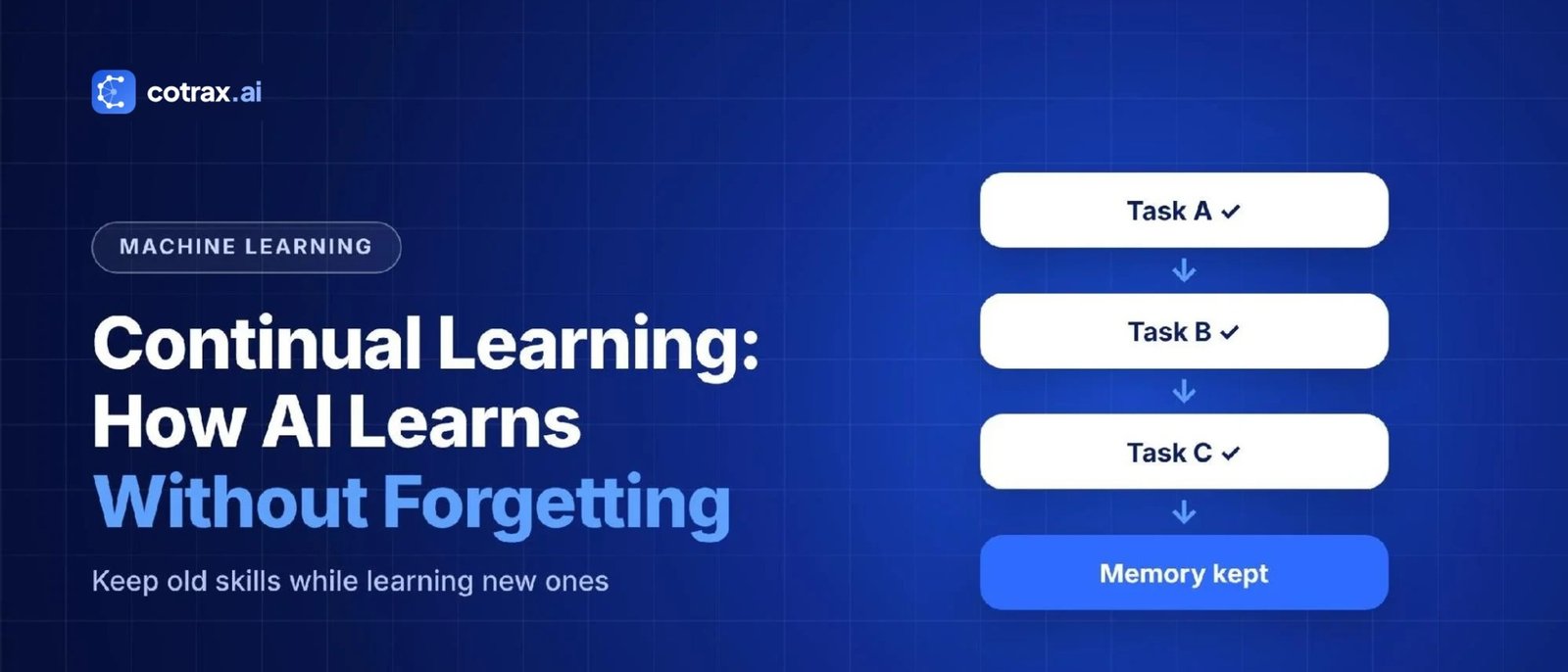
- Continual learning (also called lifelong or incremental learning) trains AI models on a stream of new data or tasks without losing earlier knowledge.
- The main enemy is catastrophic forgetting: new training overwrites the weights that stored old skills.
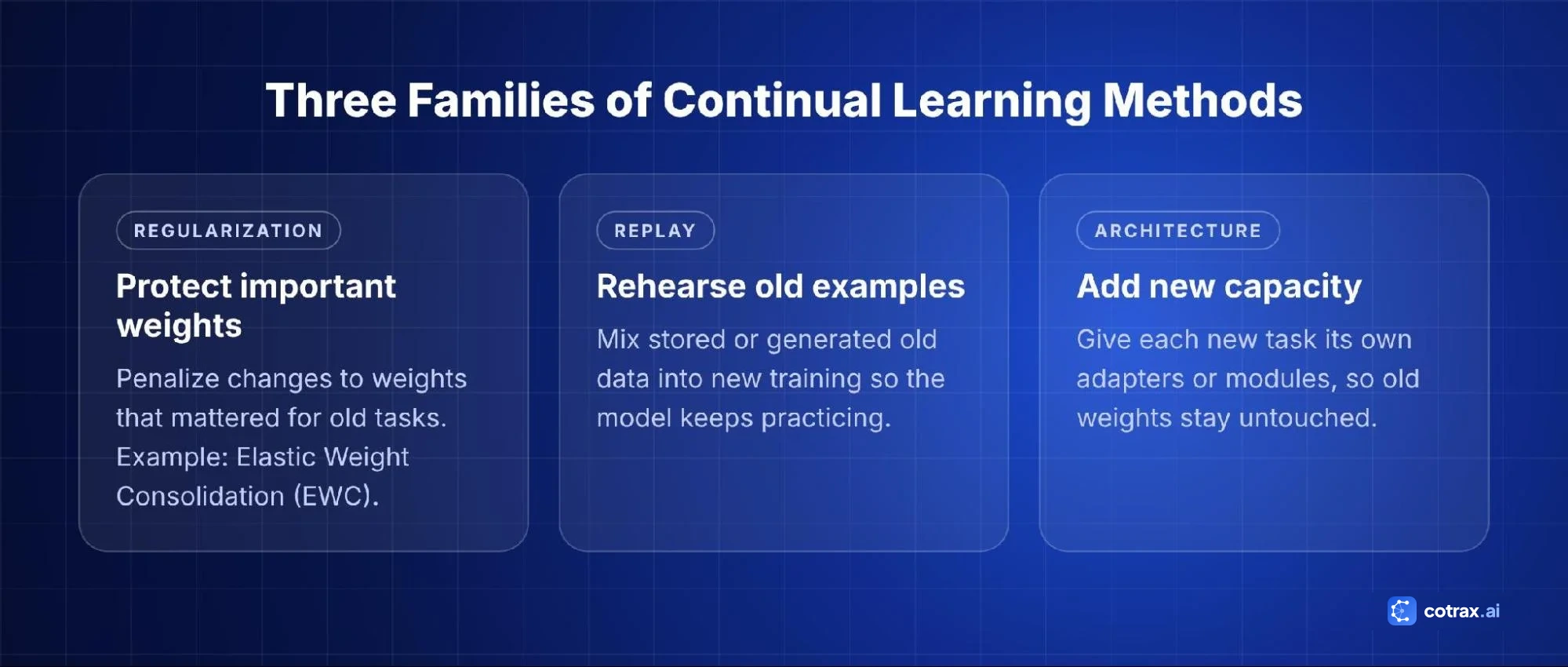
- Methods fall into three families: regularization (protect important weights), replay (rehearse old examples) and architecture (add new capacity).
- For LLMs, practical options include retrieval (RAG), adapters such as LoRA and careful data mixing during fine-tuning.
- Continual learning matters for AI agents, personal assistants, robots and any model that must adapt to a changing world.
- It is still an open research problem. Most production systems today rely on regular retraining plus monitoring.
Humans keep learning all their lives. For example, you can learn to drive without forgetting how to ride a bike. Most AI models, however, can’t do this without continual learning. Train a neural network on something new, and it often forgets what it knew before. This problem has a name: catastrophic forgetting.
Continual learning is the field of AI that tries to fix it. In short, it is about building models that keep learning from new data and new tasks over time, while holding on to old skills.
In this guide, the cotrax team explains what continual learning is, why AI forgets and the main methods researchers use. We also cover how it applies to large language models and where it is used in the real world.
What Is Continual Learning?
Continual learning is a way of training machine learning models so they can learn from a sequence of tasks or a stream of data over time. The goal is to add new knowledge while also keeping what the model already knows.
Standard machine learning assumes all training data is available at once. First, you collect a dataset. Then you train a model, test it and deploy it. However, the real world doesn’t stand still. Customer behavior shifts, new products appear, language changes and new tasks come up. Continual learning is about adapting to that change without starting from scratch every time. If you are new to these ideas, start with our guide to the types of machine learning.
You’ll also see these related terms:
- Lifelong learning: a broader name for systems that learn across their whole lifetime.
- Incremental learning: adding new classes, tasks or data step by step.
- Online learning: updating a model one example or small batch at a time as data arrives.
A model that can’t learn after launch is a snapshot. A model that learns continually is a skill that keeps growing.
cotrax.ai Editorial Team
Why Does AI Forget? Catastrophic Forgetting Explained
A neural network stores what it learns in its weights, the millions or billions of numbers inside it. When you train it on a new task, those same weights are adjusted to fit the new data. Since nothing tells the network to protect the parts that mattered for the old task, they get overwritten.
As a result, the effect can be dramatic. A model that was excellent at task A can become poor at it after a short round of training on task B. Researchers McCloskey and Cohen described this effect back in 1989, and it is still one of the core challenges in deep learning.
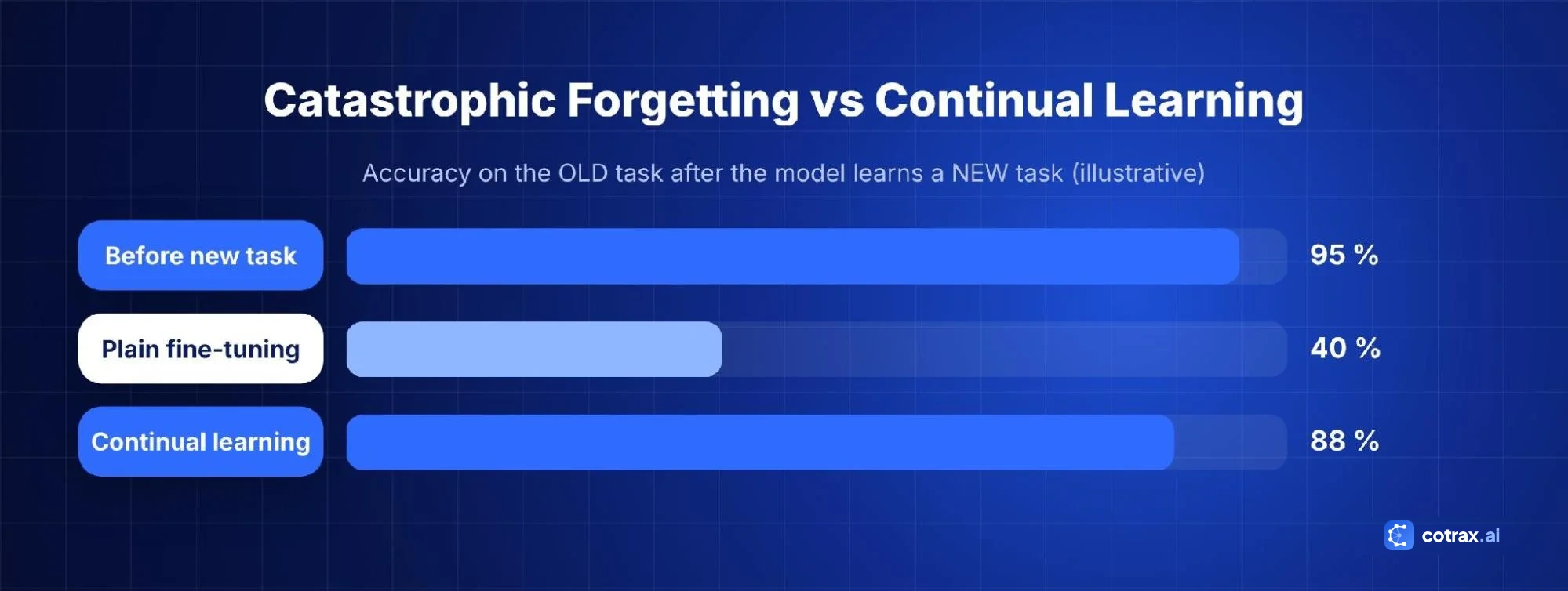
Think of it like writing new notes over old notes on a whiteboard. Unless you leave space or copy the old notes somewhere, they are gone.
The stability–plasticity dilemma
Every continual learning method has to balance two needs:
- Plasticity: the ability to learn new things quickly.
- Stability: the ability to keep old knowledge intact.
Too much plasticity causes forgetting. On the other hand, too much stability means the model can’t learn anything new. So the art of continual learning is finding the right balance.
Types of Continual Learning Scenarios
Researchers usually test continual learning in three settings:
- Task-incremental learning: the model learns separate tasks one after another and is told which task it is working on at test time.
- Domain-incremental learning: the task stays the same, but the type of data changes. For example, a self-driving system may move from sunny to snowy roads.
- Class-incremental learning: the model keeps adding new categories, such as new product types, and must tell all of them apart without being told which batch they came from. This is usually the hardest setting.
Building models that need to keep up with change?
The cotrax team can help you plan how your AI models stay accurate over time, from retraining to monitoring.
The Main Continual Learning Methods
1. Regularization methods: protect important weights
These methods add a rule to training: don’t change the weights that mattered most for old tasks. The best-known example is Elastic Weight Consolidation (EWC), which researchers at DeepMind introduced in their 2017 paper “Overcoming catastrophic forgetting in neural networks”. In simple terms, EWC slows down learning on the weights that were important for earlier tasks, like putting springs on them.
Pros: there is no need to store old data. Cons: however, it works less well when many tasks pile up.
2. Replay methods: rehearse old examples
Replay mixes some old examples into training on new data, so the model keeps practicing old skills. This is similar to how students review earlier chapters before an exam.
- Experience replay: store a small memory buffer of real past examples.
- Generative replay: use a generative model to create synthetic examples of old data. This is useful when real data can’t be kept for privacy reasons.
Pros: simple and often very effective. Cons: on the other hand, it needs memory and may raise privacy or storage concerns.
3. Architecture methods: add new capacity
These methods change the model’s structure as it learns. For instance, each new task can get its own small set of parameters, while older parts are frozen.
- Adapters and LoRA modules: small trainable add-ons for each task, with the base model frozen.
- Progressive networks: add new columns of neurons for each new task.
- Parameter isolation: reserve different parts of the network for different tasks.
Pros: old knowledge is protected by design. Cons: however, the model grows over time and may need to know which task it is doing.
In practice, the strongest systems often combine all three ideas.
Continual Learning Methods Compared
| Method family | Main idea | Example | Main trade-off |
|---|---|---|---|
| Regularization | Penalize changes to important weights | EWC | Weakens over many tasks |
| Replay | Rehearse stored or generated old data | Experience replay, generative replay | Needs memory, privacy care |
| Architecture | Add separate parameters per task | Adapters, LoRA, progressive networks | Model size grows |
Continual Learning for Large Language Models
LLMs face the same problem at a much bigger scale. Once trained, an LLM’s knowledge is frozen at its cutoff date. Fine-tuning it on new domain data can improve one skill while quietly hurting others, such as general reasoning or safe behavior. In fact, recent research continues to study exactly how and why this forgetting happens during continual fine-tuning.
Today, teams usually keep LLMs up to date with a mix of practical methods:
- Retrieval-augmented generation (RAG): instead of changing the model, give it fresh documents at question time. Because the model’s weights stay the same, nothing is forgotten.
- Adapters such as LoRA: train small add-on modules for new skills, keeping the base model frozen.
- Data mixing: when fine-tuning, include some general data alongside new data, a simple form of replay.
- Periodic retraining: retrain or update the model on a schedule, with careful testing.
- Memory for agents: AI agents can store notes, preferences and past results in an external memory. That way, they “learn” from experience without changing the model itself. For a hands-on example, see our guide on how to connect Claude to n8n.
For most businesses today, the smartest form of continual learning is not changing the model, but changing what the model can look up.
cotrax.ai Editorial Team
Real-World Uses of Continual Learning
- Personal assistants: adapting to a user’s habits, writing style and preferences over time.
- Recommendation systems: keeping up with new products, trends and changing tastes.
- Fraud and security: learning new attack patterns quickly without forgetting older ones.
- Robotics: letting robots learn new tasks in homes or factories without retraining from zero.
- Self-driving cars: adapting to new cities, weather and road rules.
- Healthcare: updating diagnostic models as new scanners, populations and diseases appear, under strict validation.
- Edge devices: phones and sensors that learn locally from new data while staying small and private.
For more examples like these, explore our guide to the applications of machine learning.
Continual Learning vs Retraining From Scratch
Why not just retrain the model on all the data every time? Many companies do, and it works well when data is small and cheap. However, retraining from scratch has real costs:
- Compute and time: retraining large models on everything again can take days or weeks.
- Data storage: keeping every past example forever is expensive and sometimes not allowed.
- Privacy rules: some data must be deleted after a set time.
- Speed of change: some problems, like fraud, change faster than a full retrain cycle.
Continual learning aims to make updates faster, cheaper and safer. Therefore, most teams today use a mix: lightweight updates often, with full retraining now and then. Keeping this process smooth is a big part of MLOps.
Challenges and Open Problems
- Measuring forgetting: teams need test sets for old tasks, not just new ones, to spot hidden losses.
- Scaling to many tasks: methods that work for five tasks may break down at five hundred.
- Bad or poisoned data: a model that learns all the time can also learn the wrong things if new data is wrong or malicious.
- Safety drift: fine-tuning can weaken safety behavior in LLMs, so safety tests must run after every update.
- Compute on small devices: learning on phones or sensors needs very efficient methods.
Get practical AI explainers every week
Join the cotrax newsletter for clear guides on machine learning, LLMs and AI agents.
How to Apply Continual Learning in Your Projects
- Start with monitoring: track model accuracy over time so you know when it starts to drift.
- Keep a “memory” test set: hold on to examples of old tasks and test on them after every update.
- Try retrieval first for LLMs: if the problem is outdated knowledge, RAG is usually simpler than retraining.
- Use adapters for new skills: add LoRA adapters instead of updating the whole model.
- Mix old and new data: when you fine-tune, include a slice of older, general data.
- Automate safely: build a pipeline that updates, tests and rolls back models if results drop.
How Humans Avoid Forgetting (and What AI Borrows)
Many continual learning ideas are inspired by the human brain. In particular, researchers often point to three human tricks:
- Sleep and replay: the brain is thought to replay recent experiences during sleep, which helps move them into long-term memory. Similarly, replay methods in AI follow the same idea.
- Protecting important connections: connections that matter for well-learned skills become harder to change. Methods like EWC copy this by making important weights “stiffer”.
- Separate memory systems: humans use fast short-term memory and slower long-term memory. Likewise, some AI systems pair a fast-learning module with a slower, stable model.
AI is still far from human-level lifelong learning. Even so, borrowing these ideas has already reduced forgetting in many tests.
A Simple Example: A Shopping App’s Product Classifier
An online store uses a model to tag product photos as shoes, bags or shirts. Next month, it adds watches and sunglasses.
- Naive approach: fine-tune the model only on photos of watches and sunglasses. It learns the new categories, but then starts tagging shoes and bags wrongly. That’s catastrophic forgetting.
- Continual learning approach: keep a small sample of old product photos (replay), add the new photos, and train with a penalty on changing important weights. As a result, the model learns watches and sunglasses while still recognizing shoes, bags and shirts.
- Check: before going live, the team tests on both old and new categories to confirm nothing important was lost.
This is a classic supervised learning task. To learn how it compares with other approaches, read our guide to supervised vs unsupervised vs semi-supervised learning.
Key Continual Learning Terms to Know
- Catastrophic forgetting: losing old skills after training on new data.
- Stability: the ability to keep old knowledge.
- Plasticity: the ability to learn new knowledge.
- Replay buffer: a small store of past examples used to rehearse old tasks.
- Data drift: when real-world data slowly changes, making a model less accurate over time.
- Backward transfer: when learning a new task actually improves performance on an old one, the opposite of forgetting.
- Forward transfer: when earlier learning helps the model learn a new task faster.
Overall, good continual learning aims for little forgetting, plus as much forward and backward transfer as possible.
Conclusion
Continual learning is about giving AI one of the most human abilities: learning something new without forgetting the old. The main obstacle, catastrophic forgetting, is tackled with three families of methods. These are protecting important weights, replaying old examples and adding new capacity.
For most teams today, practical continual learning means smart monitoring, retrieval, adapters and careful retraining. As AI agents and personal assistants become more common, models that can keep learning safely will become even more valuable. To see where this fits in the bigger picture, read machine learning vs AI vs deep learning.
The future of AI isn’t a model that knows everything on day one. It’s a model that keeps getting better every day after.
cotrax.ai Editorial Team
Keep your AI learning with cotrax
At cotrax, we help you build AI that stays useful as your business changes, from agents with memory to models that update safely.
Sources
- Kirkpatrick et al.: Overcoming catastrophic forgetting in neural networks (arXiv)
- Mechanistic Analysis of Catastrophic Forgetting in LLMs During Continual Fine-tuning (arXiv, 2026)
- Hugging Face PEFT documentation
Frequently asked questions
What is continual learning in simple words?
What is catastrophic forgetting?
Do ChatGPT and Claude learn continually?
What is the difference between continual learning and fine-tuning?
Which continual learning method is best?
Is continual learning the same as online learning?
How do I test for catastrophic forgetting?
Can continual learning make a model worse?
Which industries need continual learning most?
Want more guides like this?
Get clear, practical AI explainers from Cotrax AI in your inbox every Friday.