
Key Takeaways
- Machine learning is used wherever there is data and a repeated decision: predicting, sorting, recommending or spotting unusual events.
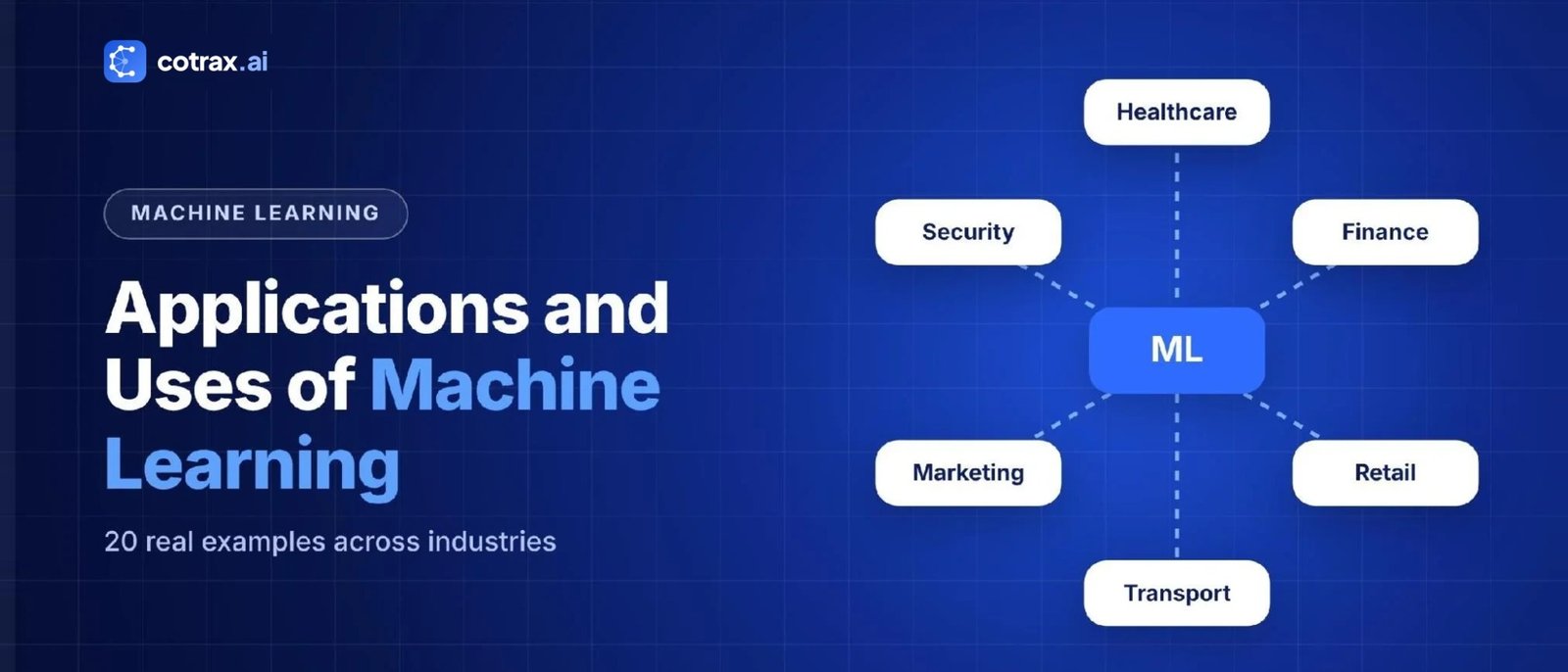
- The biggest areas today are healthcare, finance, retail, transport, marketing, cybersecurity and manufacturing.
- Everyday uses include recommendations, spam filters, voice assistants, maps and face unlock.
- Modern AI assistants and agents run on deep learning, a powerful branch of machine learning.
- Businesses use ML to cut costs, save time, reduce risk and personalize customer experiences.
- Good results need quality data, clear goals and human oversight, especially in high-stakes fields.
You use machine learning dozens of times a day, although you often don’t notice it. For example, it picks the next video you watch, blocks spam from your inbox, unlocks your phone with your face and warns your bank about strange card payments. As a result, the applications of machine learning have quietly moved from research labs into almost every app and industry.
So what are the most important applications of machine learning today? In this guide, the cotrax team walks you through 20 real-world uses across healthcare, finance, retail, transport, marketing, security and more. For each one, you’ll also see what the system does, how machine learning helps and a real example you’ll recognize.
What Is Machine Learning, in One Minute?
Machine learning (ML) is a branch of artificial intelligence where computers learn patterns from data instead of following hand-written rules. You show a model many examples, it finds patterns and then it uses those patterns to make predictions or decisions on new data.
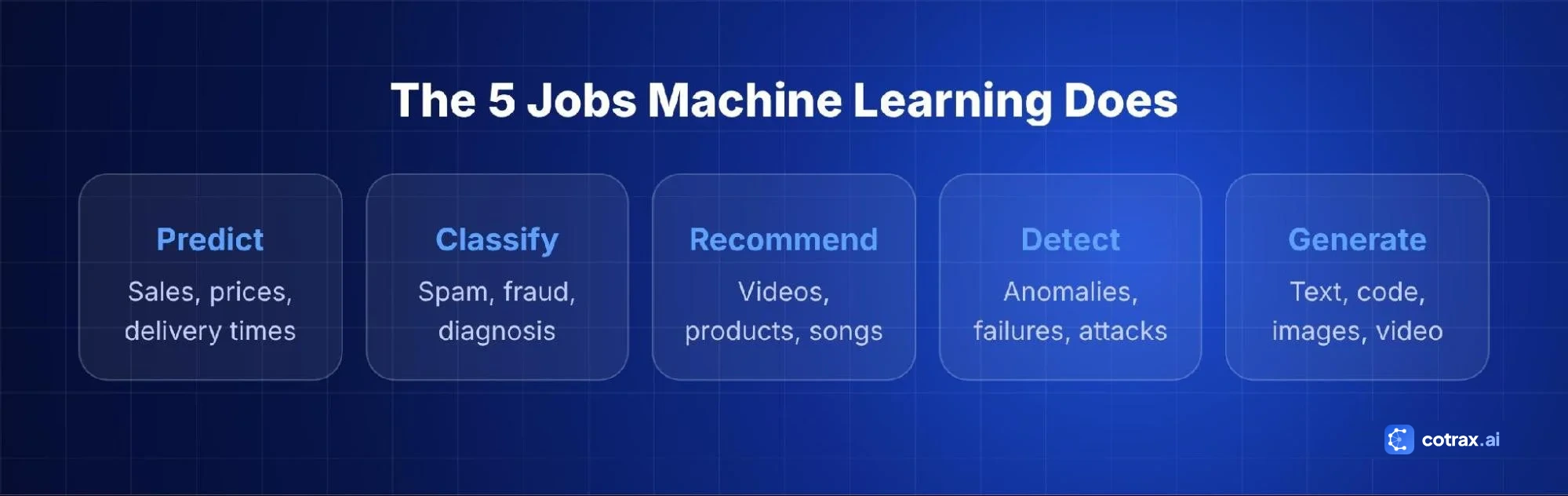
In general, most machine learning applications fall into a few simple jobs:
- Predict: estimate a number, like sales next month or the arrival time of a delivery.
- Classify: put things into groups, like spam or not spam.
- Recommend: suggest items a person is likely to want.
- Detect: spot unusual events, like fraud or machine failures.
- Understand and generate: read, write, see and speak, like chatbots and image tools.
Want the bigger picture first? Read Machine Learning vs AI vs Deep Learning.
Curious how these models are trained in the first place? After that, our guide to supervised vs unsupervised vs semi-supervised learning explains the three main ways a model learns from data. You can also read our simple guide to the types of machine learning and how each one works.
Everyday Applications of Machine Learning
1. Recommendation systems
Today, streaming services, online stores and social apps use machine learning to suggest movies, products, songs and posts. Models study what you watch, click, buy and skip, then compare it with millions of similar users.
Example: Netflix, YouTube and Spotify recommendations, and the “customers also bought” section on Amazon.
2. Email spam and phishing filters
In addition, email services train models on huge numbers of messages to separate real email from spam and phishing attempts. Then the models keep learning as new tricks appear.
Example: Gmail and Outlook spam folders.
3. Voice assistants and speech recognition
First, speech recognition models turn your voice into text. Then language models work out what you mean. Together, this powers dictation, voice search and smart speakers.
Example: Siri, Google Assistant, Alexa and automatic captions on videos.
4. Face recognition and photo organization
In particular, computer vision models learn to recognize faces, objects and scenes. For instance, your phone uses them to unlock securely and to sort photos by people, places and things.
Example: Face ID and searching “beach” or “dog” in your photo gallery.
5. Maps, traffic and travel time
In this case, navigation apps combine live location data with historical traffic patterns to predict travel times and suggest faster routes.
Example: arrival-time estimates in Google Maps and ride-hailing apps.
The best machine learning is invisible. You only notice it when it’s gone.
cotrax.ai Editorial Team
Applications of Machine Learning in Healthcare
6. Medical imaging and diagnosis
For example, deep learning models can analyze X-rays, CT scans, MRIs and eye scans to help doctors spot signs of disease earlier. They act as a second pair of eyes, flagging areas that need a closer look.
Example: tools that screen retina images for diabetic eye disease or highlight possible issues on chest scans.
7. Drug discovery
Developing a new medicine can take many years. However, machine learning helps researchers predict how molecules will behave and which compounds are worth testing, saving time in the early stages.
Example: Google DeepMind’s AlphaFold, which predicts 3D protein structures and has become a widely used research tool.
8. Patient risk prediction
Also, hospitals use ML models on patient records to estimate the risk of complications or readmission, so care teams can step in sooner.
Example: early-warning scores for patients whose condition may worsen.
Important: in healthcare, machine learning supports doctors. However, it does not replace medical judgment.
Applications of Machine Learning in Finance and Banking
9. Fraud detection
First, banks and payment companies score every transaction in real time. Models compare it with your normal behavior and flag anything unusual, such as a large purchase in a new country.
Example: the instant “Was this you?” alert from your bank.
10. Credit scoring and loan approval
Similarly, lenders use ML to estimate the chance that a borrower will repay. Models can use more signals than traditional scorecards, though they must be checked for fairness and explained to customers and regulators.
11. Algorithmic trading and risk management
In addition, investment firms use machine learning to analyze market data, news and patterns, manage risk and execute trades at high speed.
12. Customer service chatbots
Finally, banks and insurers use AI assistants to answer common questions, reset passwords and guide customers, freeing human staff for complex cases.
Have a repetitive process ML could handle?
Tell the cotrax team about it and get ideas on where machine learning or AI agents could help.
Applications of Machine Learning in Retail and E-Commerce
13. Demand forecasting and inventory
First, retailers predict how much of each product will sell, in each store, each week. As a result, better forecasts mean fewer empty shelves and less wasted stock.
Example: supermarkets planning stock for holidays or weather changes.
14. Dynamic pricing
Similarly, airlines, hotels, ride-hailing apps and online stores adjust prices based on demand, timing, competition and inventory.
Example: flight prices that change as seats fill up, and surge pricing on ride apps.
15. Visual search and personalization
For example, shoppers can upload a photo and find similar products. Stores also personalize home pages, emails and offers for each visitor.
Example: Google Lens and “shop the look” features.
Applications of Machine Learning in Transport and Logistics
16. Self-driving and driver-assist systems
Autonomous and assisted driving systems use computer vision and sensor data to detect lanes, cars, cyclists, pedestrians and traffic signs, then decide how to steer, brake and accelerate.
Example: robotaxi services such as Waymo, and lane-keeping and emergency braking in modern cars.
17. Route optimization and delivery
Meanwhile, delivery and logistics companies use ML to plan routes, predict delivery windows and balance loads across vehicles, saving fuel and time.
Example: parcel tracking with accurate delivery-time estimates.
Machine Learning in Marketing and Customer Experience
18. Customer segmentation and churn prediction
For example, marketing teams group customers by behavior and predict who is likely to leave, so they can send the right offer at the right time.
19. Sentiment analysis and social listening
Similarly, brands use natural language processing to read reviews, comments and support tickets at scale and spot what customers love or hate.
Other marketing uses: ad targeting, lead scoring, content generation, email send-time optimization and A/B test analysis.
Machine Learning in Cybersecurity, Manufacturing and More
20. Cybersecurity threat detection
Specifically, security tools learn what normal network and user behavior looks like, then flag anomalies such as unusual logins, malware patterns or data leaks.
Bonus: Predictive maintenance in manufacturing
First, sensors on machines track vibration, heat and sound. ML models predict when a part is likely to fail, so it can be fixed before it breaks and stops production.
Bonus: Agriculture
Likewise, farmers use drones, satellite images and ML to monitor crop health, detect pests and plan watering, which helps raise yields and cut waste.
Bonus: Generative AI and AI agents
The newest wave of ML applications writes text, code, images and video, and AI agents can now complete multi-step tasks across apps. See a hands-on example in our guide on how to connect Claude to n8n.
Bonus: Education
For example, learning platforms use machine learning to adapt lessons to each student. If a learner keeps missing fraction questions, the system serves more practice and simpler explanations before moving on. Teachers also get dashboards that flag students who may be falling behind.
Example: adaptive practice in language apps such as Duolingo.
Bonus: Human resources and recruiting
In addition, HR teams use ML to sort large volumes of applications, match skills to open roles and predict which employees may be at risk of leaving. Because hiring decisions affect people’s lives, these models need regular bias checks and a human making the final call.
Bonus: Energy and utilities
Likewise, power companies forecast electricity demand hour by hour, balance supply from solar and wind, and spot faults in the grid. Also, smart thermostats learn household routines to cut heating and cooling costs.
Bonus: Legal and document processing
Law firms, banks and insurers process mountains of paperwork every day. Fortunately, machine learning can now read contracts, invoices and claims, then pull out names, dates and amounts, and flag unusual clauses for review. As a result, what used to take a team days can now take minutes, with people checking the results.
Every industry with data and repeated decisions is now a machine learning industry.
cotrax.ai Editorial Team
A Closer Look: How One Application Works End to End
To illustrate, let’s follow a single application of machine learning from start to finish: card fraud detection at a bank.
- The data: years of past transactions, each marked as genuine or confirmed fraud. In addition, each record includes the amount, merchant type, location, time and device.
- The features: the team adds useful signals, such as “distance from the customer’s usual location” and “number of purchases in the last hour”.
- The model: a gradient boosting model learns which patterns usually mean fraud.
- Real-time scoring: every new card payment gets a fraud score in milliseconds.
- The action: low scores pass, medium scores trigger a “Was this you?” text, and high scores are blocked.
- The feedback loop: customer replies and confirmed cases become new training data, so the model keeps learning as fraudsters change tactics.
Overall, most other applications in this list follow the same pattern: collect data, learn patterns, score new cases, take an action and learn from the results.
Applications of Machine Learning by Industry: Summary
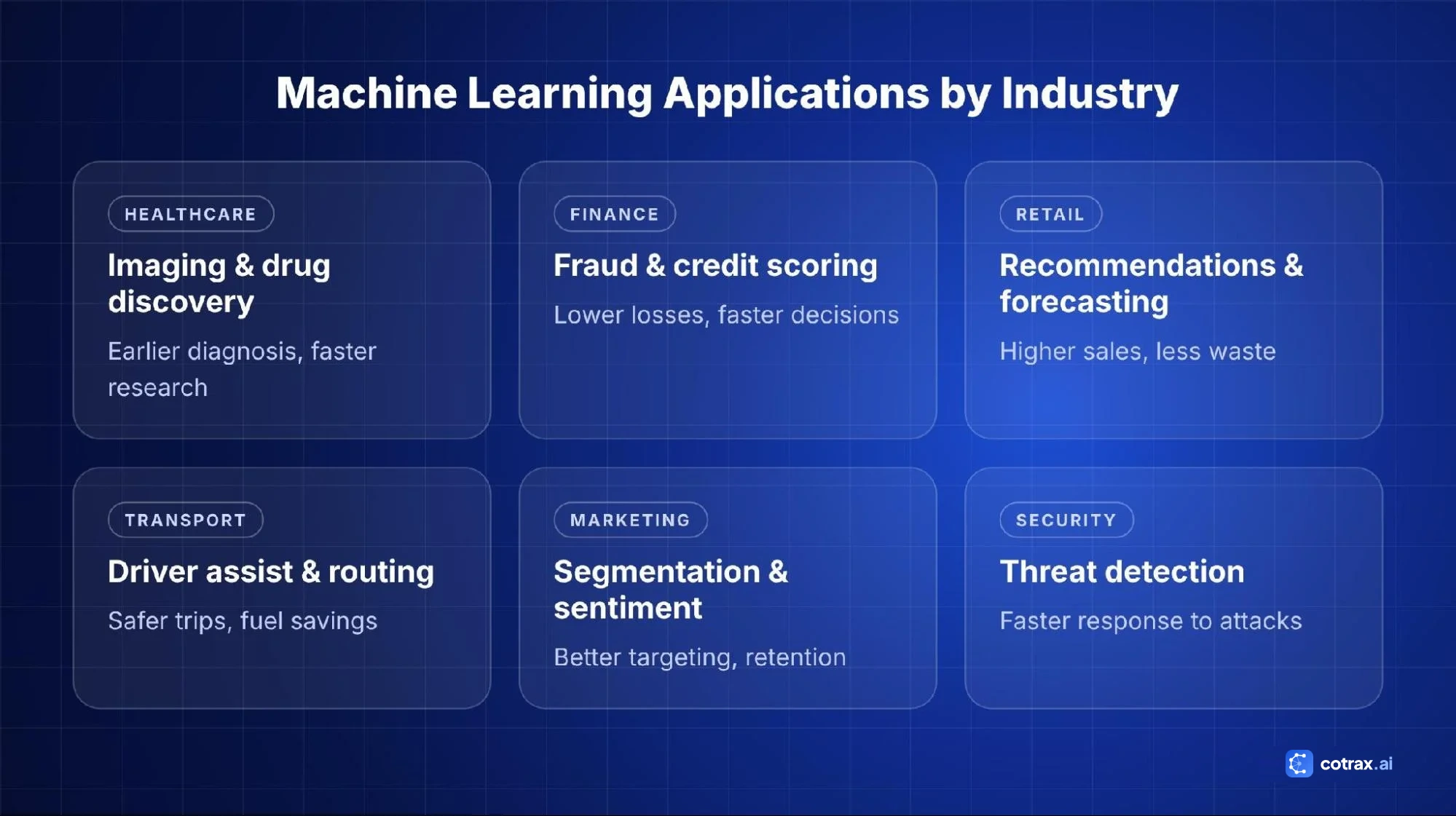
| Industry | Main ML uses | Business benefit |
|---|---|---|
| Healthcare | Imaging, drug discovery, risk prediction | Earlier diagnosis, faster research |
| Finance | Fraud detection, credit scoring, chatbots | Lower losses, faster decisions |
| Retail | Recommendations, forecasting, pricing | Higher sales, less waste |
| Transport | Driver assist, routing, ETA prediction | Safety, fuel and time savings |
| Marketing | Segmentation, churn, sentiment | Better targeting and retention |
| Cybersecurity | Anomaly and threat detection | Faster response to attacks |
| Manufacturing | Predictive maintenance, quality checks | Less downtime, fewer defects |
| Agriculture | Crop monitoring, pest detection | Higher yields, less waste |
Benefits of Machine Learning for Businesses
- Saves time: automates sorting, tagging, forecasting and routine decisions.
- Cuts costs: reduces waste, fraud losses and manual work.
- Improves accuracy: finds patterns too subtle or large for people to see.
- Personalizes at scale: gives each customer relevant offers and content.
- Works 24/7: monitors systems and transactions around the clock.
Challenges and Limits to Keep in Mind
- Data quality: bad or biased data leads to bad or biased results.
- Privacy: personal data must be handled carefully and legally.
- Explainability: some models are hard to explain, which matters in lending, hiring and healthcare.
- Maintenance: models drift as the world changes and need regular retraining. Methods like continual learning help models adapt without forgetting.
- Over-automation: high-stakes decisions still need a human in the loop.
How to Start Using Machine Learning in Your Business
- Pick one clear problem with a measurable outcome, such as reducing late deliveries.
- Check your data. Do you have enough clean, relevant history?
- Start with a simple model or an existing tool before building something custom. Our guide to the best Python libraries for machine learning can help you choose.
- Measure results against your current process.
- Scale what works and add monitoring so the model stays accurate.
Get one practical AI idea every week
Join the cotrax newsletter for real machine learning use cases you can apply right away.
What’s Next for Machine Learning Applications?
The next few years will bring machine learning into even more everyday tasks. Below are the trends to watch, such as:
- AI agents that act, not just answer: instead of only suggesting, systems will book meetings, update records and handle full workflows, with people approving key steps.
- Smaller models on devices: more ML will run directly on phones, cars and cameras, which means faster responses and better privacy.
- Multimodal AI: models that understand text, images, audio and video together will power richer search, support and creative tools.
- Industry-specific models: tools trained for law, medicine, finance and engineering will offer more accurate, domain-aware help.
- Stronger rules and trust: new regulations and better explainability tools will shape how ML is used in sensitive areas like lending, hiring and healthcare.
In short, for businesses the lesson is simple. The companies that win will not be the ones with the fanciest models, but the ones that connect machine learning to real problems, clean data and clear decisions.
Machine learning creates value only when it is connected to a real decision someone needs to make.
cotrax.ai Editorial Team
Conclusion
The applications of machine learning are everywhere, from the apps on your phone to hospitals, banks, farms and factories. Whenever there is data and a decision that repeats, machine learning can help make it faster, cheaper and more accurate.
The key is to start with a clear problem, good data and a simple solution, then grow from there while keeping people in charge of the decisions that matter most.
Put machine learning to work with cotrax
At cotrax, we help you understand and apply AI in practical ways. From simple ML use cases to AI agents that handle full workflows, we also make it easy to get started.
Sources
Frequently asked questions
What are the most common applications of machine learning?
How is machine learning used in daily life?
Which industry uses machine learning the most?
Is ChatGPT an application of machine learning?
Can small businesses use machine learning?
What is the difference between AI and machine learning applications?
How do I find the best machine learning use case for my company?
Do machine learning applications replace jobs?
Want more guides like this?
Get clear, practical AI explainers from Cotrax AI in your inbox every Friday.