Key Takeaways
- An MLP (multilayer perceptron) is a feedforward neural network with an input layer, one or more hidden layers and an output layer.
- Unlike a single perceptron, an MLP can learn curved, non-linear patterns thanks to activation functions.
- It learns with backpropagation and gradient descent.
- MLPs work well on table data and as building blocks inside bigger models like transformers.
- You can build one in a few lines with scikit-learn or PyTorch.
Before transformers and chatbots, there was a simpler neural network that started it all. It’s still everywhere today, often hiding inside much bigger models. That network is the multilayer perceptron, and understanding the MLP in machine learning is one of the best first steps into deep learning.
Moreover, once you understand how an MLP works, every other neural network becomes easier to learn. That’s because most of them reuse the same core ideas.
In this guide, the cotrax.ai team explains what an MLP is, how it learns, how it compares with a single perceptron, when to use it, and how to build one in Python.
What Is an MLP in Machine Learning?
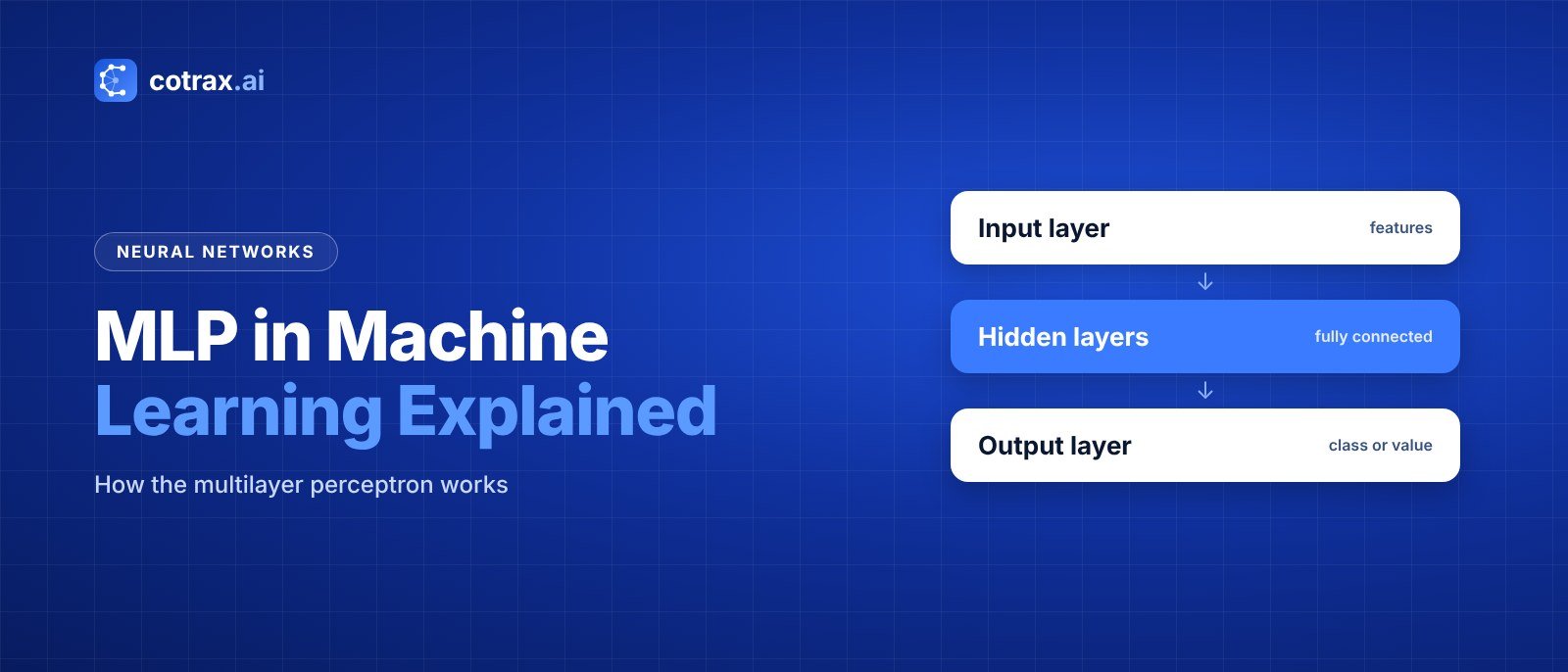
A multilayer perceptron (MLP) is a feedforward neural network made of an input layer, one or more hidden layers and an output layer, where every neuron connects to every neuron in the next layer. It uses non-linear activation functions, so it can learn complex patterns for classification and regression tasks.
“Feedforward” means data only moves in one direction, from input to output. There are no loops. Because every neuron links to all neurons in the next layer, these are also called fully connected or dense layers.
New to neural networks? Start with our guide on what neural networks are, and then come back here.
How Does a Multilayer Perceptron Work?
An MLP passes data through its layers in a few clear steps.
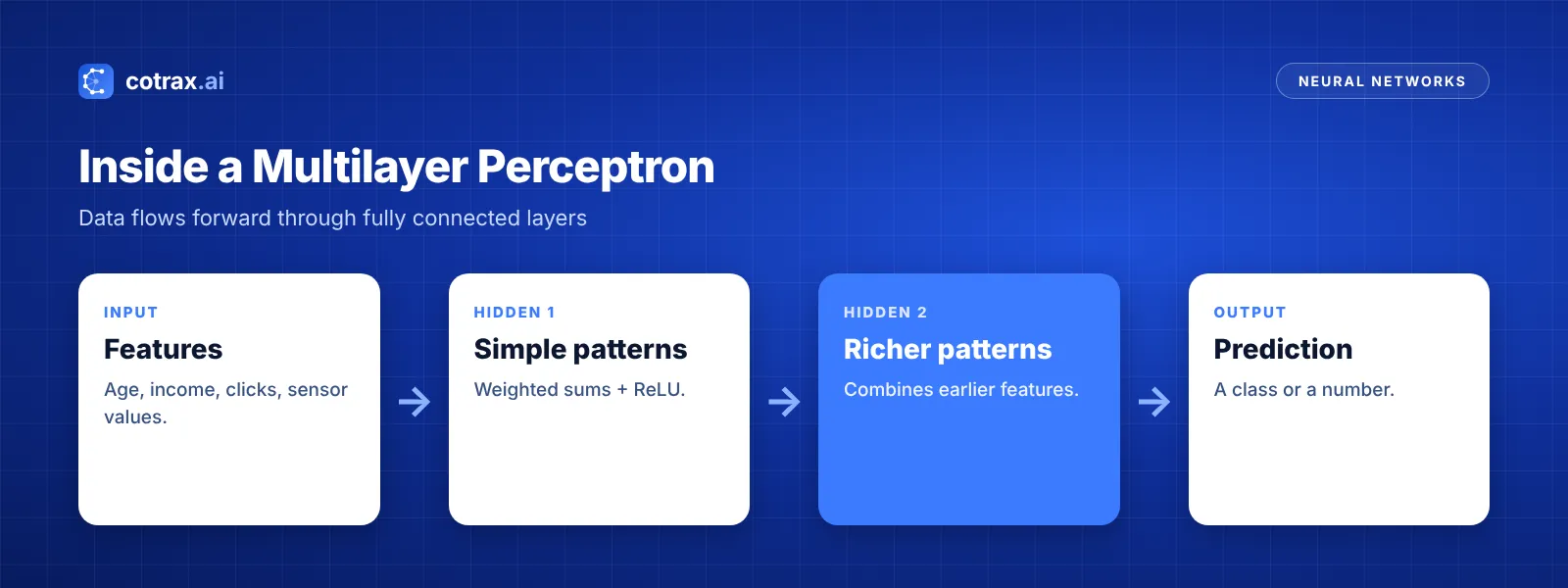
1. The input layer takes in features
First, each input neuron holds one feature, such as age, income or the number of site visits. For example, a model with 20 features has 20 input neurons.
2. Hidden layers find patterns
Next, each hidden neuron multiplies its inputs by weights, adds a bias, and applies an activation function like ReLU. As a result, the first hidden layer finds simple patterns, and later layers combine them into richer ones.
3. The output layer makes a prediction
Finally, the output layer turns those patterns into an answer. For classification, it often uses softmax to give a probability for each class. For regression, it simply outputs a number.
How an MLP Learns: Backpropagation
At first, the weights are random, so the predictions are poor. Then the MLP improves through a training loop:
- Forward pass: the network makes a prediction.
- Loss: a loss function measures how wrong it was.
- Backpropagation: the error flows backward to show how each weight contributed.
- Update: gradient descent nudges every weight to reduce the error.
After many rounds, often called epochs, the MLP learns the pattern in the data. However, if you train too long, it may memorize noise. Our guide to overfitting in machine learning shows how to avoid that.
Have table data you want to predict from?
Tell the cotrax team about your dataset, and we’ll suggest a simple model to start with.
Perceptron vs Multilayer Perceptron
The MLP grew out of the original perceptron. However, the two differ in one big way.
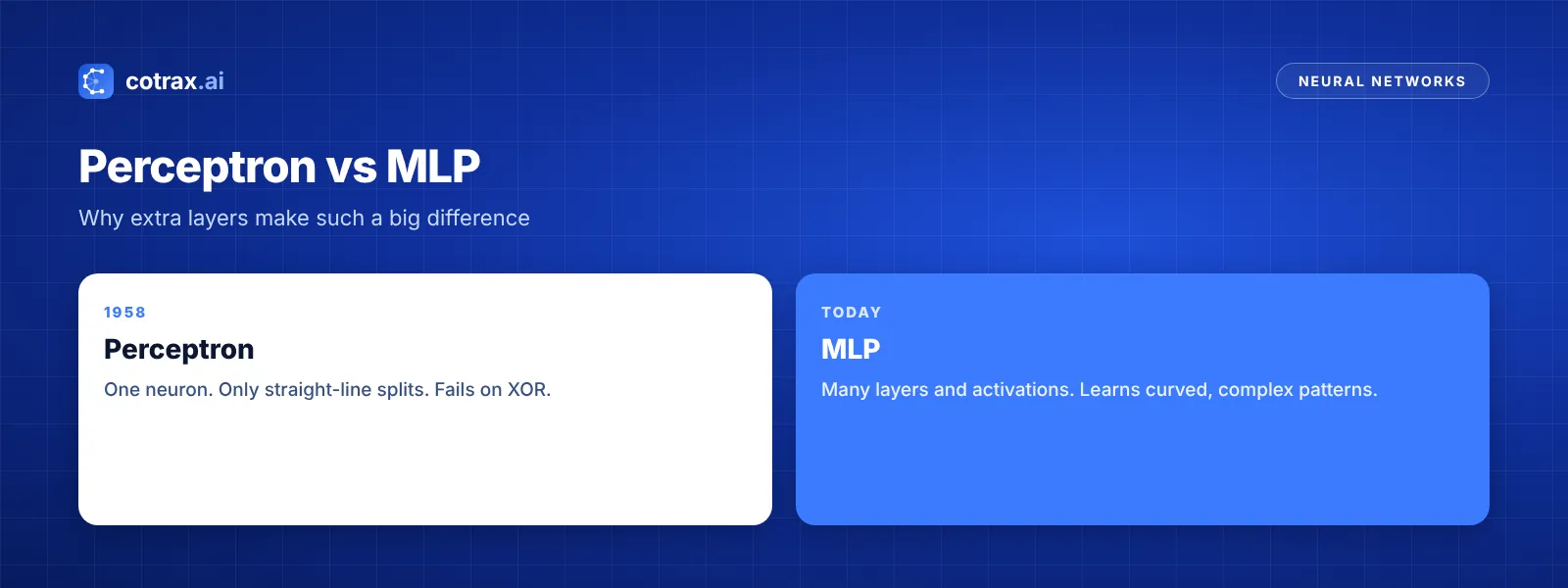
| Feature | Perceptron | MLP |
|---|---|---|
| Layers | One neuron, no hidden layer | One or more hidden layers |
| Activation | Simple step function | Non-linear, such as ReLU |
| Patterns it can learn | Straight-line splits only | Curved, complex patterns |
| Training | Perceptron rule | Backpropagation |
| Solves XOR? | No | Yes |
The XOR problem is a famous example. A single perceptron can’t separate XOR data with one straight line. An MLP, on the other hand, solves it easily with just one small hidden layer. That’s why hidden layers matter so much.
When Should You Use an MLP?
MLPs are flexible, yet they’re not always the best choice. Use this as a quick guide:
- Good fit: structured table data with enough examples, such as churn or demand prediction.
- Good fit: simple signal or sensor data with fixed-length inputs.
- Weaker fit: images, where CNNs and other network types usually win.
- Weaker fit: long text, where transformers lead.
- Weaker fit: small table datasets, where tree models like XGBoost often score higher.
Interestingly, MLPs also live inside bigger models. For instance, every transformer block, the design behind large language models, contains a small MLP called a feedforward layer.
The MLP is the “hello world” of neural networks. Master it, and the bigger models start to feel like variations on a theme.
cotrax.ai Editorial Team
Get practical AI guides every week
Join the cotrax newsletter for simple, no-jargon lessons on neural networks and AI.
Build an MLP in Python
You can train an MLP in just a few lines using scikit-learn’s MLPClassifier:
from sklearn.neural_network import MLPClassifier
from sklearn.preprocessing import StandardScaler
from sklearn.pipeline import make_pipeline

mlp = make_pipeline(
    StandardScaler(),
    MLPClassifier(hidden_layer_sizes=(64, 32), max_iter=500, early_stopping=True)
)
mlp.fit(X_train, y_train)
print(mlp.score(X_test, y_test))
This model has two hidden layers with 64 and 32 neurons. Also, notice the scaler: MLPs train much better when features share a similar range. For larger projects, PyTorch gives you more control, as shown in our guide to deep learning with Python.
Tips for better MLP results
- Scale your inputs so no feature dominates.
- Start small, with one or two hidden layers.
- Use early stopping to avoid overfitting.
- Tune the learning rate, since it affects training more than most settings.
- Compare with a baseline, such as logistic regression or a random forest.
Conclusion
The MLP in machine learning is a simple but powerful neural network. It passes data forward through fully connected layers, learns with backpropagation, and handles curved patterns that a single perceptron can’t.
Use it for table data and as a stepping stone to bigger models. In fact, you’ll find MLP layers inside nearly every modern network, including transformers. So learn it well, and the rest of deep learning gets much easier.
For more beginner-friendly AI guides, keep exploring cotrax.ai.
Build smarter with AI
Share your idea with the cotrax team and get a clear, simple plan to start.
Sources
- scikit-learn: Neural network models (supervised)
- Rumelhart, Hinton & Williams, Learning representations by back-propagating errors (Nature, 1986)
Frequently asked questions
What is an MLP in machine learning?
What is the difference between a perceptron and an MLP?
Is an MLP a deep learning model?
When should I use an MLP?
Is MLP supervised or unsupervised?
Want more guides like this?
Get clear, practical AI explainers from Cotrax AI in your inbox every Friday.