
Key Takeaways
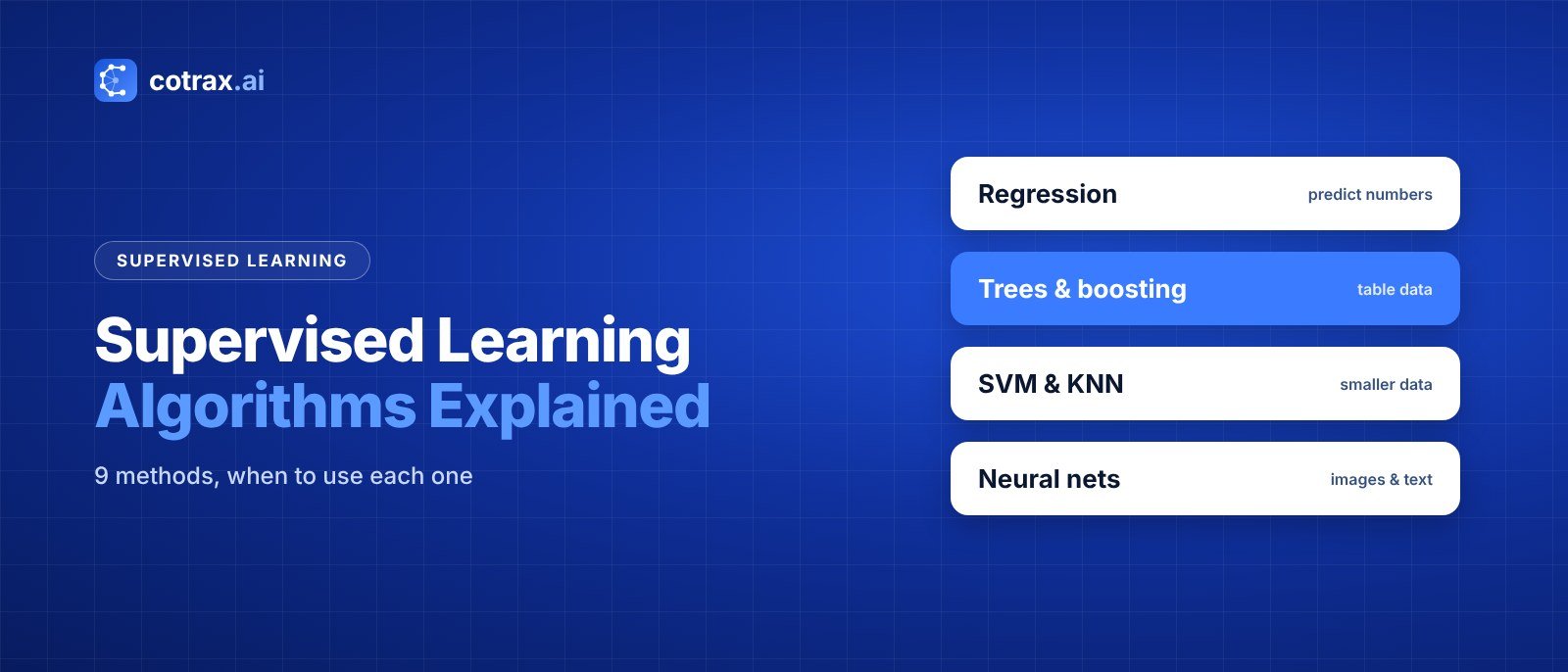
- Supervised learning algorithms learn from labeled data to predict categories or numbers.
- Linear and logistic regression are simple, fast and easy to explain, so they make great baselines.
- Decision trees, random forests and gradient boosting (like XGBoost) lead on most table data.
- SVM, KNN and Naive Bayes are handy for smaller datasets and text tasks.
- Neural networks shine with images, sound and text, but need more data.
You have labeled data and a clear question. Now comes the tricky part: which algorithm should you use? With dozens of options, the choice can feel overwhelming. Fortunately, a small set of supervised learning algorithms handles most real-world problems.
Once you know what each one does well, picking a starting point gets much easier. In fact, most data scientists try the same few models first.
In this guide, the cotrax.ai team explains the 9 most popular algorithms in plain English. For each one, you’ll see how it works, where it’s used, and its main pros and cons.
What Are Supervised Learning Algorithms?
Supervised learning algorithms are methods that learn a pattern from labeled examples, so they can predict the label for new data. Some predict categories, which is called classification. Others predict numbers, which is called regression. Many algorithms can do both.
If you need a refresher on the basics, start with our guide on what supervised learning is. Then come back here to choose your algorithm.
Quick Comparison Table
| Algorithm | Task | Strength | Watch out for |
|---|---|---|---|
| Linear regression | Regression | Simple and clear | Only straight-line patterns |
| Logistic regression | Classification | Fast, easy to explain | Misses complex patterns |
| Decision tree | Both | Easy to follow | Overfits easily |
| Random forest | Both | Stable and accurate | Slower, less clear |
| Gradient boosting | Both | Top accuracy on tables | Needs careful tuning |
| SVM | Both | Strong on smaller data | Slow on huge data |
| KNN | Both | No training step | Slow predictions |
| Naive Bayes | Classification | Very fast on text | Assumes features are independent |
| Neural network | Both | Handles images and text | Needs lots of data |
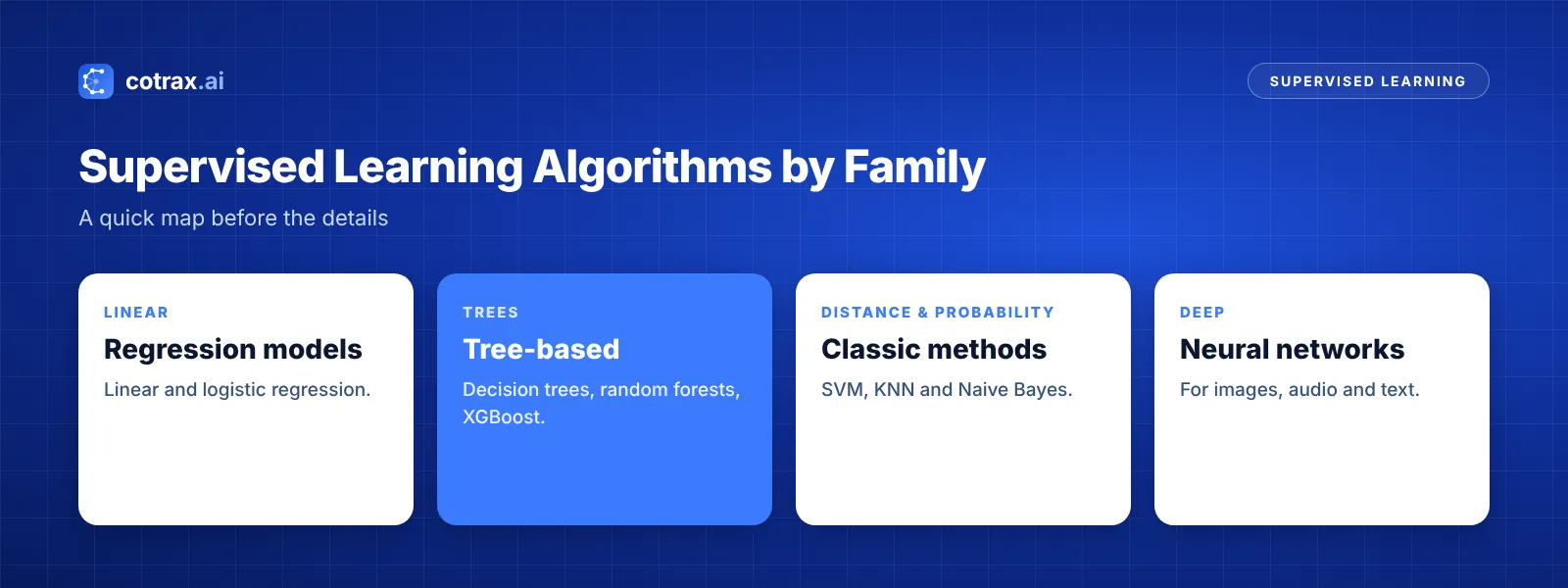
Linear Supervised Learning Algorithms
1. Linear regression
Linear regression draws the best straight line through your data. For example, it can predict a home’s price from its size. Because it’s so simple, it’s often the first model people try for number predictions.
2. Logistic regression
Despite its name, logistic regression is used for classification. It estimates the chance that something belongs to a class, such as “will churn” or “won’t churn.” Moreover, its results are easy to explain, which matters in banking and healthcare.
Tree-Based Algorithms
3. Decision tree
A decision tree asks a chain of yes-or-no questions. For instance, “Is income above $50,000?” and then “Has the customer missed a payment?” Each path ends in a prediction. However, a single deep tree can memorize the training data, which leads to overfitting.
4. Random forest
A random forest builds many decision trees on random slices of the data. Then it combines their votes. As a result, it’s far more stable than one tree and works well with little tuning.
5. Gradient boosting (XGBoost, LightGBM)
Gradient boosting also uses many trees. However, it builds them one after another, so each new tree fixes the errors of the last. Tools like XGBoost often top the charts on spreadsheet-style data.
Not sure which algorithm fits your data?
Share your use case with the cotrax team and get a simple recommendation.
Distance and Probability Methods
6. Support vector machine (SVM)
An SVM finds the boundary that separates classes with the widest possible gap. With a “kernel trick,” it can also draw curved boundaries. Therefore, it’s strong on small and medium datasets, although it slows down with very large ones.
7. K-nearest neighbors (KNN)
KNN predicts by looking at the closest examples in the training data. If most of your five nearest neighbors are “spam,” the new email is likely spam, too. It’s easy to understand, but predictions get slow as data grows.
8. Naive Bayes
Naive Bayes uses probability to guess the most likely class. It assumes each feature acts on its own, which is rarely true. Even so, it works surprisingly well for spam filtering and topic tagging, and it trains in seconds.
Neural Networks for Supervised Learning
9. Neural networks
Neural networks stack layers of connected neurons to learn complex patterns. As a result, they lead on images, speech and language. However, they need more data, more computing power and more care to explain. Learn more in our guide to what neural networks are.
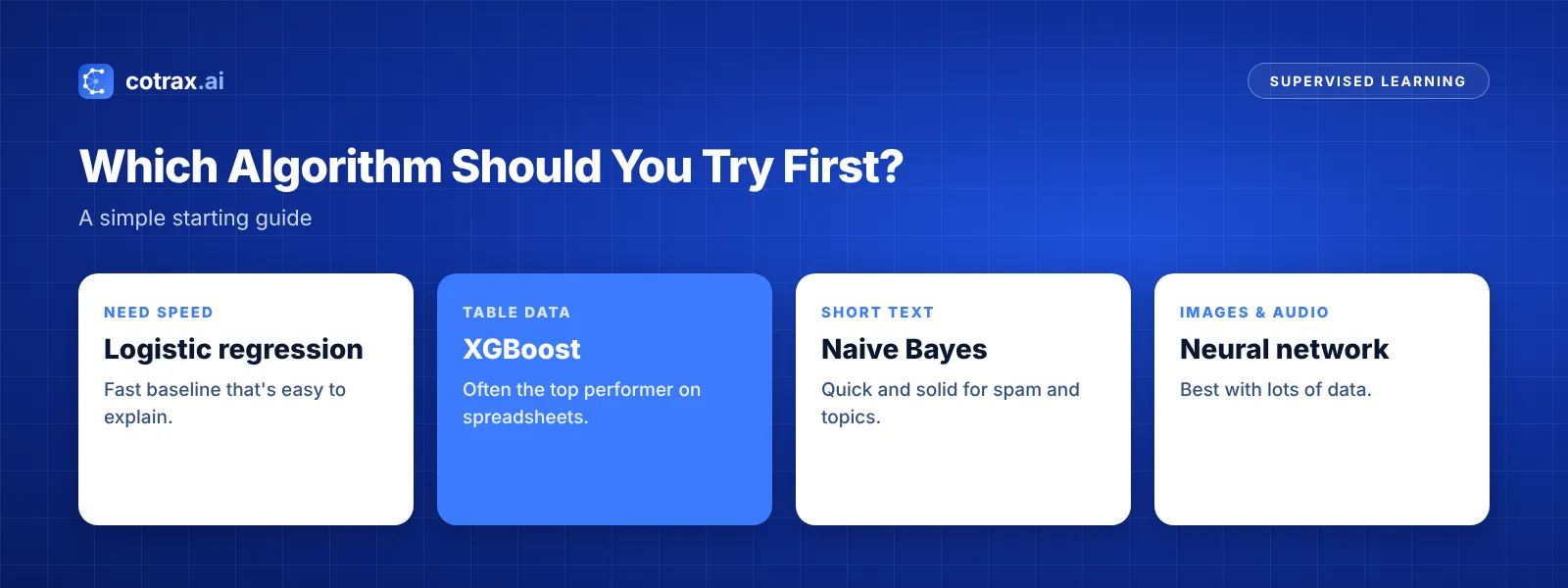
Always start with a simple baseline. If a fancy model can’t beat logistic regression, the problem is usually the data, not the algorithm.
cotrax.ai Editorial Team
How to Choose the Right Algorithm
Use these questions to narrow your options quickly:
- What are you predicting? A category points to classification, while a number points to regression.
- What kind of data do you have? Tables favor tree-based models, whereas images and text favor neural networks.
- How much data is there? With small datasets, simpler models often generalize better.
- Do you need to explain results? If so, logistic regression or a small tree is safer.
- How fast must it run? Linear models and Naive Bayes are the quickest.
Above all, test several models fairly. Cross-validation is the best way to compare them without fooling yourself.
Get practical ML guides every week
Join the cotrax newsletter for simple, no-jargon lessons on machine learning and AI.
Common Mistakes When Using Supervised Learning Algorithms
Even the best algorithm fails if you use it the wrong way. So watch out for these common traps:
- Skipping the baseline: without a simple model to compare against, you can’t tell if a complex one really helps.
- Leaking test data: if test rows sneak into training, your scores will look far better than reality.
- Ignoring class imbalance: when only 1% of cases are fraud, a model that always says “safe” looks 99% accurate but is useless.
- Forgetting to scale features: SVM, KNN and neural networks work best when features share a similar range.
- Tuning on the test set: instead, tune with cross-validation and keep the test set for the final check.
In addition, always look at the errors your model makes. Often, a quick review of wrong predictions reveals bad labels or missing features. That insight usually improves results more than switching algorithms.
Try These Algorithms in Python
You can test most of these supervised learning algorithms with just a few lines of code in scikit-learn. For example:
from sklearn.ensemble import RandomForestClassifier
from sklearn.model_selection import cross_val_score

model = RandomForestClassifier(n_estimators=200)
scores = cross_val_score(model, X, y, cv=5)
print(scores.mean())
Because every scikit-learn model shares the same fit and predict methods, swapping algorithms is easy. For more tools, see our list of the best Python libraries for machine learning.
Conclusion
The best supervised learning algorithms are the ones that fit your data and your goal. Linear and logistic regression make great baselines. Meanwhile, random forests and gradient boosting usually win on table data, and neural networks lead on images and text.
So start simple, compare a few models with cross-validation, and pick the one that balances accuracy, speed and clarity. For more hands-on guides, keep exploring cotrax.ai.
Build smarter with AI
Share your idea with the cotrax team and get a clear, simple plan to start.
Sources
Frequently asked questions
What are the most common supervised learning algorithms?
Which supervised learning algorithm is best?
Is a decision tree a supervised learning algorithm?
Is SVM supervised or unsupervised?
Is k-means a supervised learning algorithm?
Want more guides like this?
Get clear, practical AI explainers from Cotrax AI in your inbox every Friday.