

Key Takeaways
- Cross-validation tests a model on several different data splits, giving a more honest score than one test set.
- K-fold (often 5 or 10 folds) is the most common type.
- Use stratified k-fold for imbalanced classes and time series splits for time-based data.
- Data leakage can make cross-validation scores look falsely good, so preprocess inside each fold.
- In Python, scikit-learn runs cross-validation in one line of code.
You trained a model and tested it once. It scored 92%. But was that a fair test, or did you just get a lucky split? That’s the question cross-validation in machine learning answers. Instead of trusting one test, it checks your model several times on different slices of data.
As a result, you get a score you can actually trust. In addition, you can compare models and settings fairly.
In this guide, the cotrax.ai team explains how cross-validation works, which type to use, how to avoid data leakage, and how to run it in Python with a few lines of code.
What Is Cross-Validation in Machine Learning?
Cross-validation is a method that tests a model by splitting the data into several parts, training on some parts and testing on the rest, then rotating until every part has been tested. The average score across all rounds gives a more reliable estimate of how the model will perform on new data.
A single train-test split can mislead you. For example, your test set might happen to contain easy cases. Cross-validation, however, reduces that luck factor because every example gets a turn in the test set.
It’s a core skill in supervised learning, where models learn from labeled data.
How Does K-Fold Cross-Validation Work?
K-fold is the most popular type. Here’s how it works, step by step.
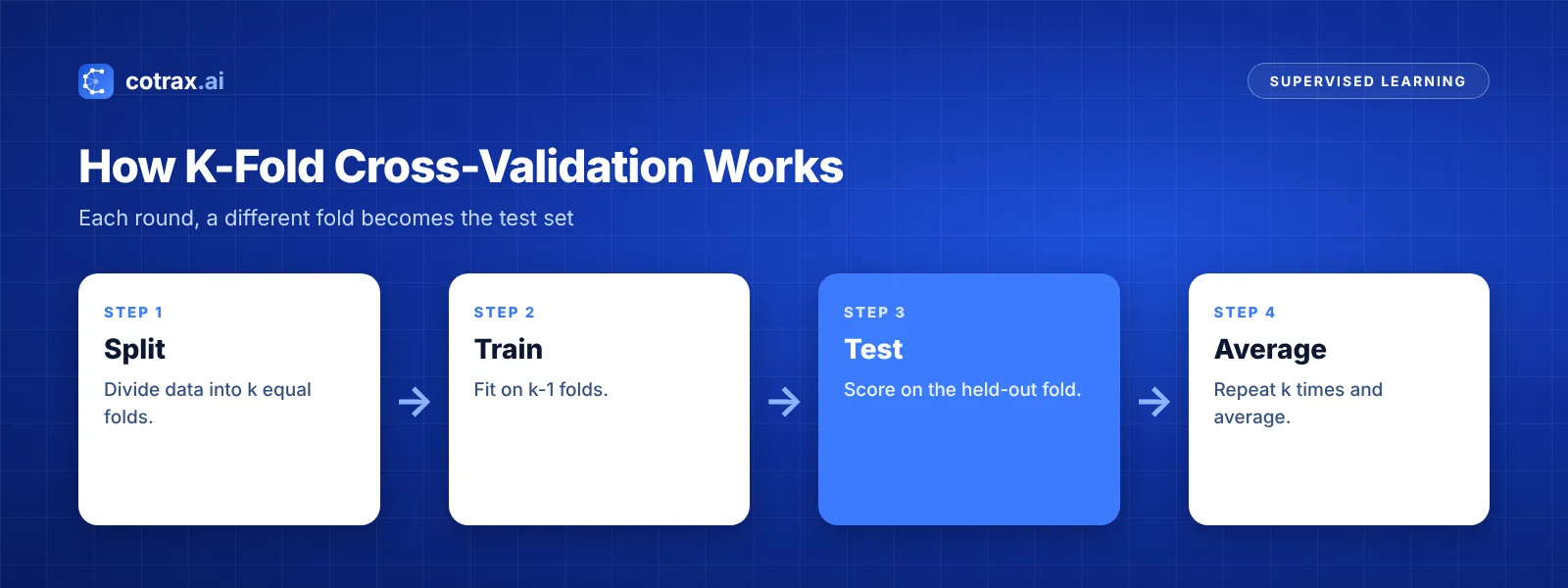
- Split the data. First, divide your dataset into k equal parts, called folds. Five or ten folds are common.
- Train the model. Next, train on all folds except one.
- Test the model. Then score it on the fold you left out.
- Rotate. After that, repeat the process so each fold serves as the test set once.
- Average the results. Finally, average all k scores to get your final estimate.
For example, with 5-fold cross-validation and 1,000 rows, each round trains on 800 rows and tests on 200. Because of this, every row is tested exactly once.
Why the spread matters
Look at more than the average. If your five scores are 90, 91, 89, 92 and 90, your model is stable. However, if they’re 95, 70, 88, 60 and 93, something is off, and the model may not generalize well.
Want a second opinion on your model’s results?
Share your setup with the cotrax team, and we’ll help you check if the numbers hold up.
Types of Cross-Validation
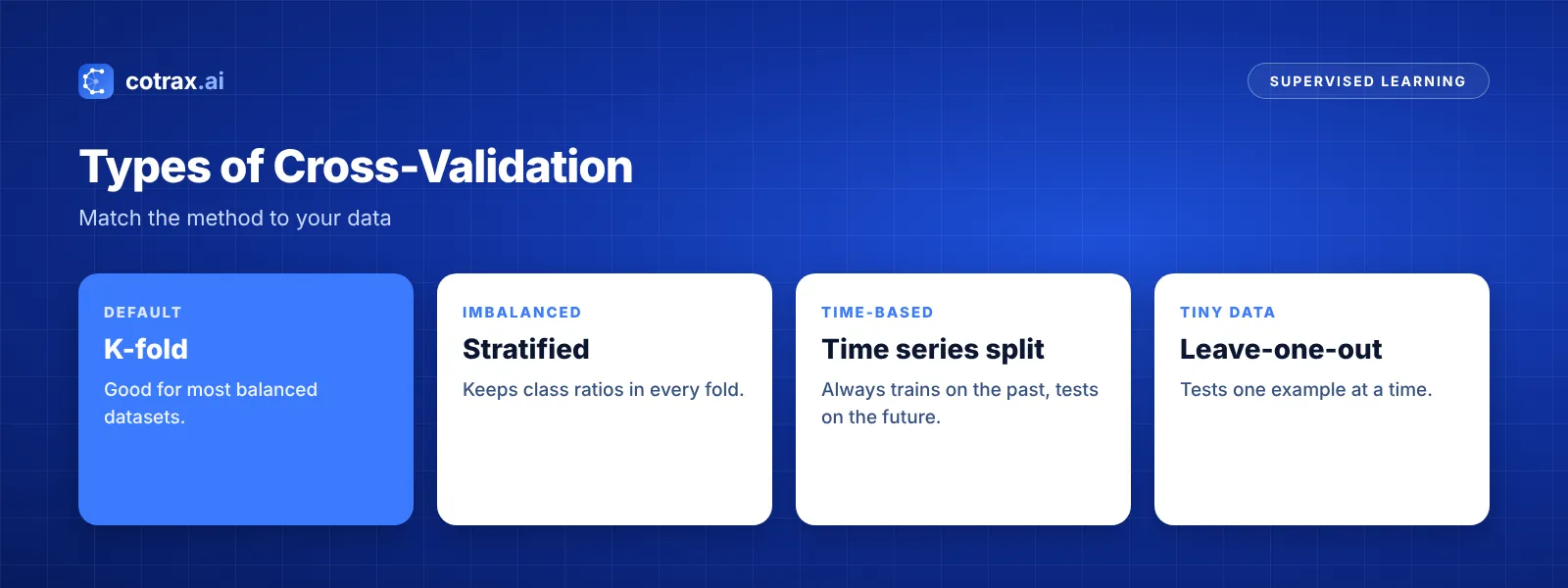
K-fold isn’t the only option. In fact, the right type depends on your data.
Stratified k-fold
If one class is rare, such as fraud cases, a random split might leave some folds with almost none. Stratified k-fold fixes this, because it keeps the same class ratio in every fold.
Time series split
With time-based data, like daily sales, you must never train on the future to predict the past. So a time series split always trains on earlier data and tests on later data.
Leave-one-out (LOOCV)
Here, each fold holds just one example. Although it uses data very efficiently, it’s slow on large datasets. Therefore, it’s best kept for very small datasets.
Group k-fold
Sometimes several rows belong to the same person or patient. Group k-fold keeps each group in a single fold, so the model can’t “cheat” by seeing the same person in training and testing.
| Type | Best for | Main benefit |
|---|---|---|
| K-fold | Most balanced datasets | Simple and reliable |
| Stratified k-fold | Imbalanced classes | Fair class balance per fold |
| Time series split | Data ordered in time | No peeking into the future |
| Leave-one-out | Very small datasets | Uses almost all data for training |
| Group k-fold | Repeated users or patients | Prevents identity leaks |
Avoid Data Leakage During Cross-Validation
Data leakage is the silent killer of honest scores. It happens when information from the test fold sneaks into training. As a result, your scores look great, but real-world performance disappoints.
Here are common causes and fixes:
- Scaling before splitting: instead, fit scalers only on the training folds.
- Selecting features on all data: likewise, do feature selection inside each fold.
- Duplicate rows: remove them, since copies can land in both train and test folds.
- Future information: for time data, drop features that wouldn’t exist at prediction time.
The easiest fix is to wrap every step in a scikit-learn Pipeline. That way, preprocessing is learned inside each fold automatically.
If your cross-validation score looks too good to be true, check for leakage before you celebrate.
cotrax.ai Editorial Team
Get practical ML guides every week
Join the cotrax newsletter for simple, no-jargon lessons on machine learning and AI.
Cross-Validation in Python
With scikit-learn, cross-validation takes only a few lines:
from sklearn.pipeline import make_pipeline
from sklearn.preprocessing import StandardScaler
from sklearn.linear_model import LogisticRegression
from sklearn.model_selection import StratifiedKFold, cross_val_score

model = make_pipeline(StandardScaler(), LogisticRegression())
cv = StratifiedKFold(n_splits=5, shuffle=True, random_state=42)
scores = cross_val_score(model, X, y, cv=cv)
print(scores.mean(), scores.std())
Because the scaler sits inside the pipeline, it’s fitted fresh on each training fold. So there’s no leakage. For more helpful tools, see our list of the best Python libraries for machine learning.
When to Use Cross-Validation
- Comparing models: for example, random forest vs logistic regression.
- Tuning settings: such as tree depth or learning rate.
- Checking for overfitting: big gaps between folds or training scores are warning signs.
- Working with small datasets: because every example gets used for both training and testing.
Cross-validation is your best tool for spotting overfitting in machine learning. It also helps you choose among supervised learning algorithms fairly. Still, keep a final test set aside that you only touch once, at the very end.
Conclusion
Cross-validation in machine learning gives you an honest view of model performance. By training and testing on several different splits, it removes the luck of a single test.
Start with 5-fold or stratified 5-fold. Then switch to a time series split for time-based data, and always guard against data leakage with pipelines. In short, if you want results you can trust, cross-validation is a must.
For more practical ML guides, keep exploring cotrax.ai.
Build smarter with AI
Share your idea with the cotrax team and get a clear, simple plan to start.
Sources
Frequently asked questions
What is cross-validation in machine learning?
What is k-fold cross-validation?
How many folds should I use?
Does cross-validation prevent overfitting?
What is data leakage in machine learning?
Want more guides like this?
Get clear, practical AI explainers from Cotrax AI in your inbox every Friday.