
Key Takeaways
- Neural networks are AI models made of connected artificial neurons arranged in layers.
- Each neuron multiplies inputs by weights, adds them up and passes the result through an activation function.
- Networks learn through backpropagation, which nudges weights to reduce errors.
- Different types, like CNNs, RNNs and transformers, suit different data.
- They power face unlock, voice assistants, translation and chatbots.
Neural networks sit behind almost every AI tool you use. They unlock your phone with your face, turn your voice into text, and power chatbots like ChatGPT. Yet many people still wonder: what are neural networks, really, and how do they “learn”?
The good news is that the core idea is surprisingly simple. In fact, it comes down to lots of tiny calculations working together.
In this guide, the cotrax.ai team breaks it down step by step. You’ll learn how a single neuron works, how layers fit together, how networks learn from mistakes, and where you see them every day.
What Are Neural Networks?
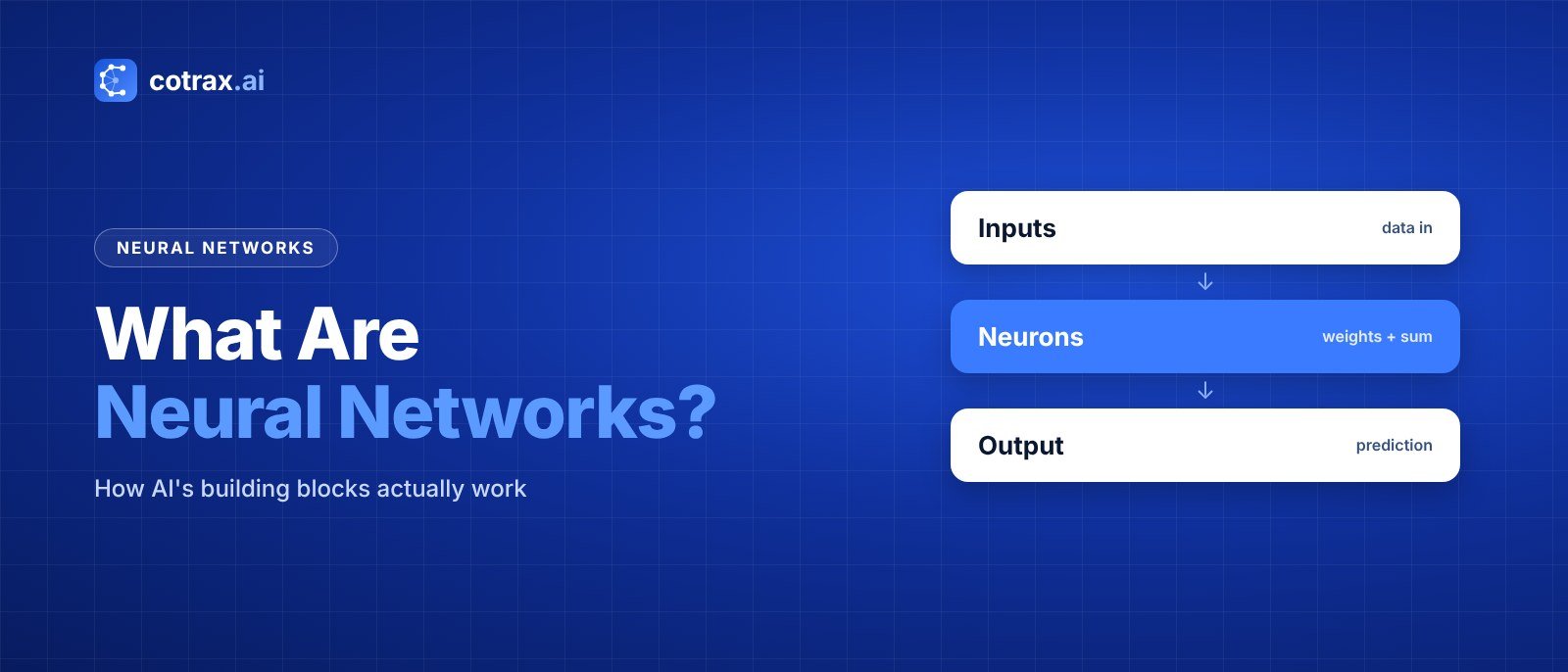
Neural networks are machine learning models made of many connected units, called artificial neurons, arranged in layers that learn patterns from data. Each neuron does a small calculation, and together they can recognize images, understand language or predict outcomes, without being given explicit rules.
The idea is loosely inspired by the human brain. However, artificial neurons are far simpler than real ones. Think of them more like tiny math functions than brain cells.
Neural networks are the foundation of deep learning. So if you want the bigger picture, read our guide on what deep learning is.
How Does a Single Neuron Work?
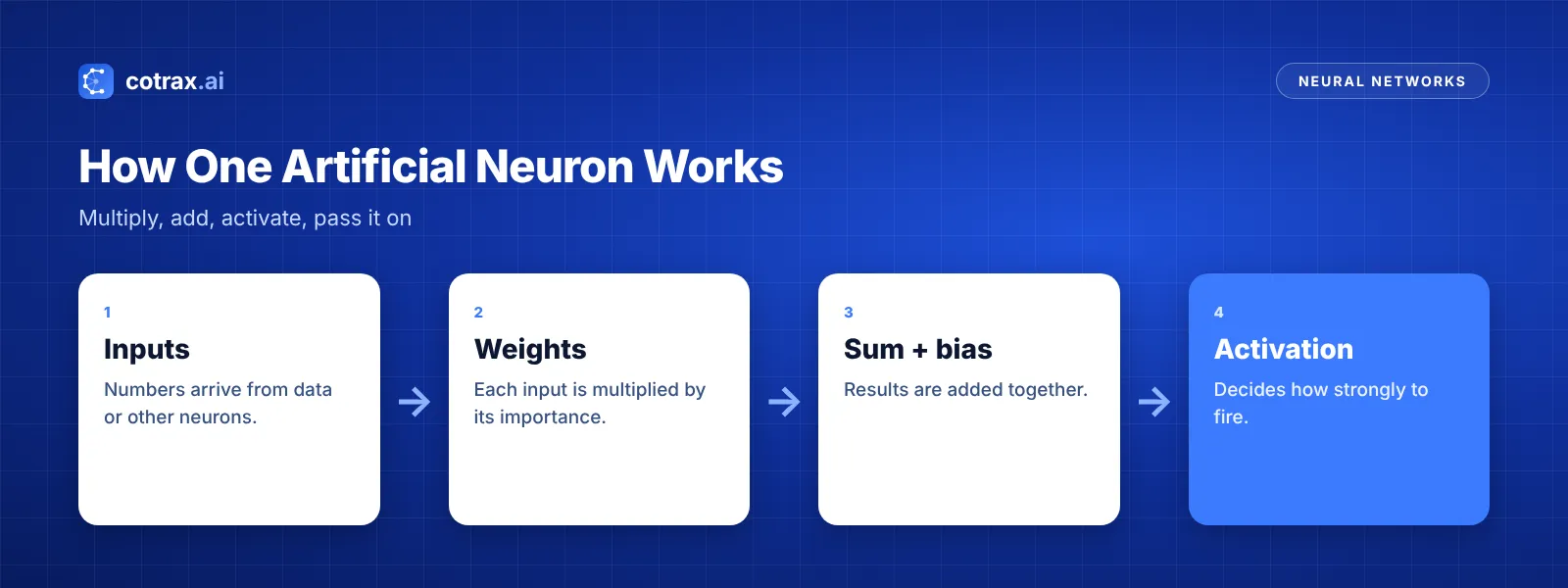
Every network is built from the same simple unit. Once you understand one neuron, the rest is just repetition at scale.
1. Inputs
First, the neuron receives numbers. These might be pixel values, prices or outputs from other neurons.
2. Weights
Next, each input is multiplied by a weight. A weight shows how important that input is. For example, in a house price model, size might get a large weight, while door color gets a tiny one.
3. Sum and bias
Then the neuron adds up all the weighted inputs, plus a small extra number called a bias. The bias helps the neuron shift its output up or down.
4. Activation function
Finally, the total passes through an activation function. This decides how strongly the neuron “fires.” Popular choices include ReLU, which outputs zero for negative values, and sigmoid, which squeezes values between 0 and 1. Without activation functions, a network could only learn straight-line patterns.
The Layers of a Neural Network
Neurons are grouped into layers. In most networks, data flows forward from one layer to the next.
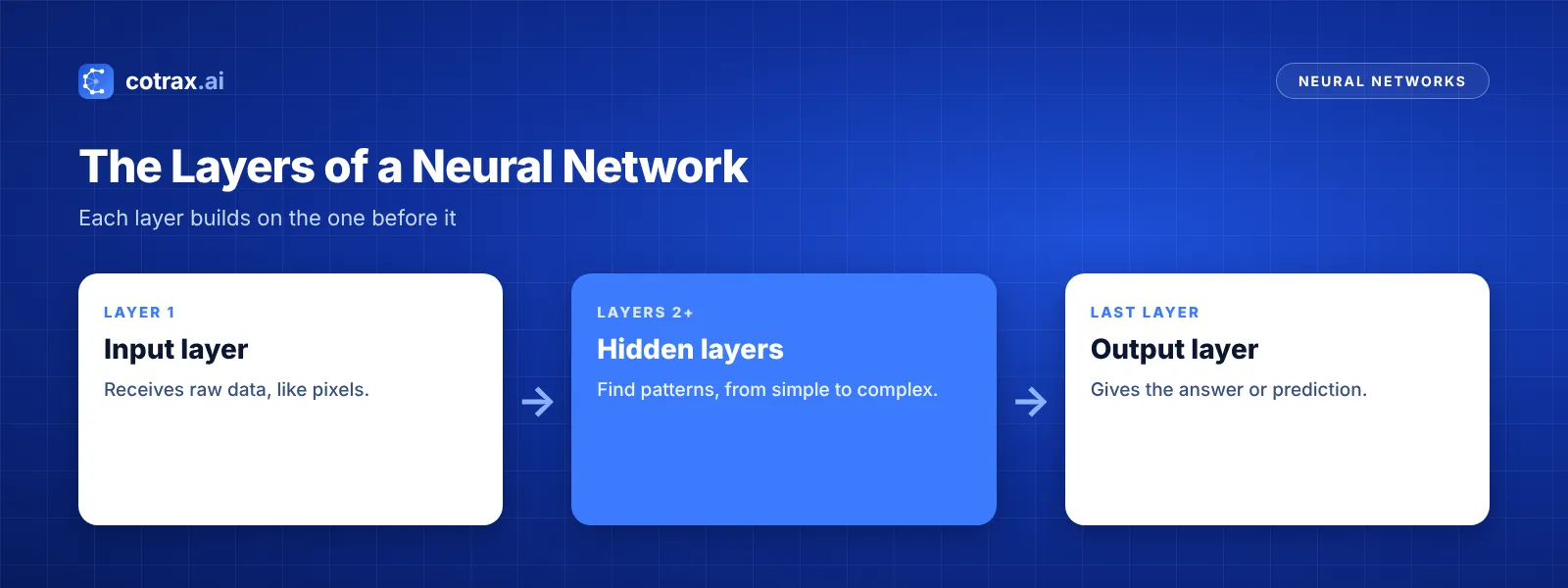
- Input layer: receives the raw data. One neuron might hold one pixel.
- Hidden layers: find patterns. Early layers spot simple features, while deeper layers combine them into complex ones.
- Output layer: gives the final result, such as “cat: 92%.”
When a network has many hidden layers, we call it a deep neural network. That’s where the term “deep learning” comes from.
Wondering how neural networks could help your business?
Tell the cotrax team what you want to predict or automate, and we’ll suggest a simple first step.
How Do Neural Networks Learn?
A new network starts with random weights, so its first guesses are poor. Then it improves through a loop of guessing and correcting.
- Forward pass: first, data flows through the network, and it makes a prediction.
- Loss: next, a loss function measures how wrong the prediction was.
- Backpropagation: then the error is sent backward, so each weight learns how much it contributed.
- Gradient descent: after that, every weight is nudged slightly in the direction that reduces the error.
- Repeat: finally, the loop runs thousands or millions of times until predictions are accurate.
Backpropagation was popularized in a famous 1986 Nature paper by Rumelhart, Hinton and Williams. It remains the core training method today.
Main Types of Neural Networks
Different problems need different network designs. Here are the most common ones:
| Type | Best for | Example |
|---|---|---|
| Feedforward (MLP) | Tables of data | Credit scoring |
| Convolutional (CNN) | Images and video | Face unlock |
| Recurrent (RNN, LSTM) | Sequences | Sensor forecasting |
| Transformer | Language and more | Chatbots |
| Graph neural network | Connected data | Fraud rings |
For a full breakdown, see our guide to the types of neural networks. You can also dig into the simplest design in our guide to the multilayer perceptron (MLP).
A neural network doesn’t understand the world the way you do. Instead, it finds patterns in numbers, and with enough good data, those patterns become remarkably useful.
cotrax.ai Editorial Team
Real-World Uses of Neural Networks
- Phones: face unlock, photo search and voice typing.
- Chatbots: large language models are giant neural networks.
- Healthcare: networks help flag issues in medical scans.
- Finance: banks use them to spot unusual transactions.
- Cars: driver-assist features detect lanes, signs and people.
- Science: some networks even learn the laws of physics, as in physics-informed neural networks.
Adoption is booming. The Stanford AI Index 2025 reports that 78% of organizations used AI in 2024, up from 55% the year before.
Get practical AI guides every week
Join the cotrax newsletter for simple, no-jargon lessons on neural networks and AI.
Neural Networks vs the Human Brain
The brain inspired the idea, but the two are very different. For example, your brain has about 86 billion neurons and runs on roughly the power of a dim light bulb. By contrast, large neural networks need data centers full of chips.
Moreover, people can learn a new concept from one or two examples. Neural networks, on the other hand, usually need thousands. That gap is an active area of research, including work on brain-inspired designs like liquid neural networks.
Limits of Neural Networks
- Data hungry: they often need large, labeled datasets.
- Black box: it’s hard to explain why they made a decision.
- Costly: training big models takes lots of computing power.
- Can overfit: they may memorize training data, as we explain in our guide to overfitting.
Conclusion
So, what are neural networks? They’re layers of simple artificial neurons that learn patterns from data by adjusting their weights. Each neuron multiplies, adds and activates. Then backpropagation helps the whole network learn from its mistakes.
From face unlock to chatbots, these models power much of modern AI. And although they have limits, they keep getting cheaper and more capable every year.
Ready to go deeper? Explore the main network types next, and keep reading cotrax.ai for more clear AI guides.
Build smarter with AI
Share your idea with the cotrax team and get a clear, simple plan to start.
Sources
- Rumelhart, Hinton & Williams, Learning representations by back-propagating errors (Nature, 1986)
- Stanford HAI: The 2025 AI Index Report
Frequently asked questions
What are neural networks in simple terms?
Are neural networks the same as the human brain?
What are the three layers of a neural network?
How do neural networks learn?
Are LLMs neural networks?
Want more guides like this?
Get clear, practical AI explainers from Cotrax AI in your inbox every Friday.