
Key Takeaways
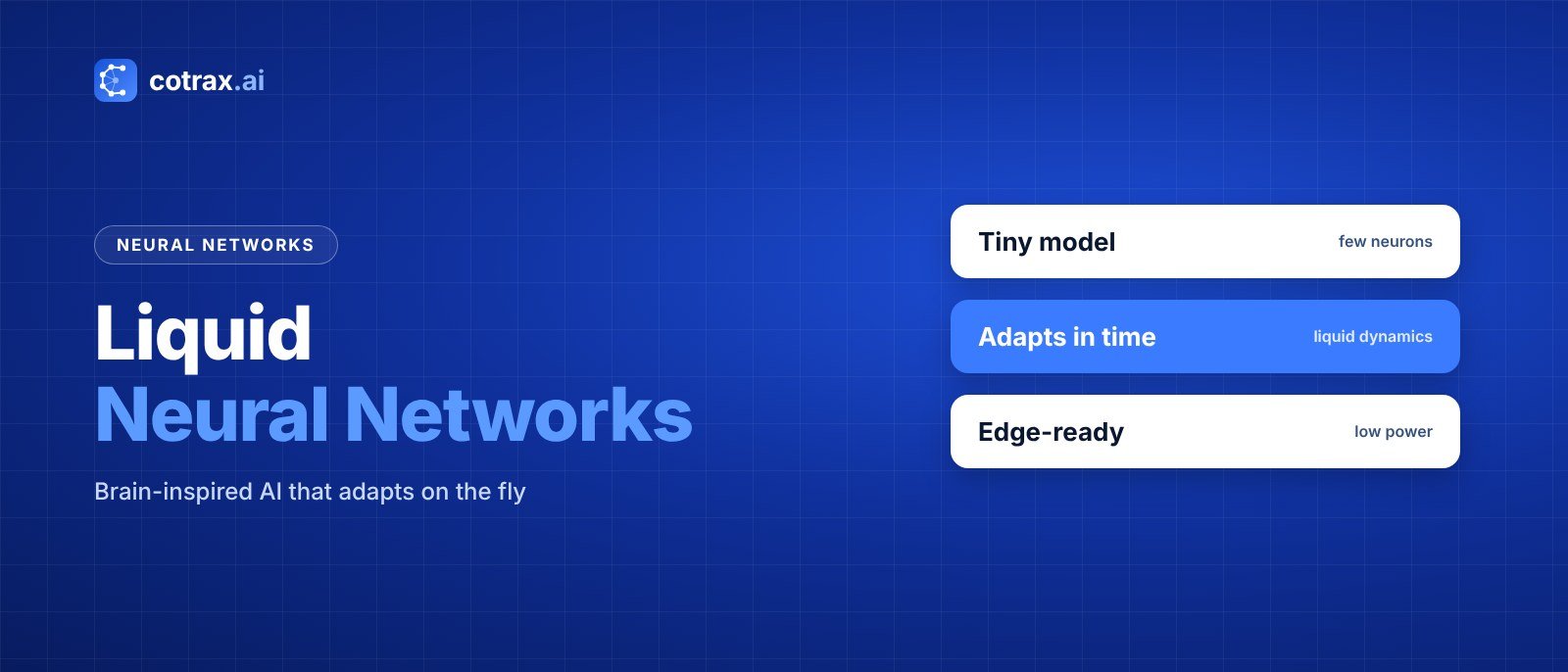
- Liquid neural networks are a brain-inspired type of neural network whose neurons change behavior over time.
- They were developed by MIT researchers and inspired by the tiny nervous system of a worm.
- They can solve control tasks, like lane keeping, with only a few dozen neurons.
- Their small size makes them efficient, easier to inspect and good for edge devices.
- They shine on time-series data but are not a replacement for transformers in language tasks.
Most AI models get bigger every year. More layers, more data, more chips. But what if a tiny network could do some jobs just as well, and even adapt on the fly? That’s the promise of liquid neural networks, a brain-inspired design from MIT that’s drawing a lot of attention.
Interestingly, the idea started with a worm. A roundworm called C. elegans gets by with just 302 neurons, yet it can sense, move and react to its world.
In this guide, the cotrax.ai team explains how liquid networks work, how they differ from regular neural networks, where they’re used, and what their limits are.
What Are Liquid Neural Networks?
Liquid neural networks are a type of recurrent neural network whose neurons follow differential equations with time constants that change based on the input, so the network keeps adapting its behavior as new data arrives. In other words, the network is “liquid” because its dynamics flow and shift instead of staying fixed after training.
The approach was introduced by researchers at MIT CSAIL in the paper “Liquid Time-constant Networks”, led by Ramin Hasani and Daniela Rus. It builds on years of work studying how small biological brains process signals.
If you’re new to the basics, start with our guide on what neural networks are.
How Do Liquid Neural Networks Work?
To see what makes them special, it helps to compare them with regular networks.
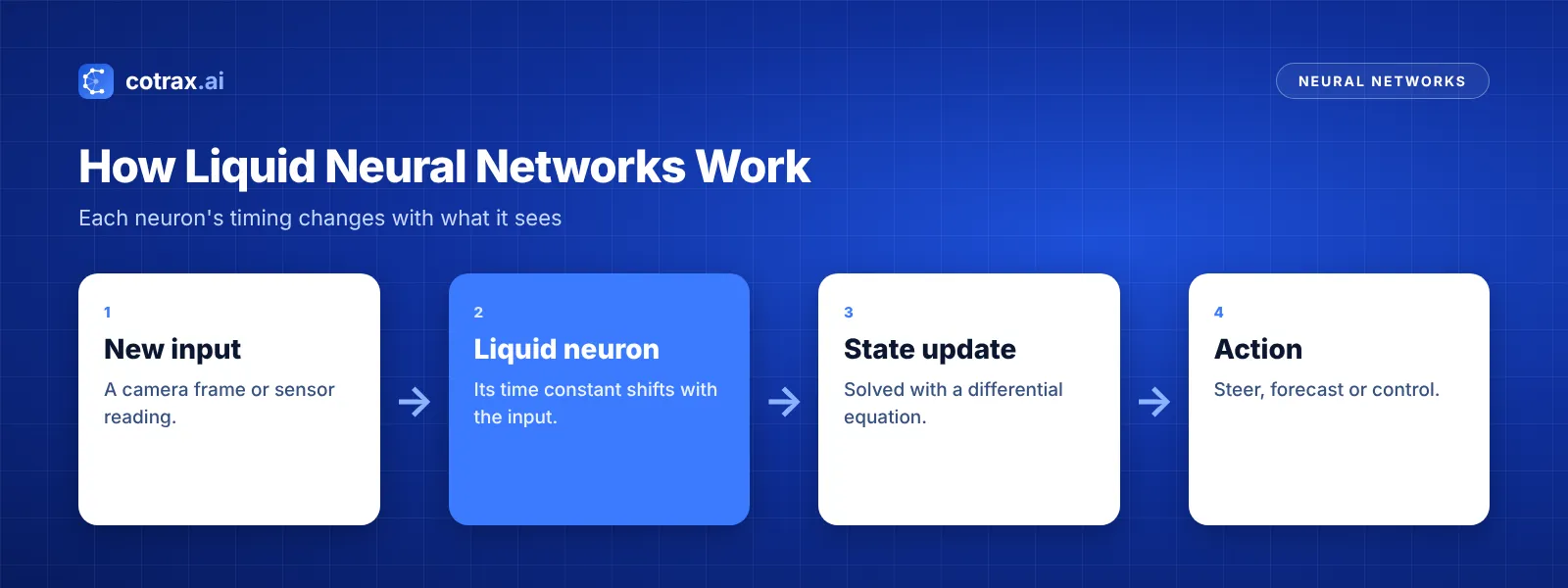
Neurons that change over time
In a typical network, each neuron applies the same fixed formula to its inputs. However, a liquid neuron is described by a differential equation, which models how its state changes over time. Crucially, its time constant, or how fast it reacts, depends on the input itself.
Continuous-time thinking
Because of this, liquid networks treat data as a continuous flow, not as separate snapshots. As a result, they handle irregular or changing signals well, such as video from a moving car or readings from a noisy sensor.
Faster versions
Solving differential equations can be slow. So in 2022, the same team introduced closed-form continuous-time (CfC) networks, which approximate the solution directly. This makes training and running them much faster.
Exploring efficient AI for devices or sensors?
Tell the cotrax team about your use case, and we’ll suggest a practical approach.
Liquid Neural Networks vs Traditional Neural Networks
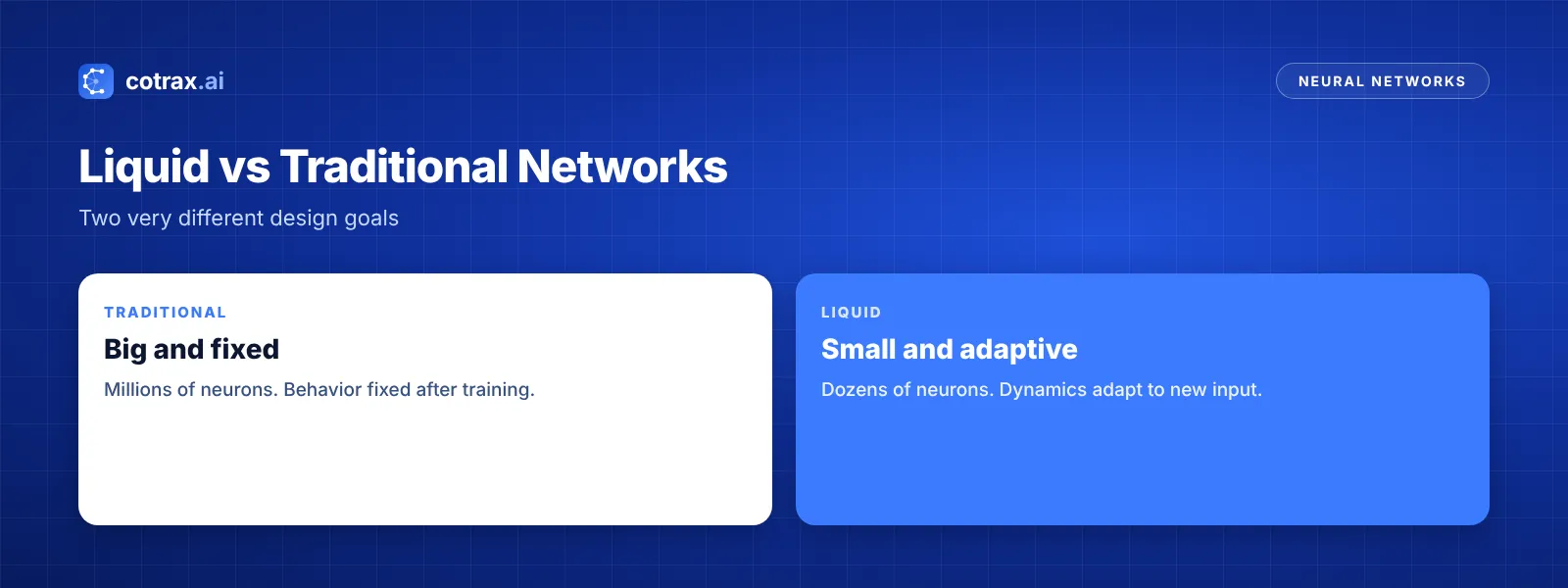
| Feature | Traditional deep network | Liquid neural network |
|---|---|---|
| Size | Often millions of neurons | Often just dozens to thousands |
| Behavior after training | Fixed | Adapts with the input |
| Time handling | Discrete steps | Continuous time |
| Interpretability | Hard to inspect | Easier, thanks to small size |
| Best for | Language, images at scale | Time series and control |
Compared with standard RNNs and LSTMs, liquid networks often reach similar or better results on time-series tasks with far fewer neurons. Still, results vary by problem, so testing is key. For a broader comparison, see our guide to the types of neural networks.
Why Liquid Neural Networks Matter
Tiny but capable
In a 2020 study, the MIT team and collaborators showed that a network with just 19 control neurons could keep a car in its lane from camera input. By contrast, typical deep networks for the same task use many thousands of neurons.
Adapting to new conditions
Later research showed liquid-style networks helping drones navigate in new environments, such as different seasons or terrain. According to ScienceDaily’s coverage of the MIT work, the network keeps adapting to new data inputs after training.
Easier to understand
With so few neurons, researchers can actually study what each one does. That matters in safety-critical areas, such as self-driving cars and medical devices, where you need to explain decisions.
Bigger isn’t the only path to smarter AI. Liquid networks show that clever structure can sometimes beat sheer size.
cotrax.ai Editorial Team
Get practical AI guides every week
Join the cotrax newsletter for simple, no-jargon lessons on new AI research.
Real-World Uses of Liquid Neural Networks
- Autonomous driving: lane keeping and steering from camera input.
- Drones: navigation that adapts to new places and weather.
- Robotics: smooth control of arms and moving robots.
- Time-series forecasting: energy use, traffic or sensor data.
- Healthcare signals: analyzing streams like heart rate data.
- Edge AI: running smart features on small, low-power devices.
The research has also moved into industry. For example, several of the original MIT researchers co-founded a company focused on liquid-based foundation models.
Limits of Liquid Neural Networks
- Not a language champion: transformers still lead for text at large scale.
- Newer ecosystem: fewer tutorials, tools and pretrained models exist.
- Math-heavy: differential equations make them harder to learn at first.
- Best on time data: on static data, like single images, the benefits shrink.
Therefore, think of them as a powerful tool for specific jobs rather than a replacement for every model. Like other networks, they can also forget old tasks when trained on new ones, a challenge we cover in our guide to continual learning.
How to Try Liquid Neural Networks
- Learn RNN basics first. Understanding sequences makes liquid networks easier to grasp.
- Use open-source code. The ncps library offers liquid-style layers for PyTorch and TensorFlow.
- Start with time-series data. For example, try forecasting a sensor signal.
- Compare with an LSTM. Then check accuracy, size and speed side by side.
For general setup help, see our guide to deep learning with Python.
Conclusion
Liquid neural networks take a different path from today’s giant models. Inspired by a tiny worm’s brain, they use neurons whose timing shifts with each input. As a result, they adapt over time, stay small, and remain easier to inspect.
They’re especially promising for robots, drones, sensors and edge devices. However, transformers still rule language tasks. So the smartest move is to use each where it fits best.
For more clear guides on new AI research, keep exploring cotrax.ai.
Build smarter with AI
Share your idea with the cotrax team and get a clear, simple plan to start.
Sources
- Hasani et al., Liquid Time-constant Networks (2020)
- ScienceDaily: “Liquid” machine-learning system adapts to changing conditions (2021)
- Neural Circuit Policies (ncps) library
Frequently asked questions
What is a liquid neural network?
Who invented liquid neural networks?
How are liquid neural networks different from RNNs?
What are liquid neural networks used for?
Will liquid neural networks replace transformers?
Want more guides like this?
Get clear, practical AI explainers from Cotrax AI in your inbox every Friday.