
Key Takeaways
- Overfitting happens when a model memorizes its training data, including noise, and then fails on new data.
- The classic sign is high training accuracy but much lower test accuracy.
- Underfitting is the opposite: the model is too simple to learn the real pattern.
- Common fixes include more data, simpler models, regularization, dropout and early stopping.
- Cross-validation is the most reliable way to catch overfitting early.
Your model hits 99% accuracy in training. You feel great. Then you test it on real data, and accuracy drops to 70%. What went wrong? In most cases, the culprit is overfitting in machine learning, one of the most common problems data teams face.
The good news is that overfitting is easy to spot once you know the signs. Better still, it’s usually easy to fix.
In this guide, the cotrax.ai team explains what overfitting is, why it happens, how to detect it, and eight proven ways to prevent it. We’ll also cover its opposite, underfitting.
What Is Overfitting in Machine Learning?
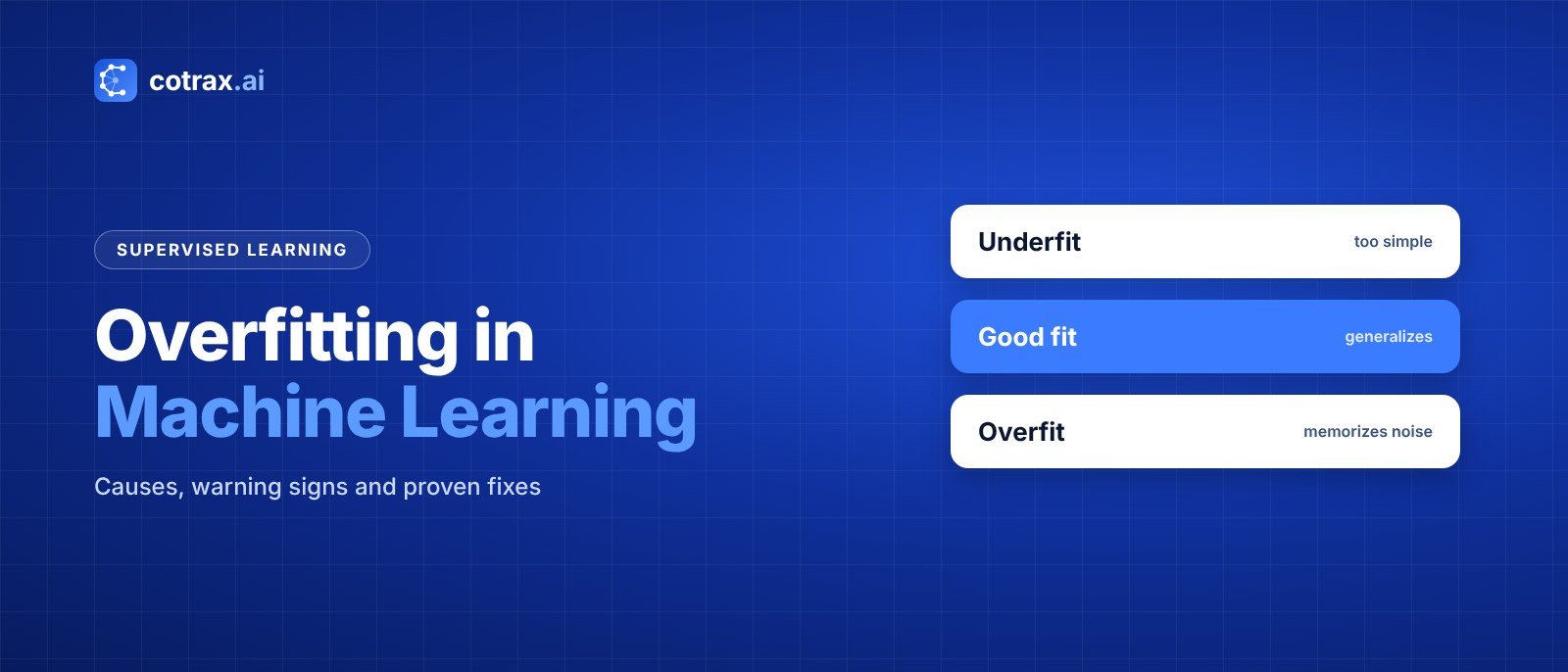
Overfitting happens when a machine learning model learns its training data too closely, including random noise and rare quirks, so it performs well on that data but poorly on new, unseen data. In other words, the model memorizes instead of learning general patterns.
Think of a student who memorizes last year’s exam answers. They ace that exact test. However, when the questions change, they struggle. An overfit model behaves the same way.
Overfitting is a key issue in supervised learning, where models train on labeled examples. Even so, it can affect almost any type of model.
Overfitting vs Underfitting
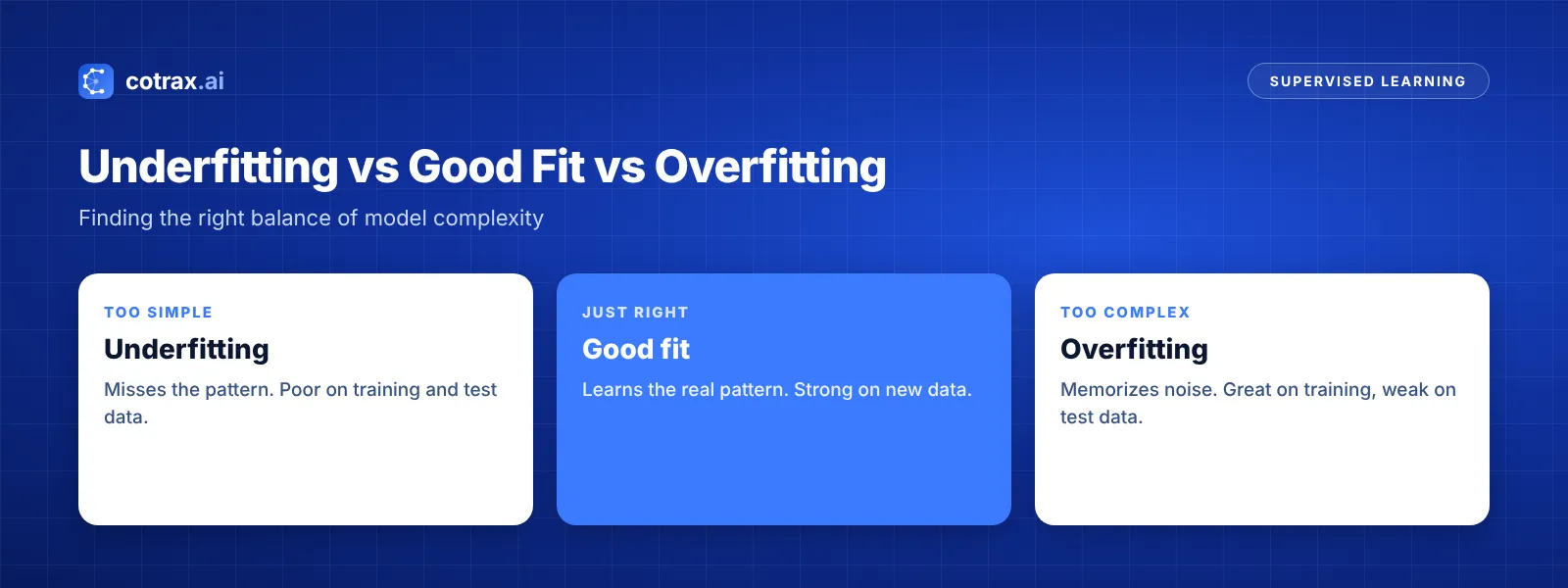
Overfitting has an opposite problem called underfitting. Understanding both helps you find the sweet spot.
| Feature | Underfitting | Good fit | Overfitting |
|---|---|---|---|
| Model complexity | Too simple | Balanced | Too complex |
| Training error | High | Low | Very low |
| Test error | High | Low | High |
| What it learned | Not enough | The real pattern | Pattern plus noise |
Data scientists often call this the bias-variance trade-off. An underfit model has high bias, meaning it makes strong, wrong assumptions. By contrast, an overfit model has high variance, so it changes too much with each new data sample.
What Causes Overfitting?
Several factors push a model toward memorizing instead of learning:
- Too little data: with few examples, a model can simply memorize them all.
- Too complex a model: deep neural networks and deep trees have huge capacity.
- Noisy data: errors and outliers give the model false patterns to chase.
- Too many features: irrelevant columns create chances for fake patterns.
- Training too long: after a point, extra training only fits noise.
- Data leakage: when test information slips into training, results look falsely good.
Is your model great in testing but weak in real life?
Tell the cotrax team what you’re seeing, and we’ll help you find the cause.
How to Detect Overfitting
You can’t fix what you can’t see. Luckily, a few simple checks reveal overfitting quickly.
Compare training and test scores
First, always hold back a test set. If training accuracy is much higher than test accuracy, your model is probably overfitting. For example, 98% in training versus 75% in testing is a red flag.
Use cross-validation
Next, use k-fold cross-validation to test the model on several different splits. If scores swing a lot between folds, the model may be unstable. Our guide to cross-validation in machine learning explains how it works step by step.
Plot learning curves
Finally, track training and validation error over time. When validation error stops falling and starts rising while training error keeps dropping, overfitting has begun.
8 Ways to Prevent Overfitting
Once you spot the problem, these proven techniques can help. In practice, teams often combine several of them.
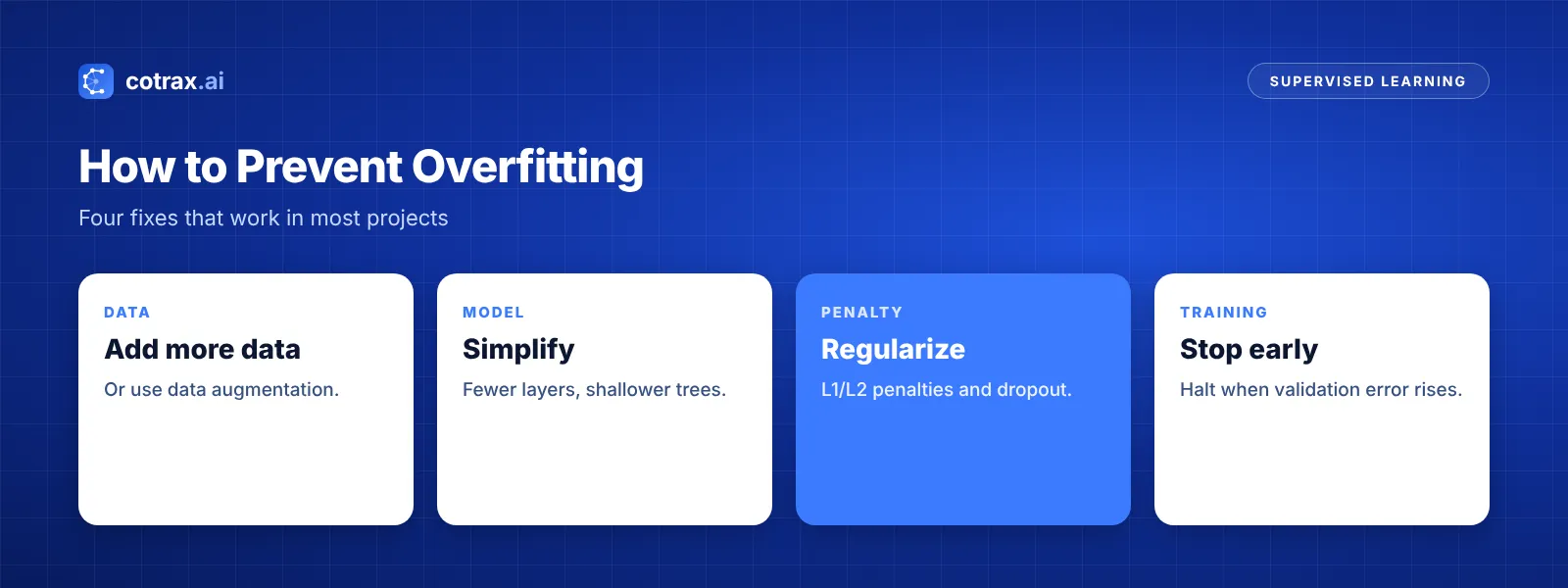
- Get more data. More varied examples make memorizing harder, so the model learns general rules instead.
- Use data augmentation. For images, you can flip, crop or rotate photos to create new training examples.
- Simplify the model. Fewer layers, fewer neurons or shallower trees reduce memorizing power.
- Add regularization. L1 and L2 penalties keep model weights small and simple.
- Use dropout. In neural networks, dropout randomly switches off neurons during training, which forces the network to learn robust features.
- Stop early. Early stopping halts training when validation error starts to rise.
- Select features carefully. Drop columns that add noise rather than signal.
- Use ensembles. Random forests and other ensembles average out the quirks of single models.
A model that’s perfect on training data should make you suspicious, not happy. Real-world data is messy, and a good model expects that.
cotrax.ai Editorial Team
Overfitting in Machine Learning: A Simple Example
Imagine you’re predicting house prices with only 20 homes. A very complex model might learn that “homes with blue doors cost more,” simply because two pricey homes had blue doors. As a result, it predicts badly for every other neighborhood.
A simpler model, on the other hand, would focus on size, location and age. Although it scores slightly lower on those 20 homes, it performs much better on new listings. That’s the trade-off in action.
Get practical ML guides every week
Join the cotrax newsletter for simple, no-jargon lessons on machine learning and AI.
How to Fix Underfitting
Sometimes the problem goes the other way. If your model performs poorly even on training data, try these fixes:
- Use a more powerful model, such as gradient boosting instead of linear regression.
- Add better features that capture the real drivers of your outcome.
- Train longer or reduce strong regularization.
To compare model options, see our guide to supervised learning algorithms. Also, the scikit-learn underfitting vs overfitting example shows the idea with real code.
Conclusion
Overfitting in machine learning happens when a model memorizes training data instead of learning real patterns. As a result, it shines in training but stumbles on new data.
To catch it, compare training and test scores, use cross-validation and watch your learning curves. Then fix it with more data, simpler models, regularization, dropout or early stopping. Above all, aim for a model that generalizes, not one that looks perfect on paper.
For more practical guides like this, keep exploring cotrax.ai.
Build smarter with AI
Share your idea with the cotrax team and get a clear, simple plan to start.
Sources
- Srivastava et al., Dropout: A Simple Way to Prevent Neural Networks from Overfitting (JMLR, 2014)
- scikit-learn: Underfitting vs. Overfitting
Frequently asked questions
What is overfitting in machine learning in simple terms?
How do I know if my model is overfitting?
What is the difference between overfitting and underfitting?
Does more data reduce overfitting?
What is regularization in machine learning?
Want more guides like this?
Get clear, practical AI explainers from Cotrax AI in your inbox every Friday.