Key Takeaways
- Supervised learning trains a model on labeled examples, so it learns to map inputs to the right outputs.
- There are two main types: classification (pick a category) and regression (predict a number).
- It powers spam filters, credit scoring, demand forecasts and medical image checks.
- Good labels matter more than fancy algorithms.
- Always test your model on data it hasn’t seen to know how it will really perform.
Every time your inbox catches a spam email, a model is using lessons it learned from millions of labeled examples. That’s supervised learning at work. So what is supervised learning, exactly, and why does it power so many of the AI tools you use each day?
In short, it’s the most common way to train machine learning models. Because of that, it’s also the best place to start if you’re new to AI.
In this guide, the cotrax.ai team explains how it works, its two main types, real examples, and the simple steps to build your own model. Along the way, we’ll also cover the mistakes that trip up most beginners.
What Is Supervised Learning?
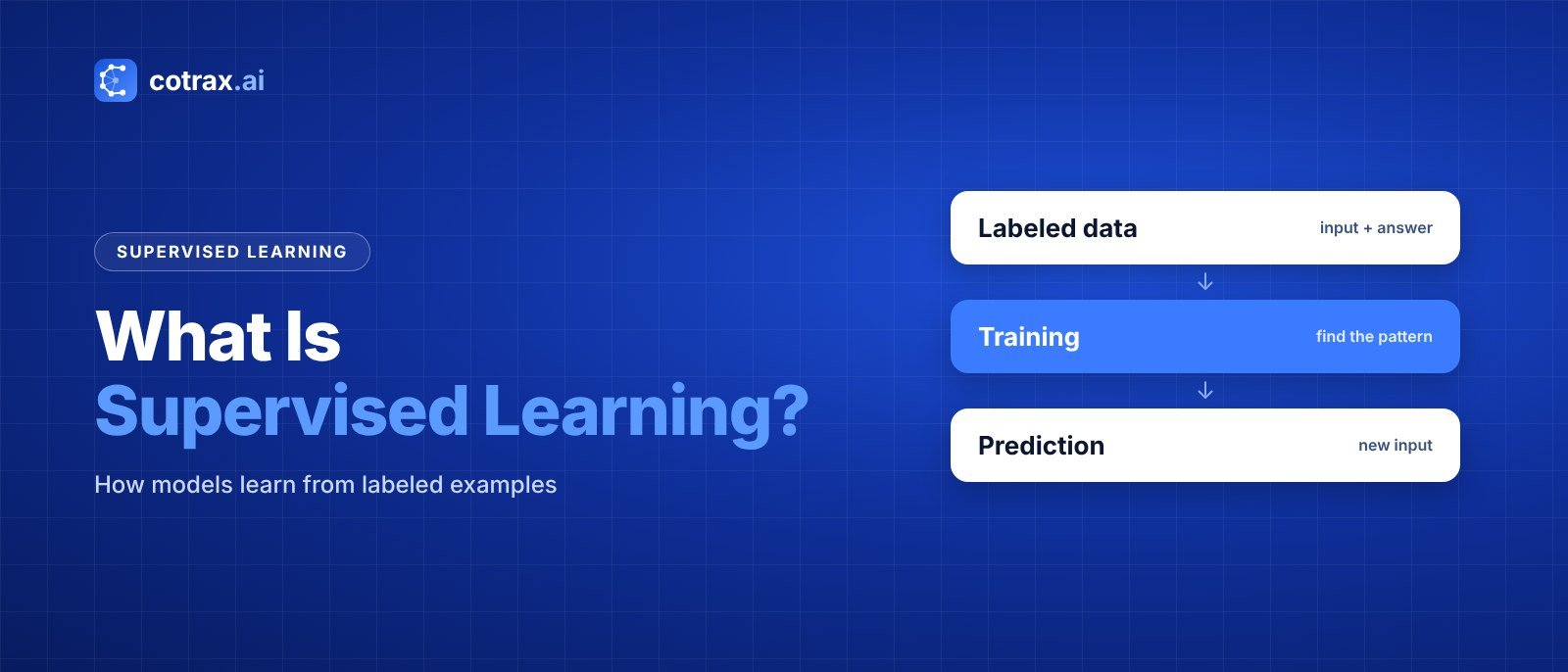
Supervised learning is a type of machine learning where a model learns from labeled data, meaning each training example comes with the correct answer. As a result, the model learns to map inputs to outputs, so it can predict the right answer for new data it has never seen before.
Think of a student with an answer key. First, the student tries each problem. Then they check the key, see their mistakes, and adjust. Over time, they get better. A supervised model learns in much the same way.
However, this is only one of several learning styles. To compare them all, read our guide on supervised vs unsupervised vs semi-supervised learning.
How Does Supervised Learning Work?
The process follows a clear loop. Although the math can get complex, the idea stays simple.
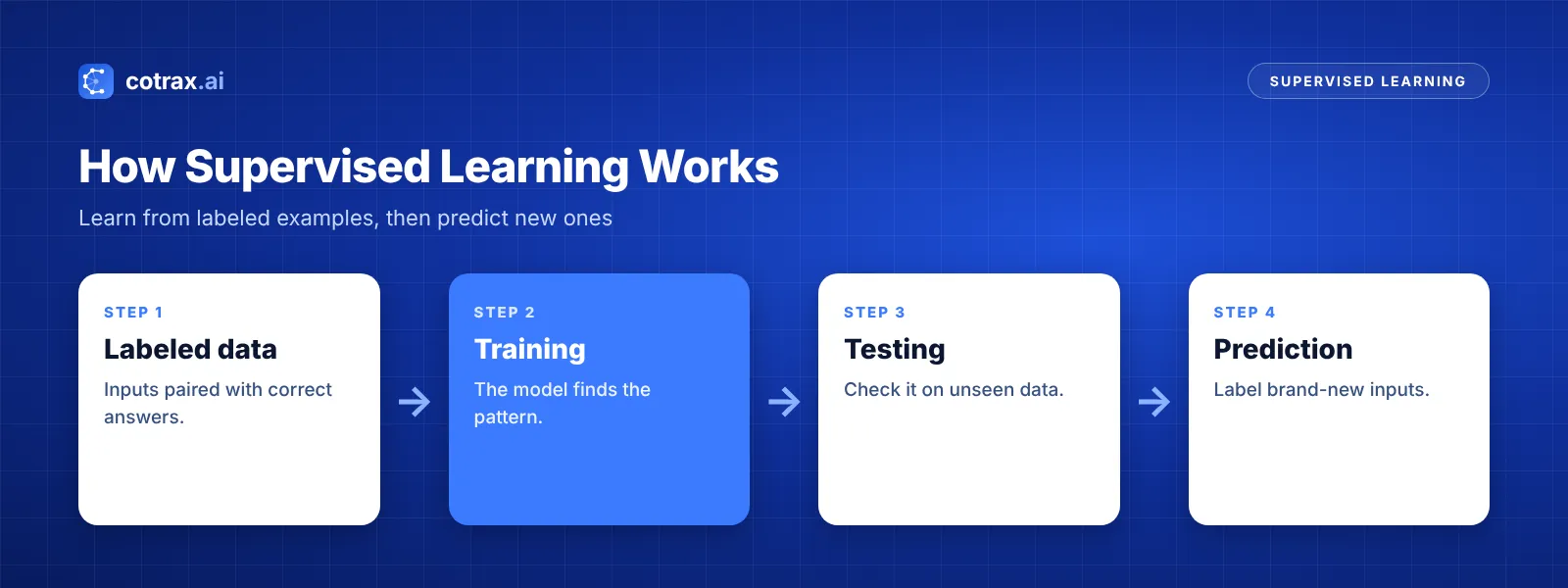
1. Collect labeled data
First, you gather examples where you already know the answer. For instance, a bank might collect past loan records marked “repaid” or “defaulted.” These answers are called labels.
2. Split the data
Next, you split the data into a training set and a test set. Typically, about 80% goes to training, while 20% stays hidden for testing.
3. Train the model
Then the model studies the training data. Each time it makes a wrong guess, a loss function measures the error. After that, the model adjusts its internal settings to shrink that error.
4. Test and predict
Finally, you check the model on the test set. If it performs well there, it will likely work well on real, new data, too. At that point, it’s ready to make predictions.
Types of Supervised Learning
Supervised learning splits into two main types. The right one depends on what you want to predict.
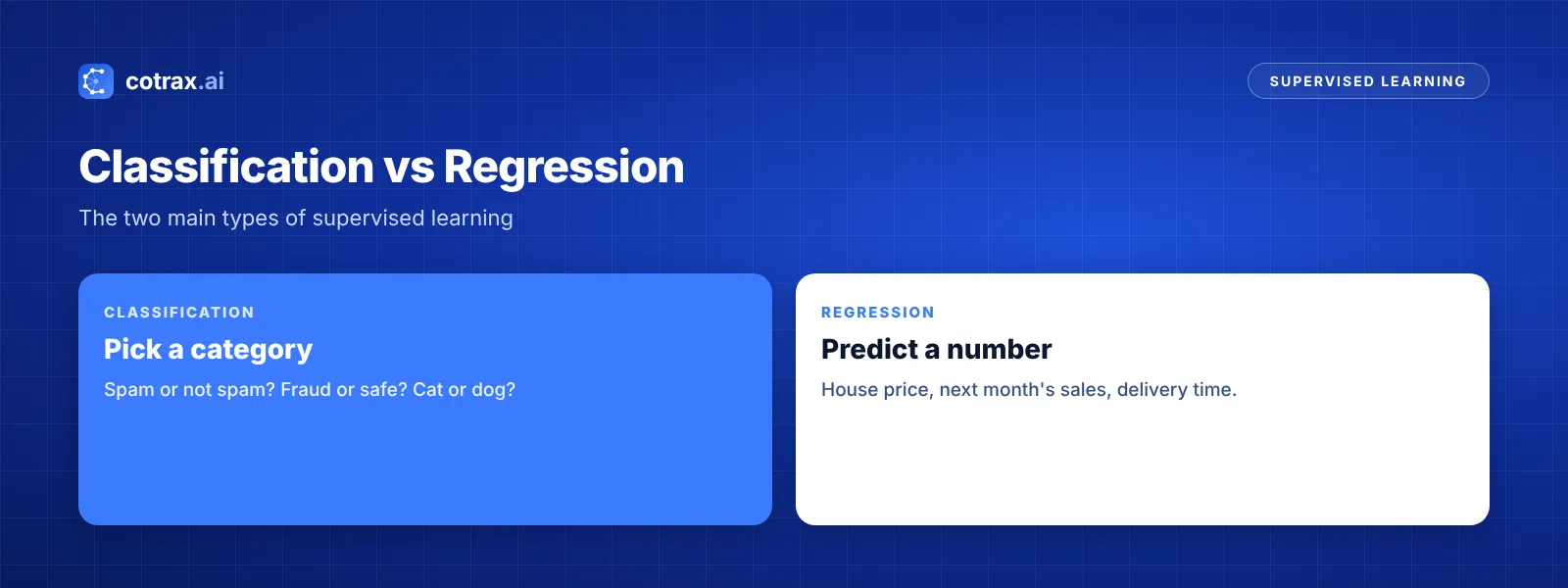
Classification
This type predicts a category. For example, is this email spam or not? Is this transaction fraud or safe? When there are only two options, it’s called binary classification. When there are more, it’s multi-class classification.
Regression
Regression, on the other hand, predicts a number. For instance, it might estimate a house price, next week’s sales, or how long a delivery will take. Because the output is continuous, the model aims to get as close as possible to the true value.
| Feature | Classification | Regression |
|---|---|---|
| Output | A category or label | A number |
| Example question | Will this customer cancel? | How much will this customer spend? |
| Common algorithms | Logistic regression, decision trees | Linear regression, random forests |
| Common metric | Accuracy, F1 score | Mean absolute error |
Have data but not sure what to predict?
Share your use case with the cotrax team and get a simple, practical recommendation.
Common Supervised Learning Algorithms
Many algorithms can learn from labeled data. However, a handful show up again and again:
- Linear regression: draws a straight line through data to predict numbers.
- Logistic regression: despite its name, it’s used for yes-or-no classification.
- Decision trees: split data with simple if-then questions.
- Random forests: combine many trees for more stable results.
- Support vector machines (SVM): find the best boundary between classes.
- Neural networks: learn complex patterns in images, text and sound.
For a deeper look at each one, see our full guide to supervised learning algorithms.
Real-World Examples of Supervised Learning
You meet supervised models almost everywhere. Here are some everyday examples:
- Email: spam filters learn from emails people have flagged.
- Banking: credit scoring models predict who is likely to repay a loan.
- Healthcare: models help spot disease in labeled X-rays and scans.
- Retail: demand forecasts help stores stock the right products.
- Real estate: pricing tools estimate home values from size and location.
- Customer service: models sort support tickets by topic and urgency.
Adoption keeps rising, too. According to McKinsey’s State of AI 2026, nearly nine in ten organizations now use AI regularly in at least one business function. For more ideas, browse our list of applications of machine learning.
A supervised model can only be as good as its labels. So before you tune any algorithm, check your answer key.
cotrax.ai Editorial Team
Pros and Cons of Supervised Learning
Pros
- Clear goal: because you know the right answers, you can measure accuracy easily.
- Proven results: it works well for many business problems.
- Wide tool support: libraries like scikit-learn make it easy to start.
Cons
- Labels cost money: people often need to tag data by hand.
- Bias risk: if labels carry bias, the model will learn it.
- Limited to known answers: it can’t find patterns you didn’t label.
Because labels are expensive, many teams now mix in unlabeled data with methods like self-supervised learning.
Get practical ML guides every week
Join the cotrax newsletter for simple, no-jargon lessons on machine learning and AI.
How to Build Your First Supervised Learning Model
You can build a simple model in an afternoon. Here’s how:
- Pick a clear question. For example, “Will this customer cancel next month?”
- Gather labeled data. Use past records where you already know the outcome.
- Clean it up. Then fix missing values and remove duplicates.
- Train a simple model. Start with logistic regression or a decision tree in scikit-learn.
- Test it honestly. Use a hidden test set or cross-validation.
- Improve step by step. Finally, add features or try stronger models.
Also, watch out for overfitting. That’s when a model memorizes training data but fails on new data.
Conclusion
So, what is supervised learning? It’s machine learning with an answer key. The model studies labeled examples, learns the pattern, and then predicts answers for new data.
It comes in two main types, classification and regression. Together, they power spam filters, credit scores, forecasts and much more. Above all, remember that clean labels and honest testing matter more than any fancy algorithm.
Ready to try it? Start with a simple question and a small dataset. And for more clear AI guides, keep exploring cotrax.ai.
Build smarter with AI
Share your idea with the cotrax team and get a clear, simple plan to start.
Sources
Frequently asked questions
What is supervised learning in simple words?
What are the two types of supervised learning?
What is an example of supervised learning?
Is ChatGPT supervised learning?
How much data do you need for supervised learning?
Want more guides like this?
Get clear, practical AI explainers from Cotrax AI in your inbox every Friday.