Key Takeaways
- Deep reinforcement learning combines neural networks with trial-and-error learning driven by rewards.
- An agent takes actions, gets rewards or penalties, and slowly learns the best strategy.
- Deep Q-Learning (DQN) taught AI to play Atari games from raw pixels.
- It powers game AI, robotics and the fine-tuning of chatbots through human feedback.
- Tools like Gymnasium and Stable-Baselines3 make it easy to run your first experiment.
How did an AI learn to beat world champions at Go? Nobody wrote the winning moves into it. Instead, it played millions of games, kept what worked, and dropped what didn’t. That approach is called deep reinforcement learning, and it’s one of the most exciting areas of AI.
It’s also more practical than it sounds. The same ideas help robots walk, help warehouses save energy, and even help chatbots give better answers.
In this guide, the cotrax.ai team explains how it works in plain English. You will learn the core loop, how Deep Q-Learning works, the main algorithms, real examples, and how to try it yourself.
What Is Deep Reinforcement Learning?
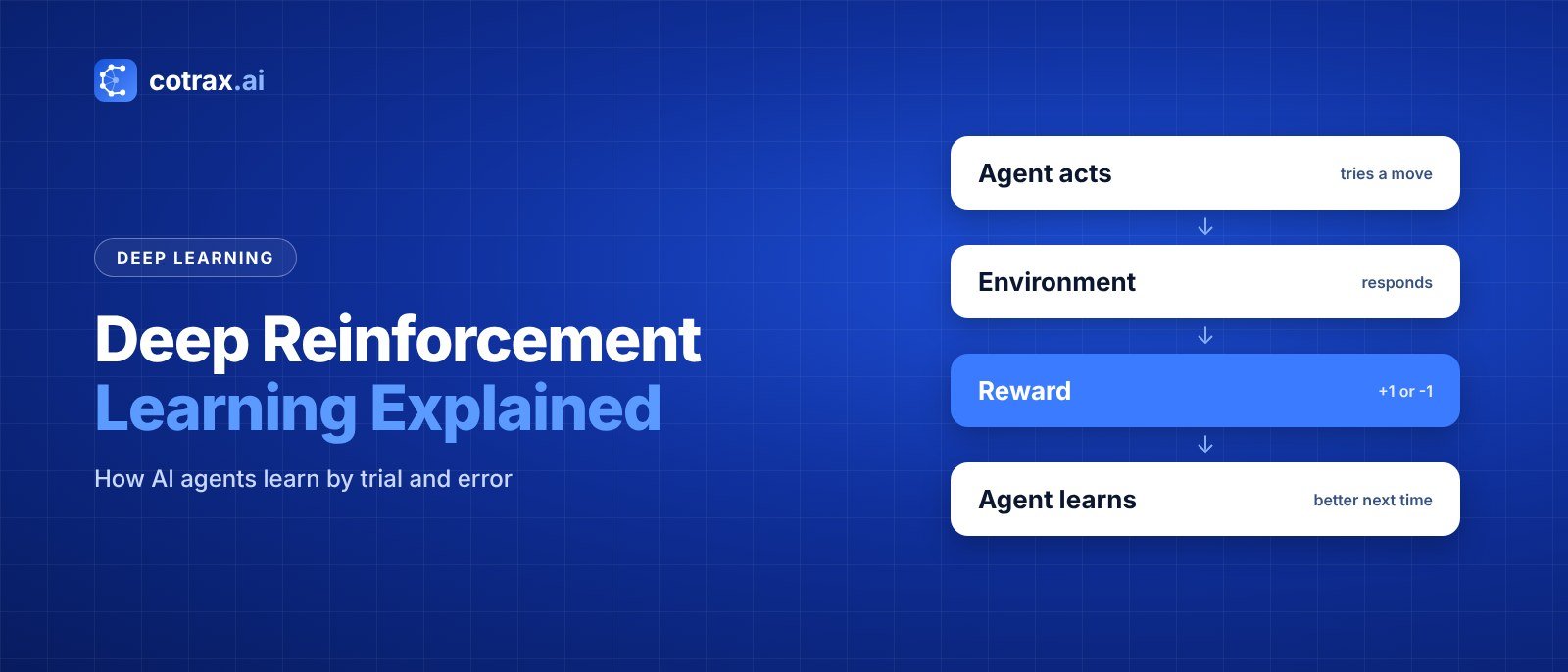
Deep reinforcement learning (deep RL) is a method where an AI agent learns to make decisions by trial and error, using a neural network to process what it sees and rewards to judge its actions. Over time, the agent learns which actions lead to the most reward in each situation.
Think of training a dog. You don’t explain the rules. Instead, you give a treat for good behavior. Reinforcement learning works the same way, while the “deep” part adds a neural network so the agent can handle complex inputs like images.
For a refresher on the basics, see our guide to what deep learning is. It covers how neural networks learn patterns.
How Does Deep Reinforcement Learning Work?
Every deep RL system has a few key parts. Once you know them, the rest makes sense.
- Agent: the learner that makes decisions.
- Environment: the world it acts in, such as a game or a robot’s room.
- State: what the agent sees right now.
- Action: a move the agent can make.
- Reward: a score that tells the agent how good its move was.
- Policy: the agent’s strategy for choosing actions.
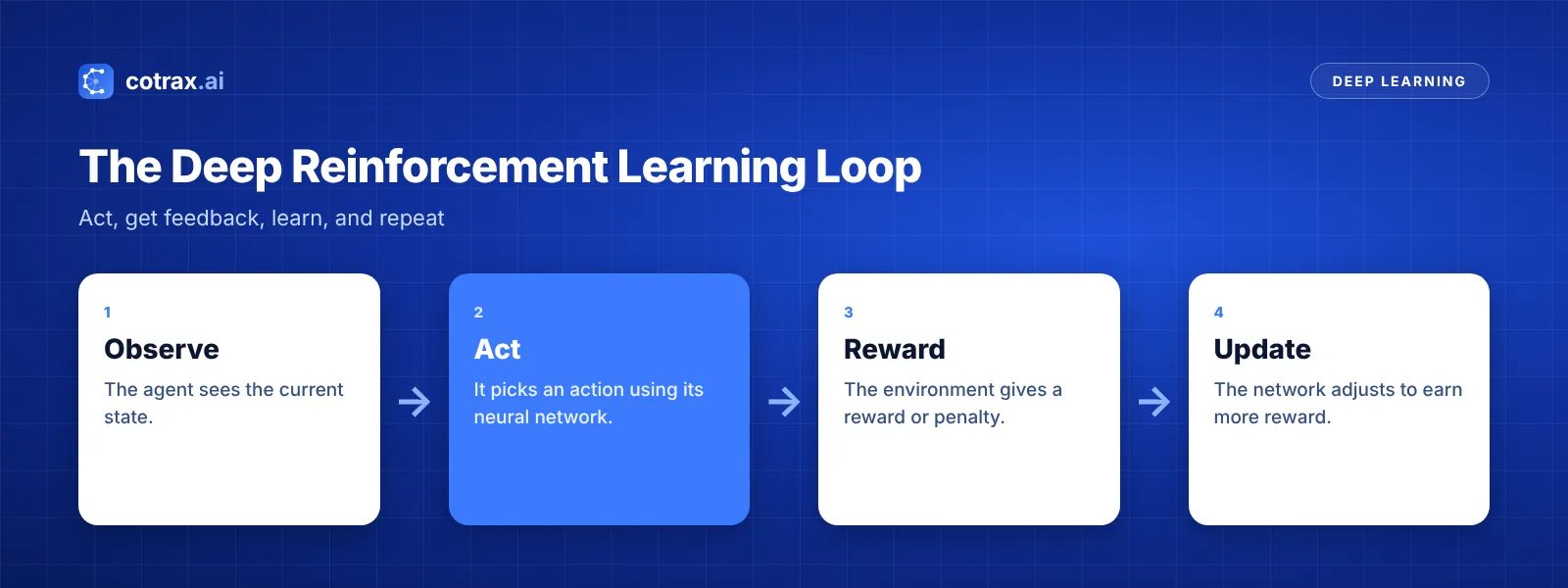
The agent loops through these steps again and again. First, it observes the state. Then it picks an action and gets a reward. Finally, it updates its neural network to do better next time. As a result, its strategy improves with every round.
Exploration vs exploitation
Every agent faces a classic trade-off. Should it try something new (explore) or stick with what already works (exploit)? Good agents balance both. For example, many start by exploring a lot and then slowly shift toward their best-known moves.
What Is Deep Q-Learning?
Deep Q-Learning is one of the most famous deep RL methods. It uses a neural network to estimate a “Q-value” for each possible action. A Q-value is simply a guess of the total future reward that action will bring.
The agent then picks the action with the highest Q-value. In 2015, DeepMind published its Deep Q-Network (DQN) research in Nature. The system learned to play dozens of Atari games using only screen pixels and the game score.
Two tricks made DQN stable. First, experience replay stores past moves and replays them in random order. Second, a separate target network keeps learning targets steady. Together, they stopped training from spinning out of control.
Curious how AI agents could help your business?
Tell the cotrax team what you want to automate, and we’ll suggest a practical first step.
Popular Deep Reinforcement Learning Algorithms
DQN is just the start. Today, several algorithms are common, and each fits a different problem.
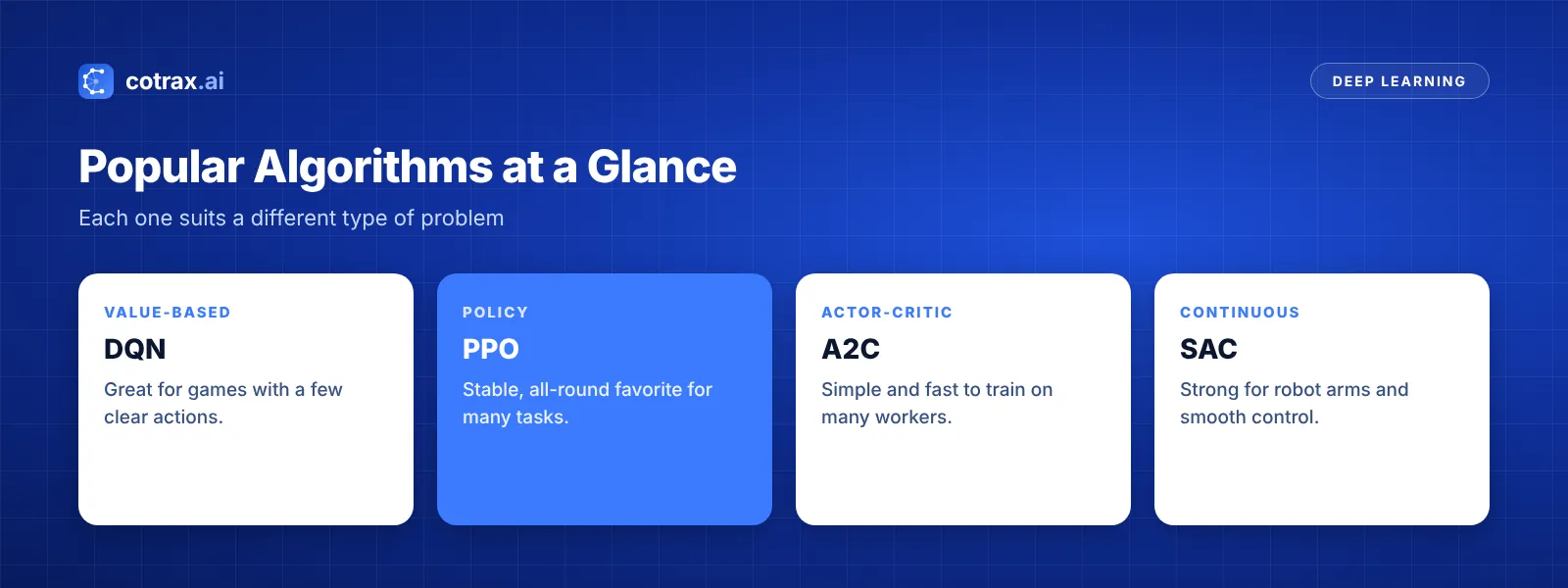
| Algorithm | Type | Best for |
|---|---|---|
| DQN | Value-based | Games with a small set of actions |
| PPO | Policy gradient | General tasks; stable and widely used |
| A2C / A3C | Actor-critic | Fast training across many workers |
| SAC | Actor-critic | Smooth, continuous control like robot arms |
| DDPG / TD3 | Actor-critic | Continuous actions with precise control |
If you’re unsure where to begin, PPO is a safe default. It’s stable, well documented and used in many real projects.
Real-World Examples of Deep Reinforcement Learning
Deep RL has moved well beyond video games. Here are some of its best-known uses:
- Board games: AlphaGo and AlphaZero learned Go and chess at a superhuman level.
- Robotics: robots learn to walk, grasp objects and recover from slips.
- Chatbots: reinforcement learning from human feedback (RLHF) helps models give more helpful answers.
- Energy savings: agents tune cooling systems in data centers.
- Recommendations: systems learn which content keeps users engaged over time.
- Trading and logistics: agents test strategies for routing, pricing and stock control in simulations.
For more everyday uses of AI, explore our list of applications of machine learning.
Reinforcement learning shines when you can describe the goal but not the steps. Just define the reward carefully, because the agent will chase it literally.
cotrax.ai Editorial Team
Reinforcement Learning vs Supervised Learning
Both are ways for a model to learn. However, they get feedback in very different ways.
| Feature | Supervised learning | Reinforcement learning |
|---|---|---|
| Feedback | The correct answer for every example | A reward after actions |
| Data | A fixed, labeled dataset | Created by the agent as it acts |
| Goal | Predict the right label | Maximize total reward over time |
| Example | Spam detection | Playing a game or steering a robot |
In short, supervised learning learns from a teacher who gives answers. Reinforcement learning, by contrast, learns from a coach who only gives a score. If you want to compare all the learning styles, read our guide on supervised vs unsupervised vs semi-supervised learning.
Challenges of Deep RL
Deep RL is powerful, but it’s not always the right tool. Keep these limits in mind:
- Needs lots of practice: agents may need millions of tries to learn.
- Reward hacking: a badly designed reward can lead to strange shortcuts.
- Unstable training: small changes in settings can break results.
- Sim-to-real gap: skills learned in a simulator don’t always transfer to the real world.
Because of this, many teams train in simulation first and then fine-tune carefully with real data. Also, agents that learn new tasks can forget old ones, a problem we cover in our guide to continual learning.
Get practical AI guides every week
Join the cotrax newsletter for simple, no-jargon lessons on AI agents and deep learning.
How to Get Started With Deep Reinforcement Learning
You can run your first deep RL experiment in an afternoon. Here’s a simple path:
- Learn Python and basic neural networks. PyTorch is the most common choice.
- Install Gymnasium. Gymnasium offers ready-made environments like CartPole and Lunar Lander.
- Use a trusted library. Stable-Baselines3 gives you tested versions of PPO, DQN and more.
- Train on CartPole. It’s small and trains in minutes on a laptop.
- Experiment. Then change the reward or settings and watch how behavior changes.
Conclusion
Deep reinforcement learning teaches AI to act, not just predict. An agent tries actions, collects rewards, and uses a neural network to improve its strategy over time.
From DQN mastering Atari to RLHF shaping today’s chatbots, this approach keeps pushing AI forward. It needs careful reward design and lots of practice runs, but simple tools make it easy to explore.
Start with CartPole and PPO, then grow from there. And for more hands-on AI guides, keep reading cotrax.ai.
Build smarter with AI
Share your idea with the cotrax team and get a clear, simple plan to start.
Sources
- Mnih et al., Human-level control through deep reinforcement learning (Nature, 2015)
- Gymnasium documentation
- Stable-Baselines3 documentation
Frequently asked questions
What is deep reinforcement learning in simple terms?
What is the difference between deep learning and reinforcement learning?
What is Deep Q-Learning?
Is ChatGPT trained with reinforcement learning?
Is deep reinforcement learning hard to learn?
Want more guides like this?
Get clear, practical AI explainers from Cotrax AI in your inbox every Friday.