Key Takeaways
- MLOps is a set of practices that helps teams build, deploy, monitor and improve machine learning models reliably.
- It combines machine learning, DevOps and data engineering.
- The MLOps lifecycle runs from data and training to deployment, monitoring and retraining.
- Automation, versioning and monitoring are the core building blocks.
- Start small: track experiments, version data and models, then automate step by step.
Building a machine learning model in a notebook is one thing. Keeping it accurate, fast and reliable in a real product is another. In fact, many models never make it past the experiment stage. That gap is exactly why teams ask, what is MLOps, and how can it help them ship AI that actually works?
In short, MLOps brings order to the messy journey from idea to production. Moreover, it keeps models healthy after launch, when real-world data starts to change.
In this guide, the cotrax.ai team explains what MLOps means, why it matters, the full lifecycle, the pipeline stages, the maturity levels, and the best practices to get started.
What Is MLOps?
MLOps (machine learning operations) is a set of practices and tools that helps teams build, deploy, monitor and improve machine learning models in a reliable, repeatable way. It combines machine learning, DevOps and data engineering, so models can move from experiments to production quickly and stay accurate over time.
Think of it as DevOps for machine learning. However, ML systems depend on data as well as code. So MLOps adds extra pieces, such as data versioning, experiment tracking and model monitoring.
If you’re still learning the basics of ML, start with our guide to the types of machine learning.
Why Does MLOps Matter?
AI is now everywhere in business. According to McKinsey’s State of AI 2026, nearly nine in ten organizations use AI regularly in at least one business function. Yet far fewer have scaled it across the company. MLOps is often the missing link.
Here’s what it solves:
- Stuck experiments: models that work in a notebook but never reach users.
- Silent failures: accuracy that drops as customer behavior changes.
- No repeatability: results nobody can reproduce a month later.
- Slow updates: retraining that takes weeks of manual work.
- Risk and compliance gaps: no record of which data trained which model.
The MLOps Lifecycle
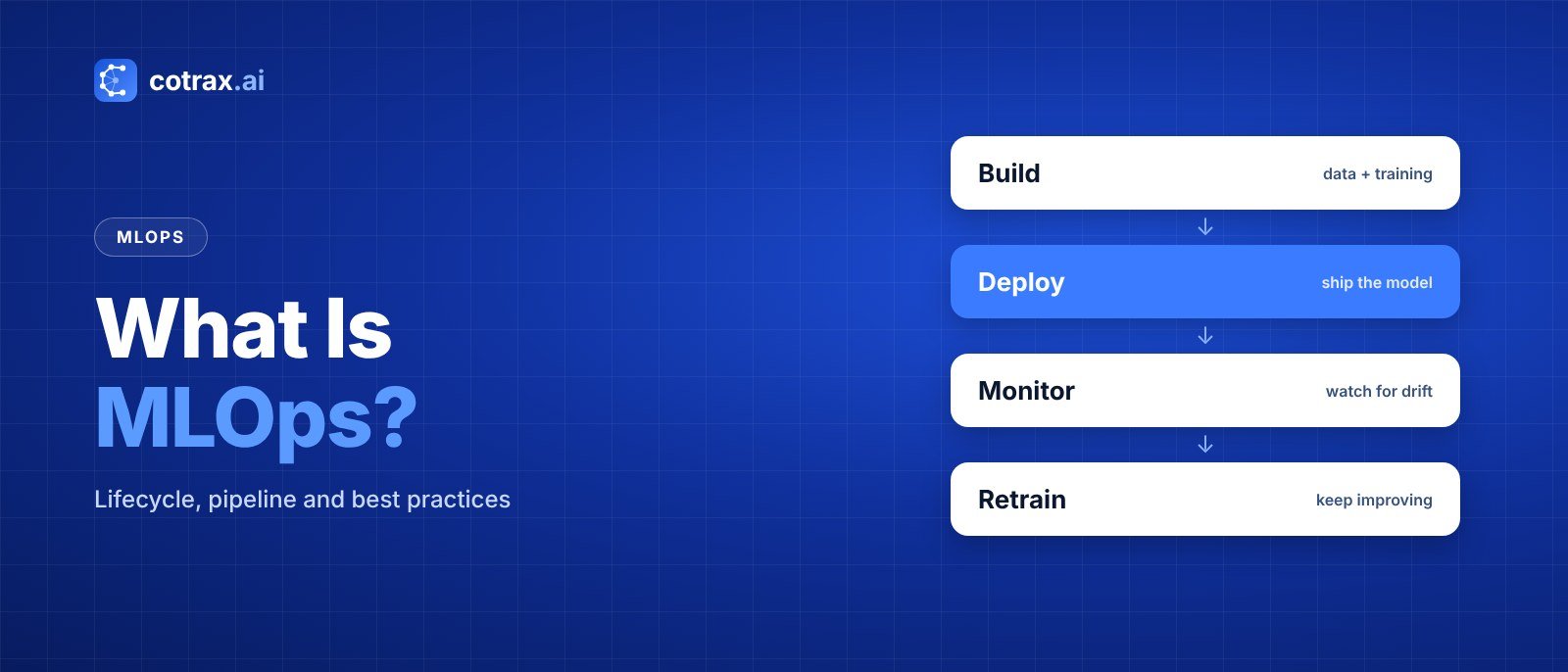
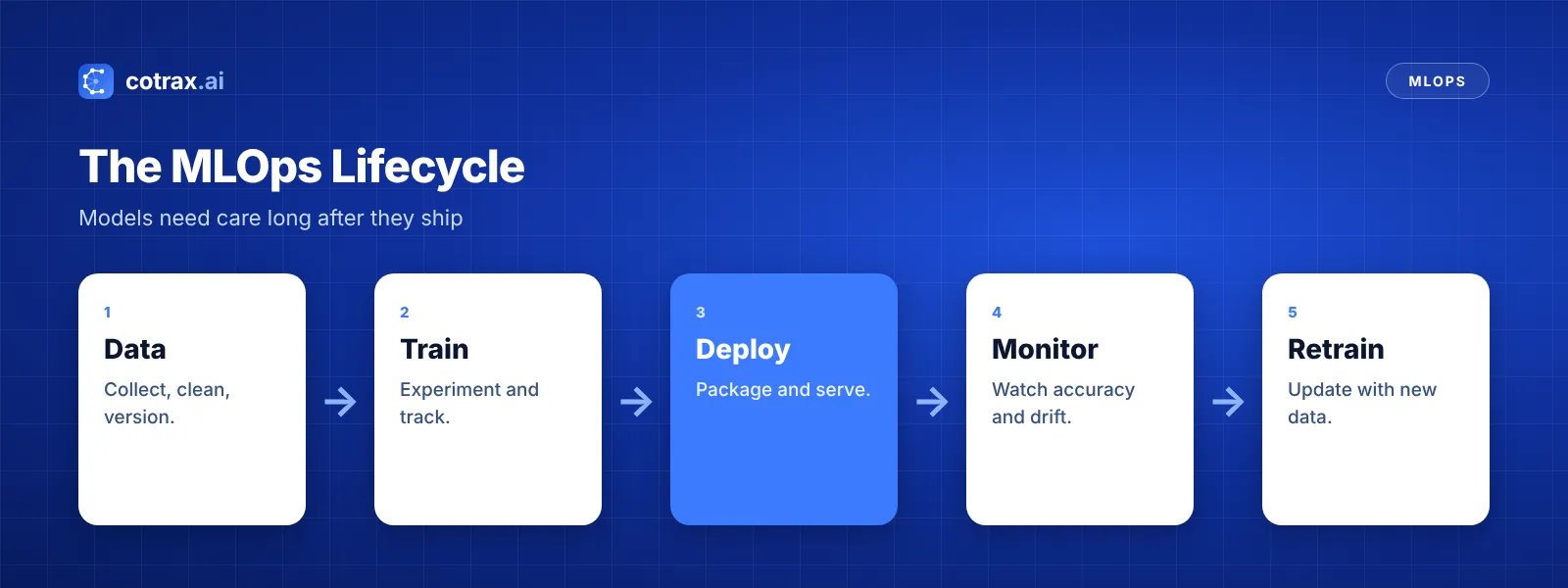
The MLOps lifecycle is a loop. Because data keeps changing, models need ongoing care rather than a one-time launch.
1. Data collection and preparation
First, teams gather, clean and label data. Then they version it, so every model can be traced back to the exact data that trained it.
2. Model training and experiment tracking
Next, data scientists try different models and settings. Experiment tracking records every run, including metrics and parameters. As a result, the best model is easy to find and reproduce.
3. Validation and testing
Before release, the model is tested for accuracy, fairness and speed. In addition, it’s checked against the current model to make sure it’s actually better. Methods like cross-validation help here.
4. Deployment
Then the model is packaged, often in a Docker container, and served through an API or batch job. Safe rollout methods, such as canary releases, limit the risk.
5. Monitoring
After launch, teams watch accuracy, response time and data drift. Drift happens when real-world data stops looking like the training data.
6. Retraining
Finally, when performance drops, the pipeline retrains the model on fresh data. Then the loop starts again.
Struggling to get models into production?
Tell the cotrax team where you’re stuck, and we’ll suggest a simple MLOps roadmap.
What Does an MLOps Pipeline Look Like?
An MLOps pipeline automates the lifecycle steps above. In practice, it often includes these parts:
| Pipeline stage | What it does | Example tools |
|---|---|---|
| Data pipeline | Ingests, validates and versions data | DVC, Airflow |
| Training pipeline | Trains and tracks models | MLflow, Kubeflow |
| Model registry | Stores approved model versions | MLflow Model Registry |
| CI/CD | Tests and deploys code and models | GitHub Actions, Jenkins |
| Serving | Runs the model for users | Docker, Kubernetes, BentoML |
| Monitoring | Tracks performance and drift | Evidently, Prometheus |
For a deeper look at these options, see our guide to the best MLOps tools. And to get hands-on, try our step-by-step guide to MLflow for MLOps.
MLOps Maturity Levels
Google describes three levels of MLOps maturity in its well-known MLOps architecture guide. Most teams climb them gradually.
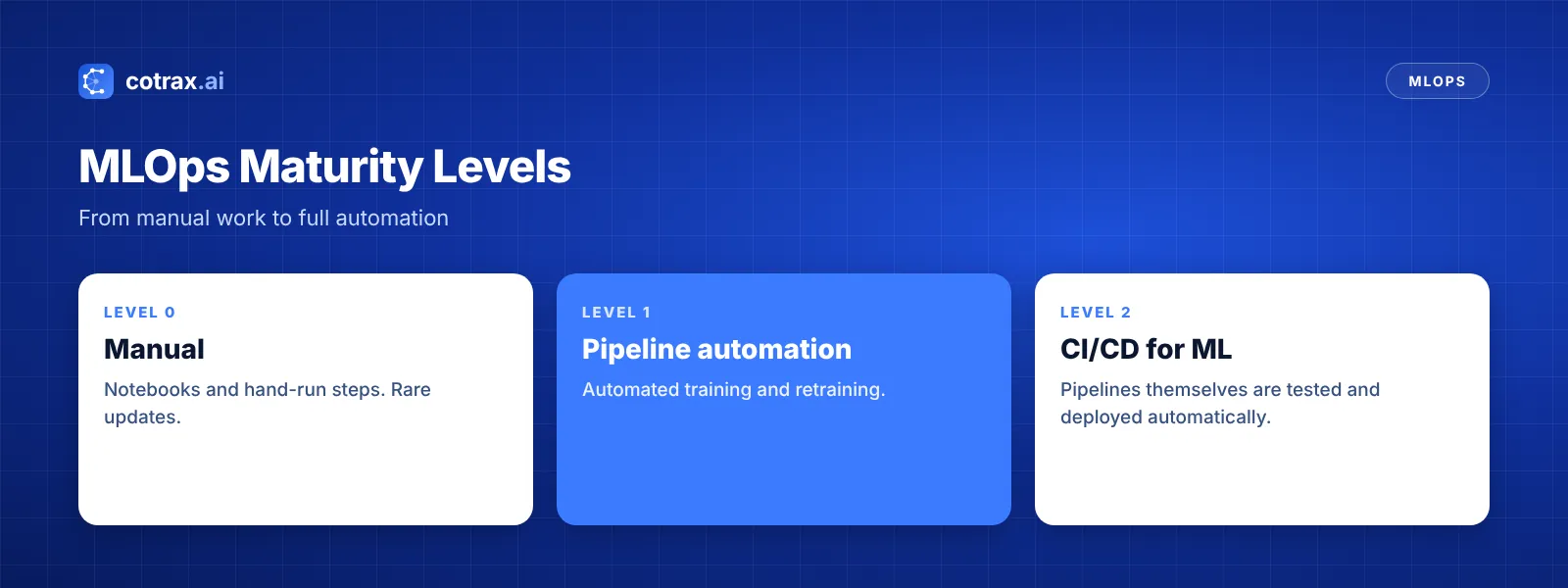
- Level 0, manual: data scientists hand off a trained model, and updates are rare.
- Level 1, pipeline automation: training and retraining run automatically when new data arrives.
- Level 2, CI/CD automation: the pipelines themselves are tested and deployed automatically, so teams can update quickly and safely.
A model in production is a living system. If nobody is watching it, it’s already getting worse.
cotrax.ai Editorial Team
MLOps vs DevOps
MLOps borrows a lot from DevOps. Still, there are key differences. For example, ML needs data versioning, experiment tracking and drift monitoring, which regular software doesn’t. For a full comparison, read our guide on MLOps vs DevOps vs AIOps.
Get practical AI guides every week
Join the cotrax newsletter for simple, no-jargon lessons on MLOps and AI.
MLOps Best Practices
- Version everything: code, data, models and settings.
- Track every experiment so results are easy to reproduce.
- Automate early, starting with training and testing.
- Use a model registry to control which model is live.
- Monitor in production, including drift and business metrics.
- Plan for retraining before you launch, not after.
- Keep humans in the loop for high-risk decisions.
Teams also need the right people. In fact, the MLOps engineer role has become one of the most in-demand jobs in AI. Learn more in our guide to becoming an MLOps engineer.
Conclusion
So, what is MLOps? It’s the practice of building, deploying, monitoring and improving machine learning models in a reliable, repeatable way. It joins ML, DevOps and data engineering into one workflow.
The payoff is big: faster launches, fewer silent failures and models that stay accurate as the world changes. Start small by tracking experiments and versioning data. Then automate one step at a time.
For more practical AI guides, keep exploring cotrax.ai.
Build smarter with AI
Share your idea with the cotrax team and get a clear, simple plan to start.
Sources
- Google Cloud: MLOps, continuous delivery and automation pipelines in machine learning
- McKinsey: The State of AI
Frequently asked questions
What is MLOps in simple terms?
Why is MLOps important?
What are the stages of the MLOps lifecycle?
Is MLOps the same as DevOps?
What skills do you need for MLOps?
Want more guides like this?
Get clear, practical AI explainers from Cotrax AI in your inbox every Friday.