
Key Takeaways
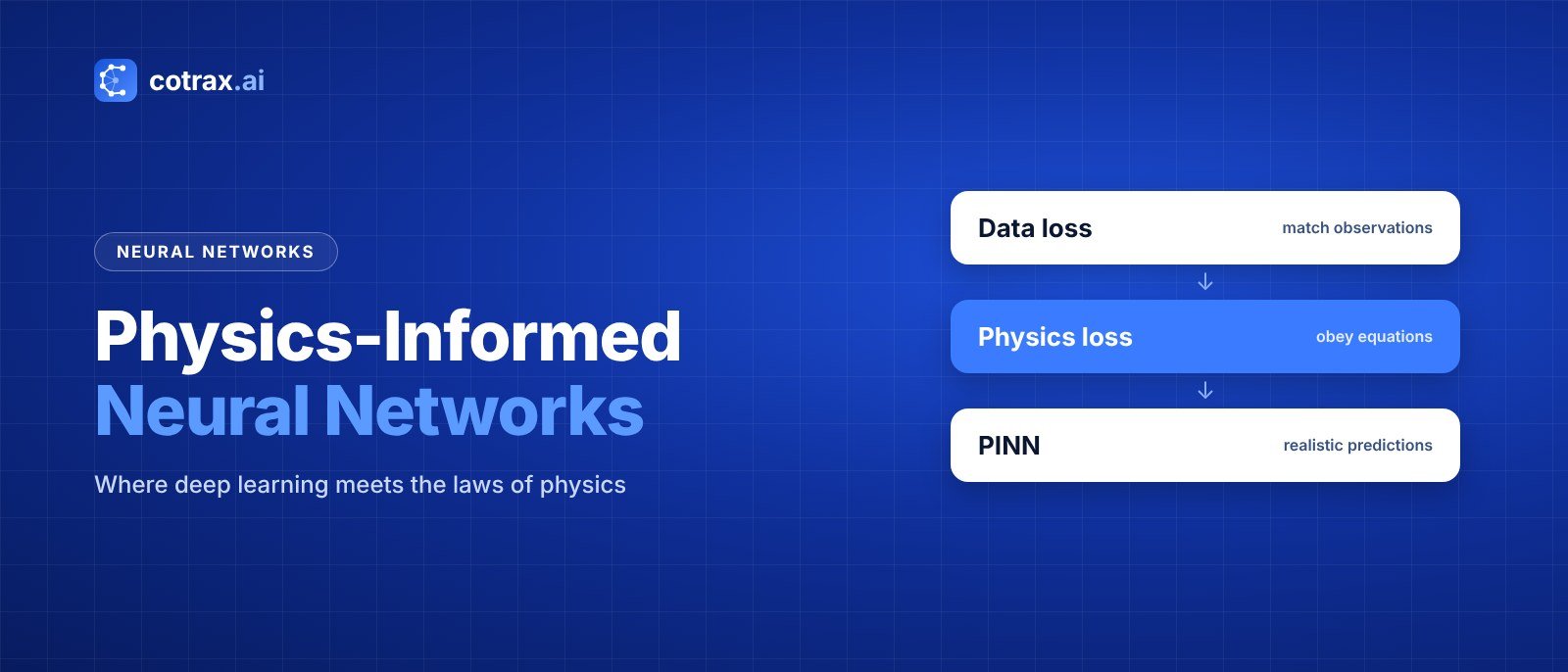
- Physics-informed neural networks (PINNs) train a neural network to fit data and obey known physics equations at the same time.
- They add a physics penalty to the loss, so the model is punished when it breaks the laws of nature.
- PINNs can work with little data and can solve both forward and inverse problems.
- They’re used in fluid flow, heat transfer, weather, materials and medical modeling.
- They can be slow and tricky to train, so they’re best for problems where physics is well known.
Regular neural networks learn only from data. So when data is thin, they can make wild guesses that break the laws of nature. For example, a model might predict water flowing uphill. Physics-informed neural networks fix that by teaching the model the rules of physics as well as the data.
As a result, these models can make realistic predictions with far less data. That’s why engineers and scientists are so excited about them.
In this guide, the cotrax.ai team explains what PINNs are, how they work, where they’re used, their pros and limits, and how you can build your first one.
What Are Physics-Informed Neural Networks?
Physics-informed neural networks (PINNs) are neural networks trained to fit observed data while also obeying known physical laws, usually written as differential equations. During training, the model is penalized whenever its predictions break those equations. So it learns solutions that match both the measurements and the physics.
The modern approach comes from Raissi, Perdikaris and Karniadakis. Their work was later published in the Journal of Computational Physics in 2019, and it has since been cited thousands of times.
If you’re new to neural networks, start with our guide on what neural networks are.
How Do Physics-Informed Neural Networks Work?
A PINN looks like a normal neural network. However, the way it’s trained is different.
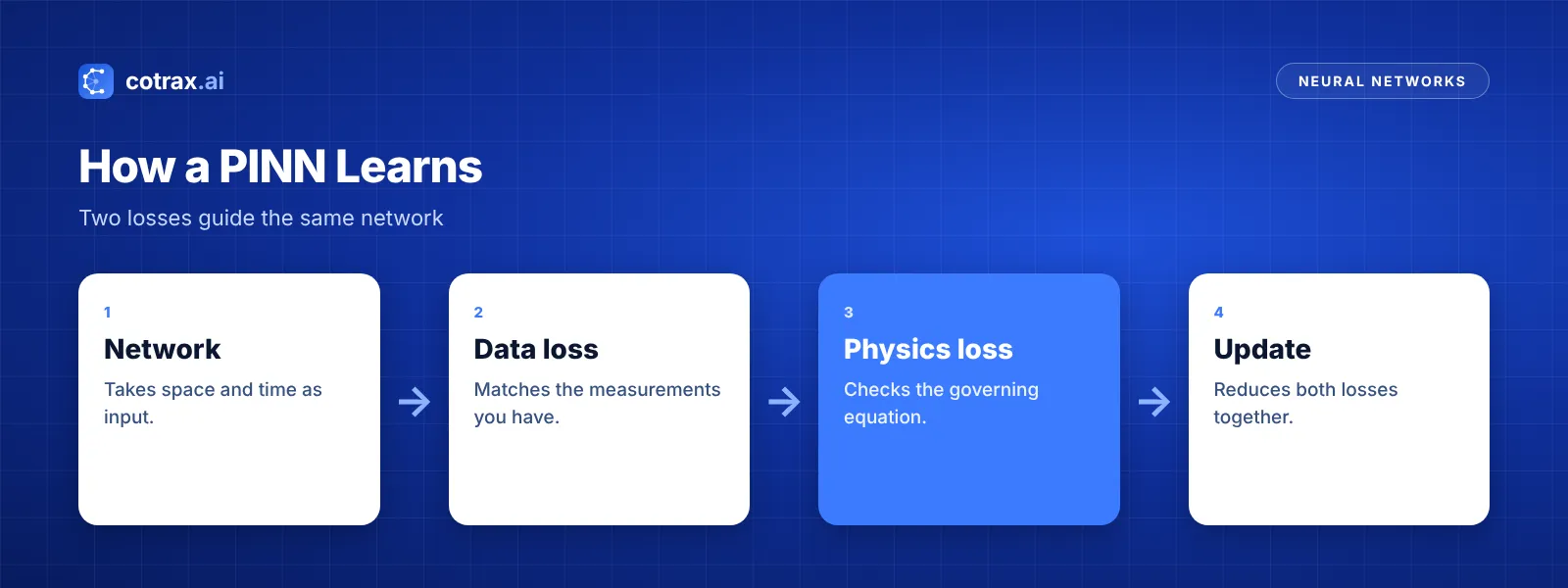
1. The network predicts a physical quantity
First, the network takes inputs like position and time. Then it outputs a value such as temperature, pressure or speed at that point.
2. The data loss checks the measurements
Next, the model compares its predictions with any real measurements you have. This part works just like regular supervised learning.
3. The physics loss checks the equations
Here’s the key idea. Using automatic differentiation, the network calculates its own derivatives. Then it plugs them into the governing equation, such as the heat equation. If the equation isn’t satisfied, the physics loss goes up.
4. Both losses shrink together
Finally, training reduces the data loss and the physics loss at the same time. As a result, the model fits the data without breaking the laws of nature. Boundary and starting conditions are added as extra loss terms in the same way.
Working on a science or engineering AI project?
Tell the cotrax team about your problem, and we’ll help you map out a practical approach.
PINNs vs Traditional Neural Networks and Solvers
| Feature | Regular neural network | Traditional solver | PINN |
|---|---|---|---|
| Uses data | Yes, lots | Rarely | Yes, often little |
| Uses physics laws | No | Yes | Yes |
| Needs a mesh | No | Usually | No |
| Handles inverse problems | Limited | Harder | Naturally |
| Speed for standard problems | Fast once trained | Fast and proven | Often slower to train |
In short, PINNs sit between pure data-driven AI and classic simulation. They’re most useful when you have some data, known physics, and gaps that neither approach handles well alone.
Forward vs Inverse Problems
PINNs can tackle two kinds of tasks.
- Forward problems: you know the equation and conditions, and you want the solution. For example, how will heat spread through a metal plate?
- Inverse problems: you have measurements, and you want to find unknown properties. For instance, what’s the thermal conductivity of this material?
Inverse problems are where PINNs really shine. Because the unknown values can simply become trainable parameters, the network estimates them while it learns.
Real-World Applications of PINNs
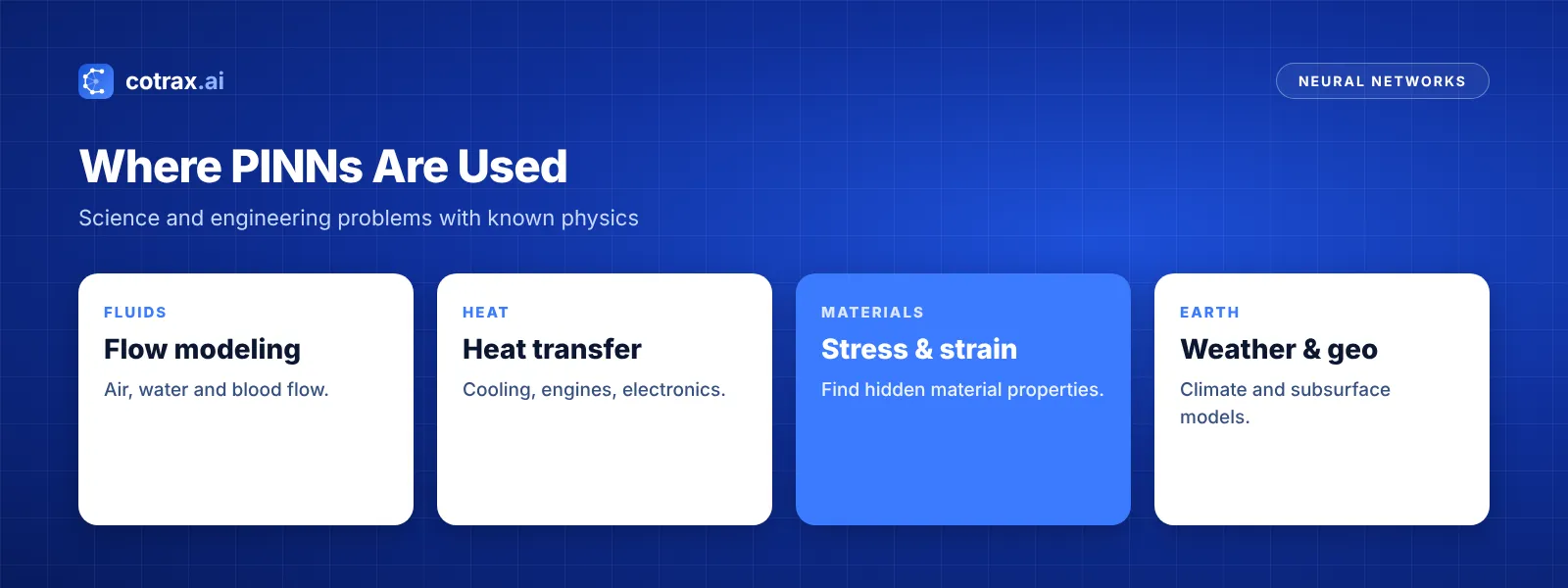
- Fluid dynamics: modeling airflow over wings or water in pipes.
- Healthcare: estimating blood flow and pressure from limited scans.
- Heat transfer: designing cooling for engines and electronics.
- Materials science: finding stiffness or stress inside structures.
- Climate and weather: filling gaps in sparse sensor data.
- Energy: modeling oil, gas and groundwater flow underground.
When data is scarce, knowledge is your best training signal. PINNs turn centuries of physics into a guide for modern AI.
cotrax.ai Editorial Team
Get practical AI guides every week
Join the cotrax newsletter for simple, no-jargon lessons on AI research.
Benefits and Limits of PINNs
Benefits
- Less data needed: physics fills the gaps between measurements.
- Realistic outputs: predictions respect known laws.
- No mesh required: they work on scattered points in space and time.
- Great for inverse problems: hidden parameters can be learned directly.
Limits
- Slow training: computing derivatives everywhere adds cost.
- Tricky balance: weighting data loss vs physics loss takes care.
- Hard problems: sharp shocks and chaotic systems remain difficult.
- Not always faster: mature solvers often beat PINNs on standard tasks.
Because of these limits, researchers keep improving PINNs with better loss weighting, adaptive sampling and hybrid models. Like other neural networks, they can also overfit if the setup is poor.
How to Build Your First PINN
- Pick a simple equation. For example, start with a 1D heat or Burgers’ equation.
- Choose a framework. PyTorch or JAX both support automatic differentiation.
- Use a helper library. DeepXDE makes setting up PINNs much easier.
- Define the losses. Then add the equation, boundary and starting conditions.
- Train and compare. Finally, check results against a known solution.
A small MLP is usually enough for a first PINN. Learn more in our guide to the MLP in machine learning, and set up your tools with our guide to deep learning with Python.
Conclusion
Physics-informed neural networks combine the flexibility of deep learning with the reliability of physics. By adding a physics loss to training, they produce realistic predictions even when data is limited.
They’re especially strong for inverse problems and sparse data in fields like fluids, heat and materials. However, they can be slow and tricky to train. So use them where physics is well known and data is hard to get.
For more clear guides on AI research, keep exploring cotrax.ai.
Build smarter with AI
Share your idea with the cotrax team and get a clear, simple plan to start.
Sources
- Raissi, Perdikaris & Karniadakis, Physics-informed neural networks (Journal of Computational Physics, 2019)
- Raissi et al., Physics Informed Deep Learning, Part I (arXiv, 2017)
- DeepXDE documentation
Frequently asked questions
What are physics-informed neural networks?
Who introduced PINNs?
What are PINNs used for?
Are PINNs better than traditional simulation?
What do I need to learn before PINNs?
Want more guides like this?
Get clear, practical AI explainers from Cotrax AI in your inbox every Friday.