Key Takeaways
- DevOps automates how software code is built, tested and released.
- MLOps applies DevOps ideas to machine learning and adds data, model and drift management.
- AIOps uses AI to help run IT operations, like spotting outages and reducing alert noise.
- MLOps needs everything DevOps does, plus data versioning, experiment tracking and retraining.
- Most teams build on DevOps first, add MLOps when they ship ML, and adopt AIOps as systems grow.
DevOps, MLOps, AIOps. The names sound almost identical, and they’re often mixed up in job posts and vendor pitches. However, each one solves a different problem. So if you’re comparing MLOps vs DevOps, and wondering where AIOps fits in, you’re asking the right question.
Getting this right matters. Otherwise, you may hire the wrong role, buy the wrong tools, or miss the steps that keep your AI working.
In this guide, the cotrax.ai team explains each practice in plain English, compares them side by side, and helps you decide which one your team needs first.
MLOps vs DevOps: What’s the Difference?
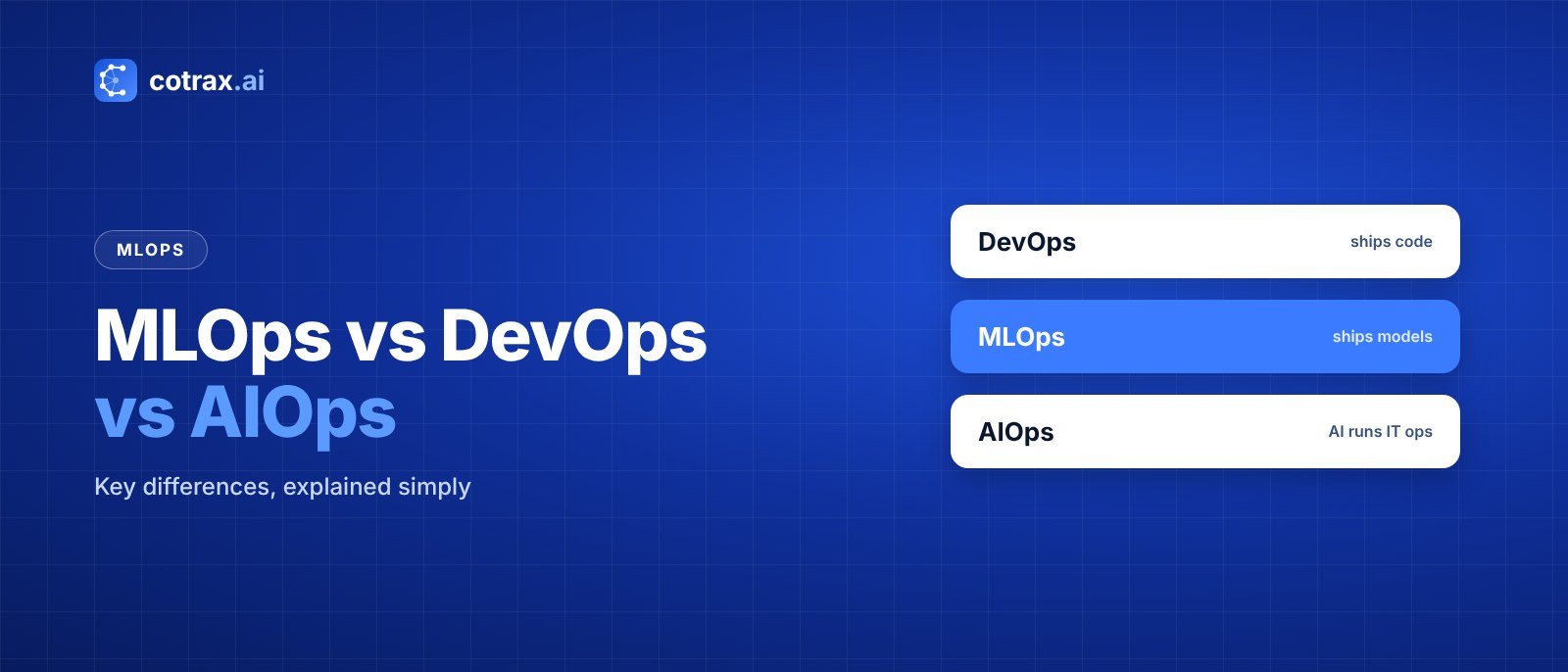
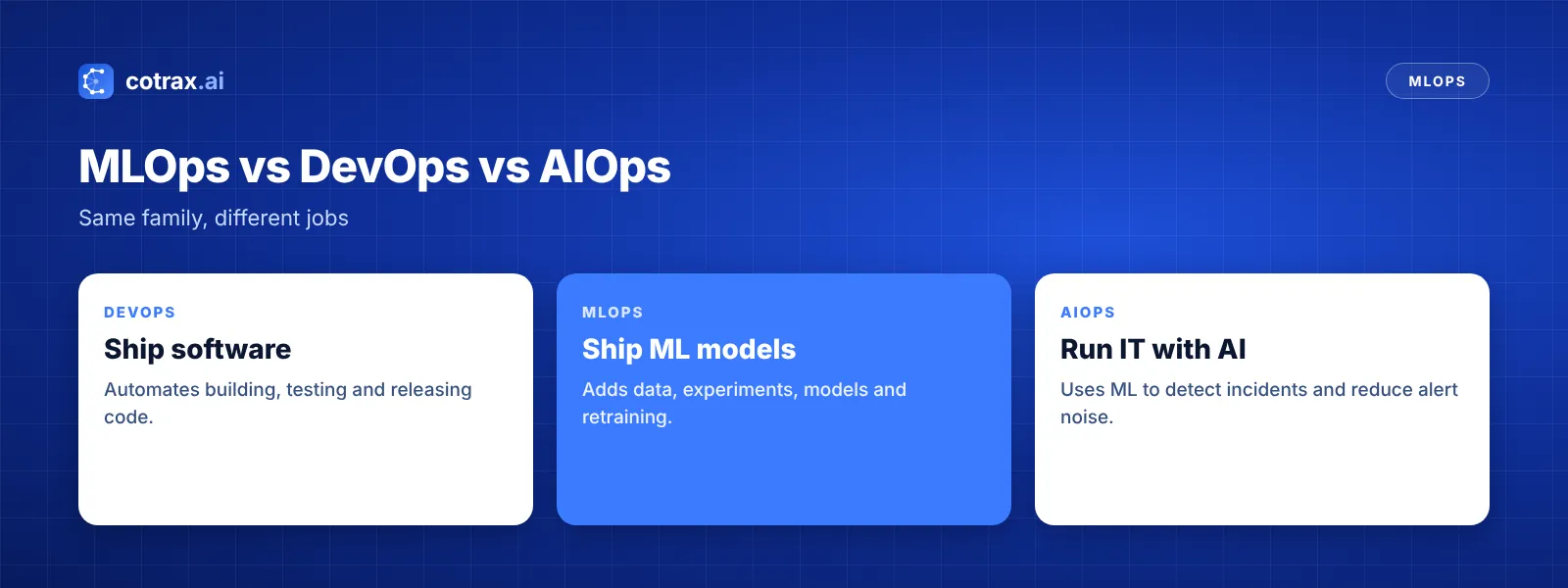
DevOps automates how software code is built, tested and released, while MLOps applies those same ideas to machine learning and adds the management of data, experiments, models and model drift. In short, DevOps ships code, whereas MLOps ships models that depend on both code and data.
That extra dependency on data changes a lot. For example, a regular app works the same way until someone changes its code. An ML model, on the other hand, can get worse on its own as real-world data shifts.
What Is DevOps?
DevOps is a set of practices that brings software development and IT operations together. Its goal is to release software faster and more reliably. To do that, teams use version control, automated testing, CI/CD pipelines, infrastructure as code and monitoring.
For instance, when a developer pushes code, a CI/CD pipeline tests it and deploys it automatically. As a result, releases that once took weeks can happen many times a day.
What Is MLOps?
MLOps, or machine learning operations, extends DevOps to machine learning systems. It covers the full lifecycle: data preparation, training, validation, deployment, monitoring and retraining. For a deep dive, read our guide on what MLOps is.
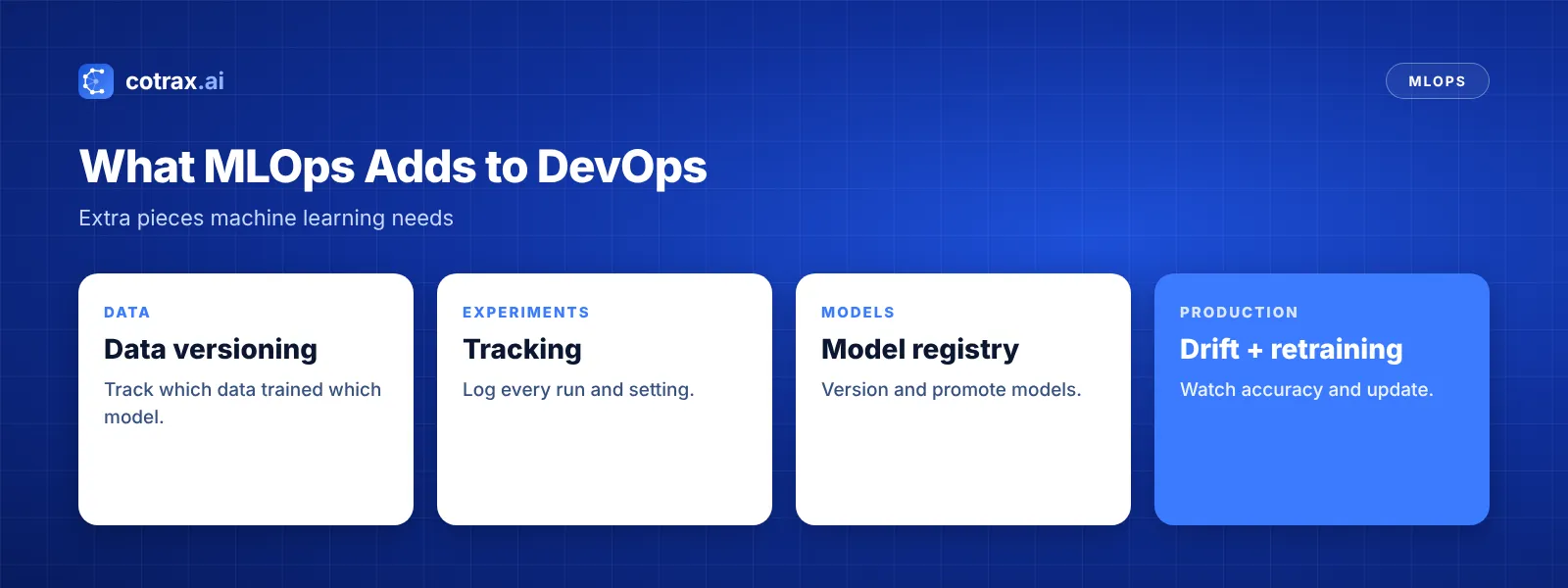
Because ML depends on data, MLOps adds new building blocks to the DevOps toolkit.
What Is AIOps?
AIOps, short for artificial intelligence for IT operations, flips the relationship. Instead of running AI, it uses AI to run IT. AIOps tools analyze logs, metrics and alerts to spot incidents, find root causes and cut alert noise.
Here’s an easy way to remember it. MLOps is about operating machine learning. AIOps, by contrast, is about using machine learning to operate everything else.
Not sure which practice your team needs?
Tell the cotrax team about your setup, and we’ll suggest a practical starting point.
MLOps vs DevOps vs AIOps: Side-by-Side Comparison
| Feature | DevOps | MLOps | AIOps |
|---|---|---|---|
| Main goal | Ship software fast and safely | Ship and maintain ML models | Run IT systems with AI help |
| What changes | Code | Code, data and models | Infrastructure and alerts |
| Key practices | CI/CD, testing, IaC | Data versioning, tracking, retraining | Anomaly detection, root-cause analysis |
| Typical tools | Git, Jenkins, Docker, Kubernetes | MLflow, Kubeflow, DVC, Evidently | Observability and incident platforms |
| Main users | Developers, DevOps engineers | Data scientists, MLOps engineers | IT ops and SRE teams |
| Failure mode | Bugs in code | Model drift and bad data | Missed or noisy alerts |
Key Differences Between MLOps and DevOps
1. Data is a first-class citizen
In DevOps, you version code. In MLOps, however, you must also version data, because the same code with different data produces a different model.
2. Experiments come before releases
Data scientists run many experiments before picking a model. Therefore, MLOps needs experiment tracking, which DevOps rarely requires. Tools like MLflow handle this.
3. Testing goes beyond code
DevOps tests whether code works. MLOps also tests whether the model is accurate, fair and better than the current one. For example, teams use cross-validation and holdout tests.
4. Models decay over time
Software doesn’t get worse on its own. Models do, because customer behavior and data change. So MLOps adds drift monitoring and automated retraining.
5. Different hardware
Finally, ML training often needs GPUs and large storage. As a result, MLOps teams manage more specialized infrastructure.
DevOps asks “does the code still work?” MLOps also asks “is the model still right?” That second question never stops needing an answer.
cotrax.ai Editorial Team
Get practical AI guides every week
Join the cotrax newsletter for simple, no-jargon lessons on MLOps and AI.
Which One Does Your Team Need?
- Building any software? Start with DevOps. It’s the foundation for everything else.
- Putting ML models into production? Then add MLOps on top of your DevOps setup.
- Running lots of servers and services? In that case, consider AIOps to tame alerts and spot incidents early.
In practice, most growing companies end up using all three. DevOps keeps software flowing, MLOps keeps models accurate, and AIOps keeps the whole system healthy.
Career paths
Similarly, the career paths overlap. Many MLOps engineers start in DevOps and then learn ML, or they start in data science and learn DevOps. Read our guide to becoming an MLOps engineer for a full roadmap. And to choose your stack, see the best MLOps tools.
Google’s MLOps architecture guide is also a useful reference. It shows how CI/CD ideas extend to ML pipelines.
Conclusion
When comparing MLOps vs DevOps, remember this: DevOps ships code, while MLOps ships models that depend on code and data. MLOps keeps the DevOps foundation and adds data versioning, experiment tracking, model registries, drift monitoring and retraining.
AIOps, meanwhile, is different again. It uses AI to help run IT operations. So start with DevOps, add MLOps when you deploy ML, and bring in AIOps as your systems grow.
For more practical AI guides, keep exploring cotrax.ai.
Build smarter with AI
Share your idea with the cotrax team and get a clear, simple plan to start.
Sources
- Google Cloud: MLOps, continuous delivery and automation pipelines in machine learning
- MLflow documentation
Frequently asked questions
What is the difference between MLOps and DevOps?
What is AIOps?
Is MLOps part of DevOps?
Should I learn DevOps before MLOps?
Which is better, MLOps or DevOps?
Want more guides like this?
Get clear, practical AI explainers from Cotrax AI in your inbox every Friday.