Key Takeaways
- Self-supervised learning lets a model create its own labels from raw, unlabeled data.
- It works by hiding part of the data and training the model to predict the missing part.
- It’s the main way large language models like GPT, Claude and Gemini are pretrained.
- Key methods include masked prediction, next-token prediction and contrastive learning.
- It cuts labeling costs, but it still needs lots of data and computing power.
Labeling data is slow and expensive. For example, tagging a million images by hand can take a team months. So how did models like GPT learn from almost the entire public internet? The answer is self-supervised learning, a method where the data teaches the model by itself.
This idea quietly sits behind most modern AI. In fact, it’s the reason today’s chatbots, image tools and speech apps became so capable so quickly.
In this guide, the cotrax.ai team explains how it works, the main methods, real examples, and how it compares with supervised and semi-supervised learning. As always, we keep it simple.
What Is Self-Supervised Learning?
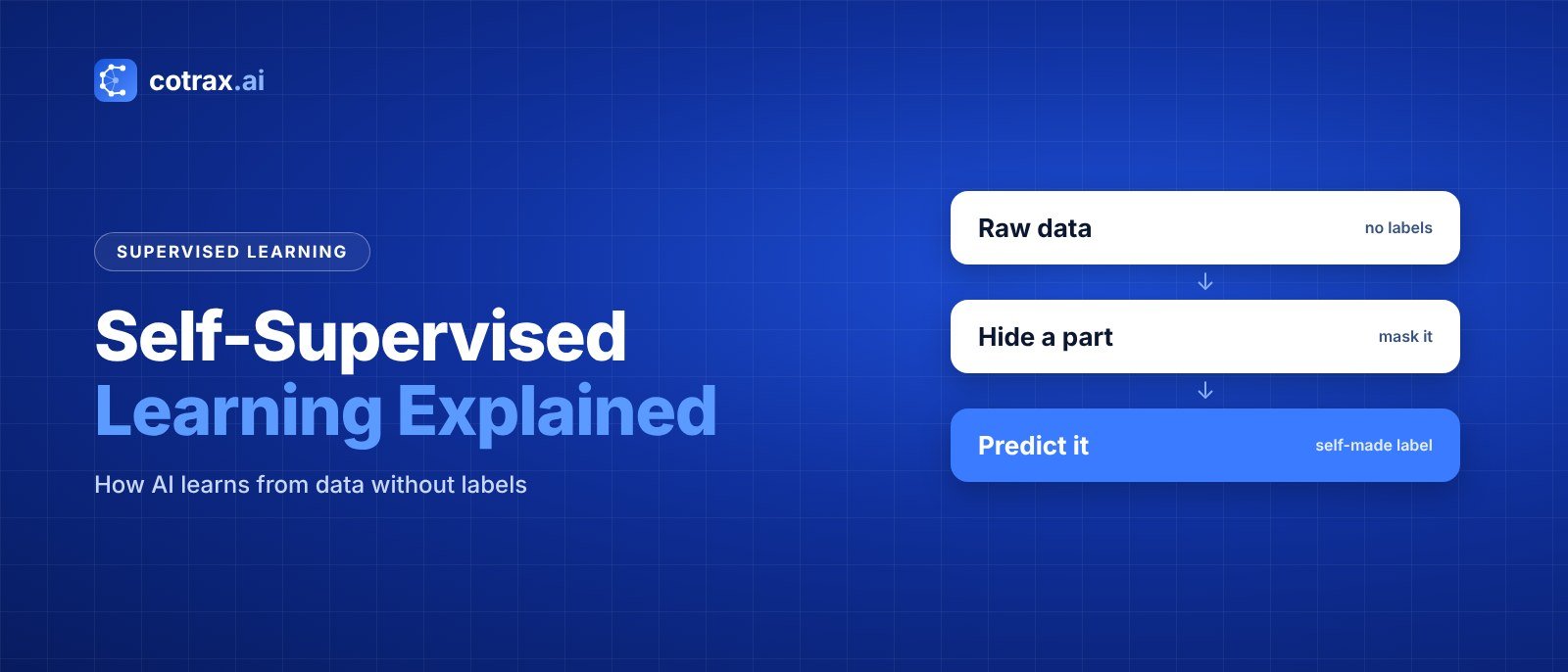
Self-supervised learning is a machine learning method where a model creates its own labels from raw, unlabeled data, usually by hiding part of the data and learning to predict it. Because the answers come from the data itself, no human labeling is needed. Later, the model can be fine-tuned for specific tasks with only a small labeled set.
Here’s a simple example. Take the sentence “The cat sat on the ___.” The missing word is “mat,” and that answer is already in the text. So the model gets a free practice question. Repeat that billions of times, and the model learns grammar, facts and meaning.
Meta’s AI team once called this approach the “dark matter of intelligence”, because so much learning can happen without labels.
How Does Self-Supervised Learning Work?
Most systems follow two stages. First comes pretraining, and then comes fine-tuning.
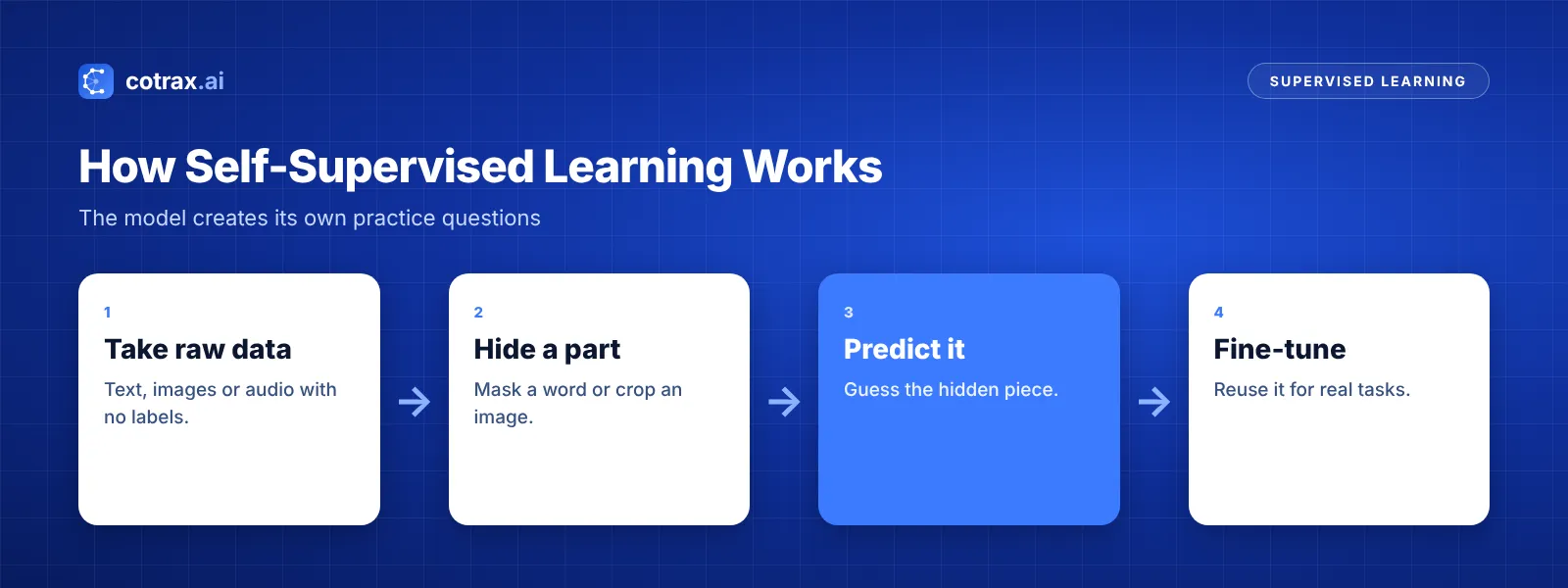
Stage 1: Pretraining on a pretext task
During pretraining, the model solves a made-up “pretext task.” For instance, it might predict a hidden word, the next word, or a missing patch of an image. While solving these puzzles, it builds a rich understanding of the data.
Stage 2: Fine-tuning on a real task
After that, you adapt the pretrained model to your actual goal, such as sorting support tickets. Because the model already understands language or images, it needs far fewer labeled examples. As a result, projects become faster and cheaper.
Main Self-Supervised Learning Methods
Several tricks can turn raw data into learning tasks. However, three methods show up most often.
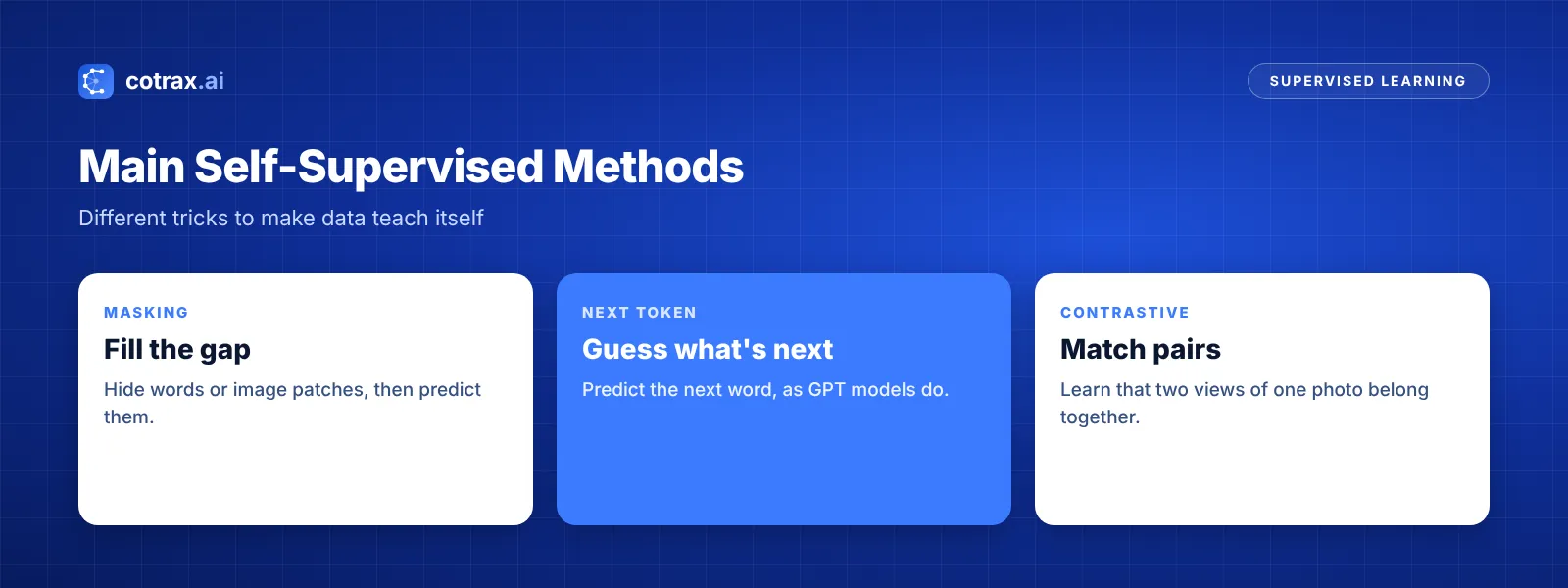
Masked prediction
The model hides parts of the input and then fills them in. Google’s BERT famously learned language by predicting masked words. Similarly, masked autoencoders hide patches of an image and rebuild them.
Next-token prediction
Here, the model reads text and guesses the next word, or “token.” GPT models, Claude and Gemini all learn this way during pretraining. Although the task sounds simple, it forces the model to learn facts, logic and style.
Contrastive learning
Contrastive methods create two edited versions of the same photo, such as a crop and a color change. Then the model learns that these two views belong together, while views from other photos don’t. Google’s SimCLR is a well-known example.
Want to use pretrained AI in your business?
Tell the cotrax team about your data, and we’ll suggest a simple way to start.
Self-Supervised vs Supervised vs Semi-Supervised Learning
These three methods are easy to mix up. So here’s a quick side-by-side view.
| Feature | Supervised | Semi-supervised | Self-supervised |
|---|---|---|---|
| Human labels | All data | A small part | None for pretraining |
| Where labels come from | People | People plus model guesses | The data itself |
| Typical use | Spam filters, scoring | Lots of data, few labels | Pretraining big models |
| Main cost | Labeling time | Some labeling | Computing power |
In short, supervised learning needs a full answer key. Semi-supervised learning stretches a small answer key further. Self-supervised learning, by contrast, writes its own answer key. For a deeper comparison, read our guide on supervised vs unsupervised vs semi-supervised learning, or start with what supervised learning is.
Real-World Examples of Self-Supervised Learning
- Chatbots: large language models are pretrained by predicting the next word.
- Search: language models help search engines understand what you mean.
- Speech: audio models learn from hours of raw speech before learning transcription.
- Medical imaging: models pretrain on unlabeled scans, so they need fewer expert labels later.
- Photo apps: image models learn visual features without tagged photos.
Self-supervised learning didn’t remove the need for labels. Instead, it moved most of the learning to a stage where labels aren’t needed at all.
cotrax.ai Editorial Team
Benefits and Limits
Benefits
- Lower labeling costs: because data labels itself, you save time and money.
- Uses huge datasets: it can learn from billions of examples.
- Reusable models: one pretrained model can serve many tasks.
Limits
- Heavy computing: pretraining large models needs many GPUs.
- Data quality still matters: biased or messy data leads to biased models.
- Not plug-and-play: you usually still need fine-tuning for your task.
The good news is that you rarely need to pretrain anything yourself. Instead, you can download a pretrained model and fine-tune it. Our list of the best deep learning tools shows where to find them.
Get practical ML guides every week
Join the cotrax newsletter for simple, no-jargon lessons on machine learning and AI.
How to Use Self-Supervised Models in Your Projects
- Pick a pretrained model. For text, try a BERT-style model; for images, try a vision transformer.
- Collect a small labeled set. Often, a few hundred good examples are enough.
- Fine-tune. Then train the model briefly on your labeled examples.
- Evaluate. Finally, test on held-out data before you trust the results.
This approach also connects to other learning ideas. For example, see how models keep learning over time in our guide to continual learning.
Conclusion
Self-supervised learning lets AI learn from raw data by turning that data into its own practice questions. As a result, models can learn from billions of examples without an army of labelers.
It’s the engine behind modern language models, speech tools and image systems. Moreover, it makes advanced AI easier to use, because you can fine-tune a pretrained model with just a small labeled set.
So start with a pretrained model and a few hundred examples. And for more clear guides, keep exploring cotrax.ai.
Build smarter with AI
Share your idea with the cotrax team and get a clear, simple plan to start.
Sources
- Meta AI: Self-supervised learning, the dark matter of intelligence
- Devlin et al., BERT (2018)
- Chen et al., SimCLR (2020)
Frequently asked questions
What is self-supervised learning in simple terms?
Is self-supervised learning supervised or unsupervised?
Is ChatGPT self-supervised?
What is the difference between self-supervised and semi-supervised learning?
What are examples of self-supervised learning?
Want more guides like this?
Get clear, practical AI explainers from Cotrax AI in your inbox every Friday.