Key Takeaways
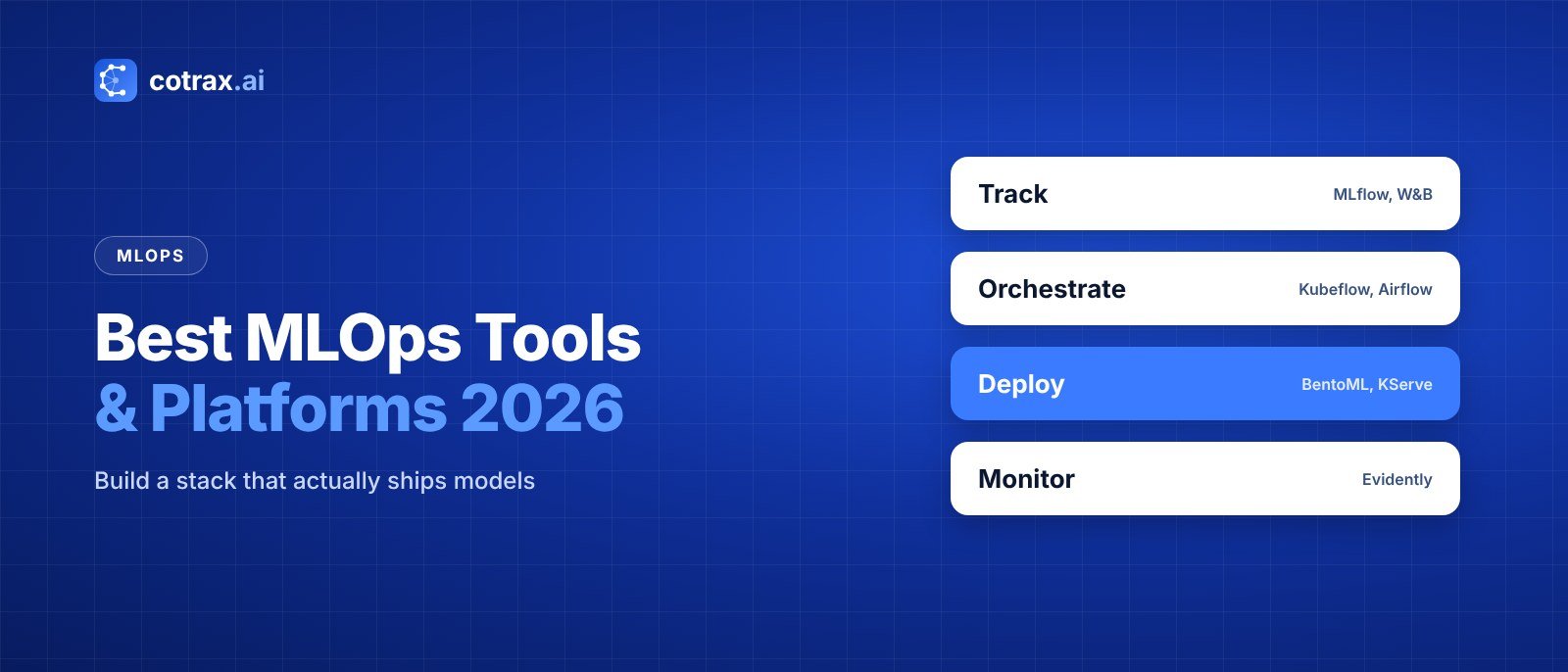
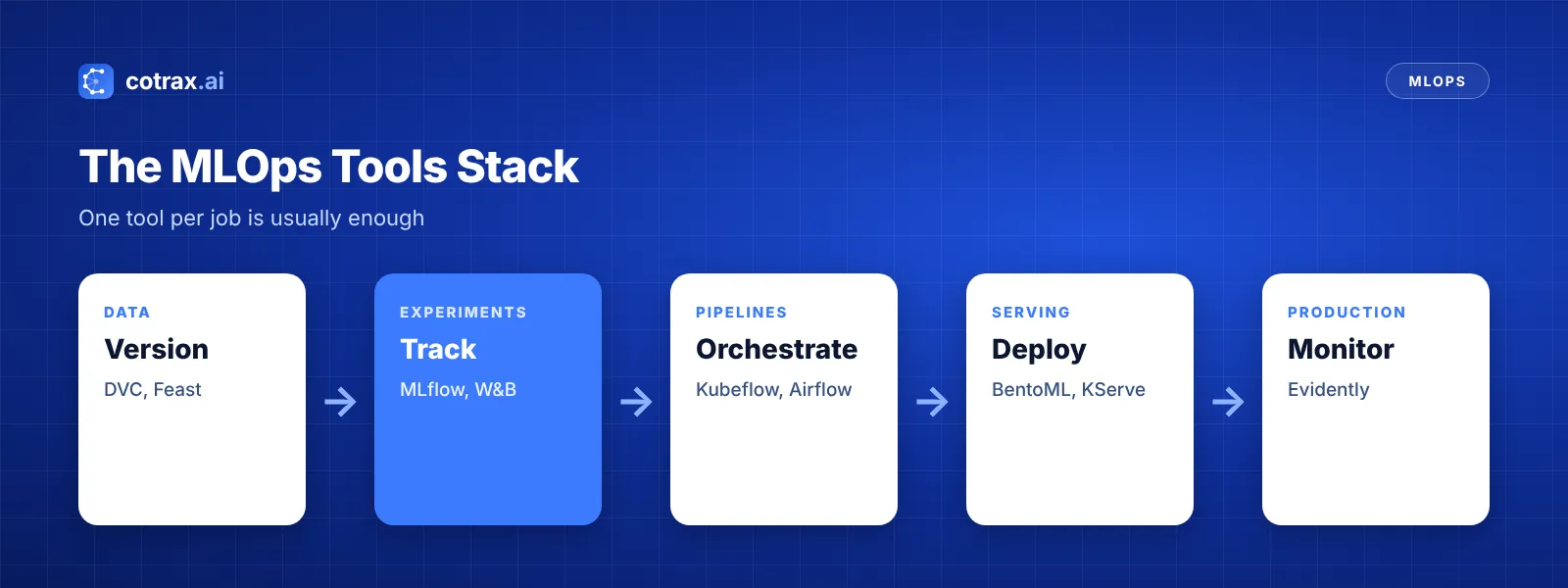
- MLOps tools cover five jobs: data versioning, experiment tracking, pipelines, deployment and monitoring.
- MLflow is the most popular open-source starting point for tracking and model registry.
- Cloud platforms like SageMaker, Vertex AI and Azure ML bundle many tools in one place.
- Kubeflow and Airflow handle pipelines, while Evidently and Prometheus handle monitoring.
- Start with a small, open-source stack and add tools only when a real problem appears.
Your team trained a great model. Now you need to track experiments, ship it, and watch it in production. Suddenly, you’re facing a long list of MLOps tools, each promising to solve everything. So which ones do you actually need?
The truth is that most teams need far fewer tools than they think. In fact, one good tool for each stage of the lifecycle is usually enough.
In this guide, the cotrax.ai team groups the 15 best options by the job they do. You’ll see what each tool is good at, when to use it, and how to build a simple stack that works.
What Are MLOps Tools?
MLOps tools are software products that help teams manage the machine learning lifecycle, including data versioning, experiment tracking, pipeline automation, model deployment and production monitoring. Some focus on a single job, while full platforms bundle many jobs together.
If you’re new to the field, read our guide on what MLOps is first. It explains the lifecycle these tools support.
Quick Comparison of the Best MLOps Tools
All tools below are open source except Weights & Biases, which has a free tier, and the three cloud platforms, which are paid services.
| Tool | Main job |
|---|---|
| MLflow | Tracking and model registry |
| Weights & Biases | Experiment tracking |
| DVC | Data and model versioning |
| Feast | Feature store |
| Kubeflow | Pipelines on Kubernetes |
| Apache Airflow | Workflow orchestration |
| ZenML | Portable ML pipelines |
| Metaflow | Data science workflows |
| BentoML | Model serving |
| KServe | Serving on Kubernetes |
| Evidently | Drift and quality monitoring |
| Prometheus + Grafana | System metrics and dashboards |
| Amazon SageMaker | All-in-one platform |
| Google Vertex AI | All-in-one platform |
| Azure Machine Learning | All-in-one platform |
Experiment Tracking and Versioning Tools
1. MLflow
MLflow is the most widely used open-source MLOps tool. It tracks experiments, packages models and includes a model registry. Because it works with almost any library, it’s a great first pick. See our hands-on MLflow for MLOps guide to get started.
2. Weights & Biases
Weights & Biases offers polished dashboards for logging and comparing training runs. It’s especially popular for deep learning research. However, the full feature set is paid for larger teams.
3. DVC
DVC (Data Version Control) works like Git for data and models. As a result, you can trace every model back to the exact dataset that trained it.
4. Feast
Feast is an open-source feature store. It keeps the features used in training and in production consistent, which prevents subtle bugs.
Not sure which MLOps tools fit your stack?
Tell the cotrax team about your cloud and models, and we’ll suggest a lean setup.
Pipeline and Orchestration Tools
5. Kubeflow
Kubeflow runs ML pipelines on Kubernetes. It’s powerful and scalable. On the other hand, it takes real Kubernetes skills to set up and maintain.
6. Apache Airflow
Airflow schedules and runs workflows written in Python. Although it wasn’t built only for ML, many teams use it for data and training pipelines.
7. ZenML
ZenML lets you write pipelines once and run them on different backends. So it’s handy if you may switch clouds or tools later.
8. Metaflow
Originally built at Netflix, Metaflow helps data scientists move from laptop to cloud with simple Python code. In addition, it handles versioning of each step automatically.
Model Deployment and Serving Tools
9. BentoML
BentoML turns trained models into production-ready APIs with little code. It also builds Docker images for you, which speeds up deployment.
10. KServe
KServe serves models on Kubernetes with features like autoscaling and canary rollouts. Therefore, it fits teams already running Kubeflow or other Kubernetes tools.
Monitoring Tools
11. Evidently
Evidently checks data drift, data quality and model performance. It creates clear reports and dashboards, so you know when a model needs retraining.
12. Prometheus and Grafana
Prometheus collects system metrics, such as latency and errors, while Grafana turns them into dashboards. Together, they’re a standard pair for production monitoring.
All-in-One MLOps Platforms
13. Amazon SageMaker
SageMaker covers training, tuning, deployment and monitoring on AWS. It’s a natural fit if your data already lives in AWS.
14. Google Vertex AI
Vertex AI brings Google Cloud’s ML services together, including pipelines, a model registry and model monitoring.
15. Azure Machine Learning
Azure ML offers managed training, MLflow-compatible tracking and deployment for teams on Microsoft’s cloud. Similarly, Databricks offers a managed platform with MLflow built in.
The best MLOps stack is the smallest one that solves today’s problem. You can always add tools later; removing them is much harder.
cotrax.ai Editorial Team
Get practical AI guides every week
Join the cotrax newsletter for simple, no-jargon lessons on MLOps and AI.
How to Choose MLOps Tools
- Find your biggest pain point. For example, lost experiments, slow deploys or silent drift.
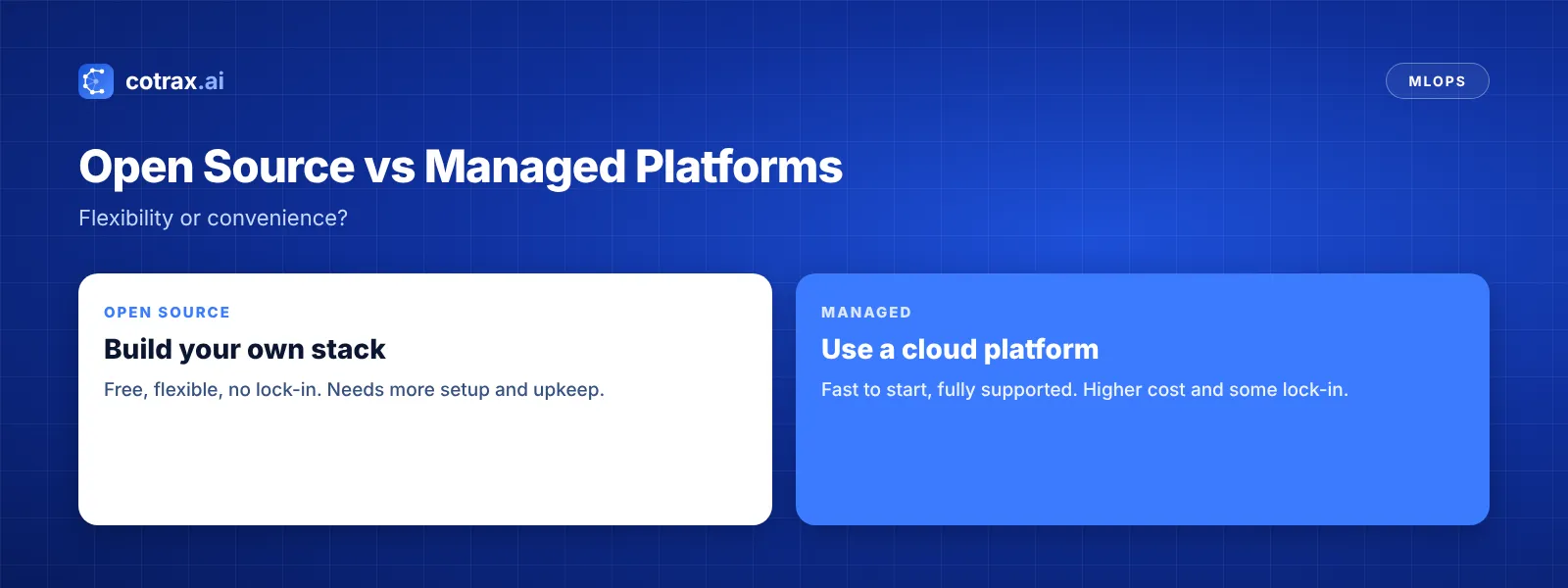
- Check your cloud. If you’re all-in on one cloud, its platform may be the fastest route.
- Match your team’s skills. Kubernetes-heavy tools need Kubernetes experience.
- Prefer tools that work together. For instance, MLflow pairs well with most platforms.
- Start small. Then add tools only when a real problem appears.
A simple starter stack
If you want a clear default, try this. Use Git and DVC for versioning, MLflow for tracking and the model registry, and GitHub Actions for CI/CD. Then add BentoML for serving and Evidently for monitoring. This setup is free to start and covers the full lifecycle.
Skills matter as much as tools. So if you’re building a career here, read our guide to becoming an MLOps engineer. Also, learn how MLOps differs from related fields in our comparison of MLOps vs DevOps.
Conclusion
The best MLOps tools are the ones that solve your current problem without adding needless complexity. MLflow, DVC and Evidently form a strong open-source core. Meanwhile, Kubeflow and Airflow handle pipelines, and BentoML or KServe handle serving.
If you prefer convenience, a managed platform like SageMaker, Vertex AI or Azure ML can cover most needs in one place. Either way, start small and grow your stack step by step.
For more practical AI guides, keep exploring cotrax.ai.
Build smarter with AI
Share your idea with the cotrax team and get a clear, simple plan to start.
Sources
Frequently asked questions
What are MLOps tools?
What is the best MLOps tool?
Are there free MLOps tools?
What is an MLOps platform?
How do I choose MLOps tools?
Want more guides like this?
Get clear, practical AI explainers from Cotrax AI in your inbox every Friday.