Key Takeaways
- An MLOps engineer builds the systems that deploy, monitor and maintain machine learning models in production.
- Core skills include Python, Docker, Kubernetes, CI/CD, cloud platforms and ML basics.
- Glassdoor data cited by Coursera puts median US total pay at about $161,000 per year.
- Many MLOps engineers come from DevOps, software engineering or data science backgrounds.
- Build a portfolio project that takes a model from training to a monitored API.
Data scientists build models. But who makes sure those models actually run in production, stay accurate, and don’t crash at 2 a.m.? That’s the job of an MLOps engineer, one of the fastest-growing roles in AI.
Because more companies now run machine learning inside real products, they need people who can bridge data science and software engineering. As a result, demand for this skill set keeps rising.
In this guide, the cotrax.ai team explains what an MLOps engineer does, the skills and tools you need, what the job pays in the US, and a clear roadmap to get hired.
What Is an MLOps Engineer?
An MLOps engineer is a software engineer who builds and maintains the systems that deploy, monitor and update machine learning models in production. They automate pipelines, manage infrastructure and keep models reliable, so data science work turns into real business value.
Think of the role as part DevOps engineer and part machine learning engineer. If you’re new to the field itself, start with our guide on what MLOps is.
What Does an MLOps Engineer Do?
The daily work varies by company. Still, most MLOps engineers spend their time on a few core tasks:
- Building pipelines: automating data prep, training and testing.
- Deploying models: packaging them in containers and serving them through APIs.
- Monitoring: tracking accuracy, latency and data drift in production.
- Managing infrastructure: setting up GPUs, clusters and cloud services.
- Versioning: keeping track of data, code and model versions.
- Collaborating: working with data scientists, engineers and product teams.
For example, a data scientist might hand over a fraud detection model. Then the MLOps engineer containerizes it, deploys it behind an API, sets alerts for drift, and schedules automatic retraining.
A typical day
Here’s what a normal day might look like. In the morning, you check dashboards for drift alerts and failed pipeline runs. Next, you join a stand-up with data scientists to plan the next model release. After lunch, you might write a CI/CD workflow that tests a new model before it goes live. Later, you could tune a Kubernetes setup so the model handles more traffic at lower cost.
Of course, some days are quieter, while others involve urgent fixes. Either way, the goal stays the same: keep models fast, accurate and safe for users.
MLOps Engineer vs Similar Roles
| Role | Main focus | Typical output |
|---|---|---|
| Data scientist | Analysis and model building | Insights and prototype models |
| ML engineer | Model design and optimization | Production-ready models |
| MLOps engineer | Deployment, automation, monitoring | Reliable ML systems |
| DevOps engineer | Software delivery and infrastructure | CI/CD and stable services |
In smaller companies, one person may cover several of these roles. However, larger teams usually separate them. To see how the fields overlap, read our comparison of MLOps vs DevOps vs AIOps.
Need MLOps help on a real project?
Tell the cotrax team about your models and stack, and we’ll suggest a practical next step.
Key Skills for an MLOps Engineer
Technical skills
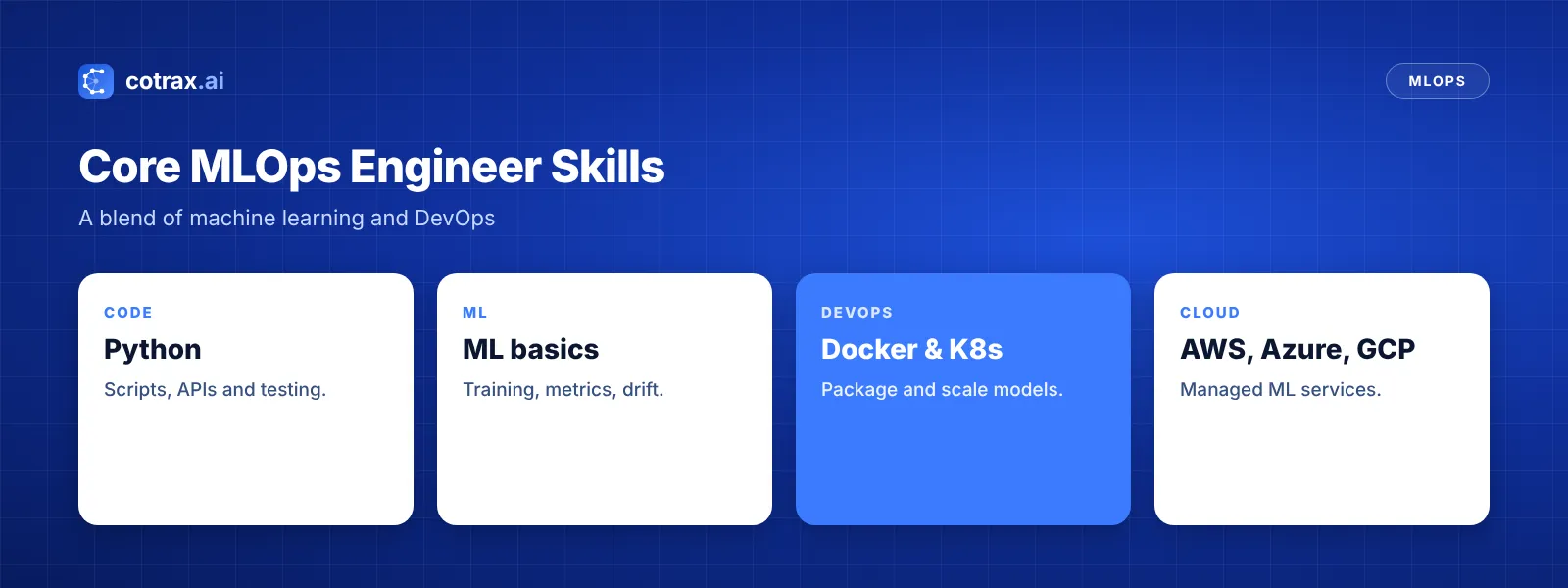
- Python: the main language for ML and automation scripts.
- Machine learning basics: training, evaluation, overfitting and drift.
- Containers: Docker for packaging and Kubernetes for scaling.
- CI/CD: GitHub Actions, GitLab CI or Jenkins.
- Cloud platforms: AWS SageMaker, Azure Machine Learning or Google Vertex AI.
- MLOps tools: MLflow, Kubeflow, Airflow and monitoring tools.
- SQL and data skills: because every model depends on data pipelines.
Soft skills
- Communication: explaining trade-offs to data scientists and managers.
- Problem solving: debugging issues across data, code and infrastructure.
- Ownership: caring about reliability long after launch.
For a deep dive into the software side, see our guide to the best MLOps tools.
MLOps Engineer Salary in the US
MLOps engineers are well paid, although numbers vary by city, company and experience. According to Coursera’s MLOps engineer guide, which cites Glassdoor data from 2026, median total pay in the US is about $161,000 per year. That includes base pay of roughly $106,000 to $149,000 plus bonuses.
The wider field is growing, too. For instance, the US Bureau of Labor Statistics projects data scientist jobs to grow 35% from 2025 to 2035, much faster than average. Many MLOps roles grow alongside those teams.
The best MLOps engineers think like operators. They don’t just ask “does the model work?” but also “what happens when it stops working?”
cotrax.ai Editorial Team
Get practical AI guides every week
Join the cotrax newsletter for simple, no-jargon lessons on MLOps and AI careers.
MLOps Engineer Roadmap
Here’s a practical path you can follow. With steady effort, many people become job-ready in six to twelve months, especially with a software or data background.
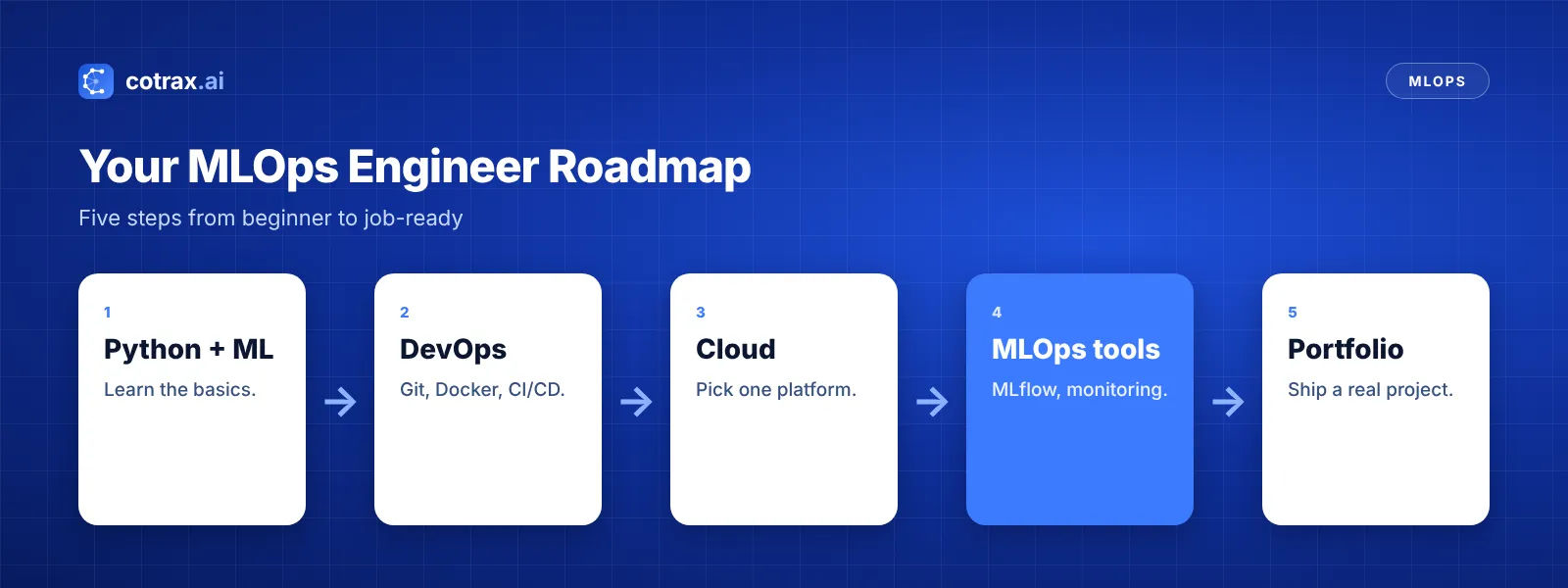
- Learn Python and ML basics. First, train simple models with scikit-learn and learn how to evaluate them. Our guide to deep learning with Python is a good next step.
- Learn DevOps fundamentals. Next, get comfortable with Git, Linux, Docker and CI/CD.
- Pick one cloud platform. Then learn its ML services, storage and permissions.
- Master MLOps tools. After that, learn experiment tracking, model registries and monitoring. Start with our MLflow for MLOps tutorial.
- Build a portfolio project. Finally, train a model, deploy it as an API, add monitoring and automate retraining. Then share it on GitHub.
Helpful certifications
- AWS Certified Machine Learning Engineer, Associate
- Google Cloud Professional Machine Learning Engineer
- Microsoft Azure Data Scientist Associate
- Certified Kubernetes Administrator (CKA)
Certifications help, but a real project usually matters more to hiring managers. So build first, then certify.
Conclusion
An MLOps engineer turns machine learning experiments into reliable products. They build pipelines, deploy and monitor models, and keep everything running as data changes.
The role blends Python, ML, DevOps and cloud skills, and it pays well in the US. So if you enjoy both coding and AI, it’s a strong career path. Start with the basics, learn one cloud, then ship a real project.
For more practical AI career guides, keep exploring cotrax.ai.
Build smarter with AI
Share your idea with the cotrax team and get a clear, simple plan to start.
Sources
- Coursera: What Is an MLOps Engineer? (salary data from Glassdoor)
- US Bureau of Labor Statistics: Data Scientists
Frequently asked questions
What does an MLOps engineer do?
How much does an MLOps engineer make in the US?
Is MLOps engineer a good career?
What is the difference between an MLOps engineer and a data scientist?
How do I become an MLOps engineer?
Want more guides like this?
Get clear, practical AI explainers from Cotrax AI in your inbox every Friday.