Key Takeaways
- Deep learning is a type of machine learning that uses neural networks with many layers to learn patterns from data.
- It shines with messy data like images, audio and text, where hand-written rules fail.
- Popular model types include CNNs, RNNs and transformers, which power tools like ChatGPT.
- It needs lots of data and computing power, but pretrained models make it far easier to start.
- You can begin with Python, PyTorch or TensorFlow and a small project in a weekend.
Your phone unlocks when it sees your face. Netflix seems to know what you want to watch next. And a chatbot can write an email in seconds. So what ties all of these together? The answer is one technology, and if you have ever asked what is deep learning, this guide is for you.
Deep learning sounds complex. However, the core idea is simple: computers learn by example, much like people do. Once you get that idea, the rest falls into place.
In this guide, the cotrax.ai team explains how it works, the main model types, real examples you already use, and how you can start learning it yourself. No math degree needed.
What Is Deep Learning?
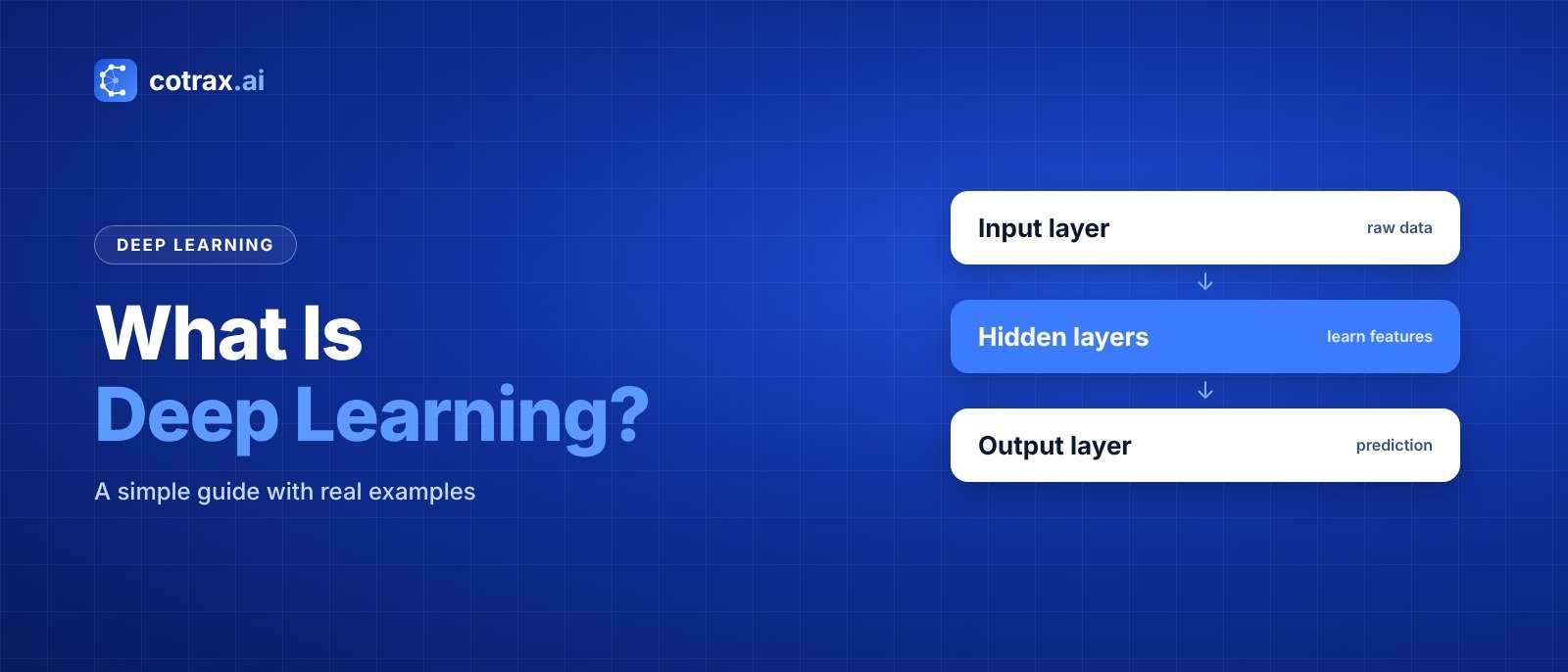
Deep learning is a type of machine learning that uses artificial neural networks with many layers to learn patterns from large amounts of data. Instead of following rules written by a person, the model studies examples. It then adjusts itself until it can recognize images, understand speech or write text on its own.
The word “deep” refers to the number of layers in the network. A shallow network may have one or two layers. In contrast, a deep network can have dozens or even hundreds. Each layer learns something a bit more complex than the layer before it.
If you want the bigger picture first, read our guide on machine learning vs AI vs deep learning. It shows exactly where this field fits inside AI.
How Does Deep Learning Work?
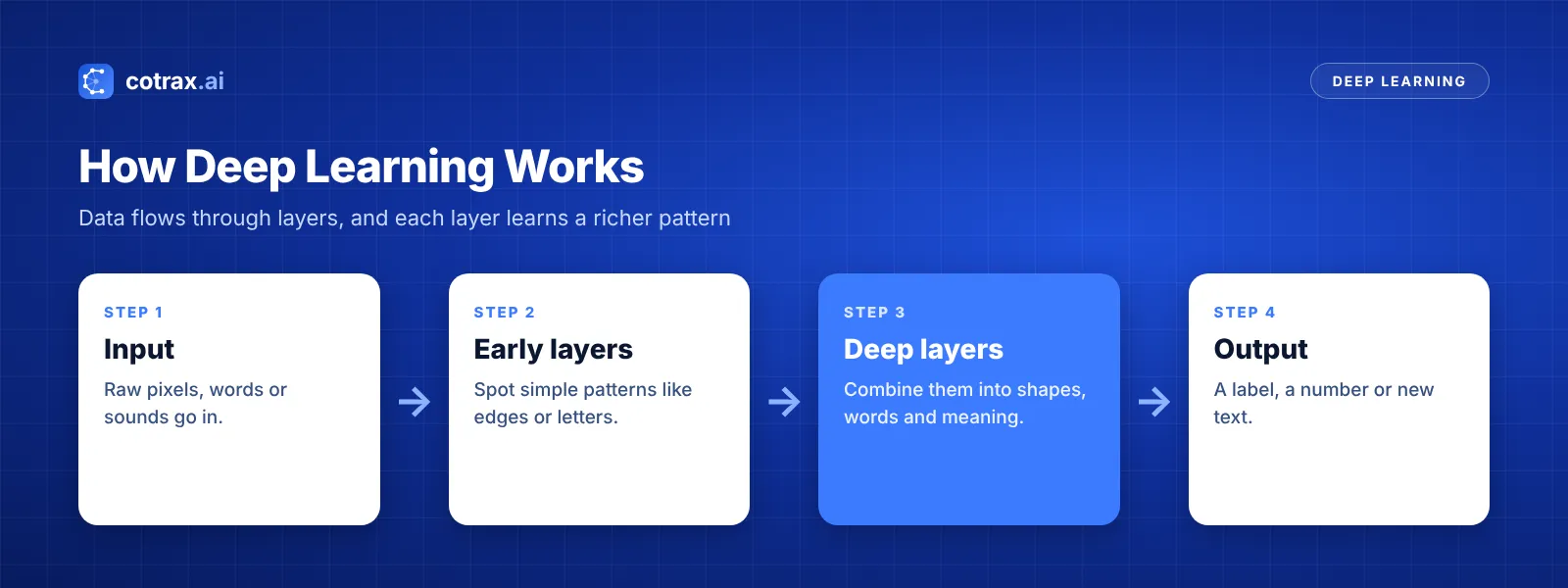
Deep learning works by passing data through layers of connected “neurons.” Each neuron does a small calculation and passes the result forward. During training, the network compares its answer with the correct one. It then nudges its internal settings, called weights, to reduce the error.
Step 1: Data goes in
First, you feed the model raw data. For a photo, that means thousands of pixel values. For text, it means words turned into numbers.
Step 2: Layers learn features
Next, the early layers pick up simple patterns, such as edges in an image. Then the middle layers combine those into shapes. Finally, the deepest layers recognize whole objects, like a cat or a stop sign.
Step 3: The model checks its answer
After that, the network makes a guess. A loss function measures how wrong that guess was. Then a method called backpropagation sends the error backward through the network, so each weight can be adjusted a little.
Step 4: Repeat thousands of times
The model repeats this loop over and over. As a result, its guesses get better with every round. Eventually, it can handle data it has never seen before.
Deep Learning vs Traditional Machine Learning
Both approaches learn from data. Still, they differ in how much help they need from humans. The table below sums it up.
| Feature | Traditional machine learning | Deep learning |
|---|---|---|
| Feature design | Humans choose the features | The model finds features itself |
| Best data type | Tables and structured data | Images, audio, text, video |
| Data needed | Hundreds to thousands of rows | Thousands to millions of examples |
| Hardware | A normal CPU is fine | GPUs speed it up a lot |
| Explainability | Usually easier to explain | Often a “black box” |
In short, traditional methods are great for clean spreadsheets. Meanwhile, deep neural networks win when the data is messy and unstructured. For a full breakdown of the other approaches, see our guide to the types of machine learning.
Main Types of Deep Learning Models
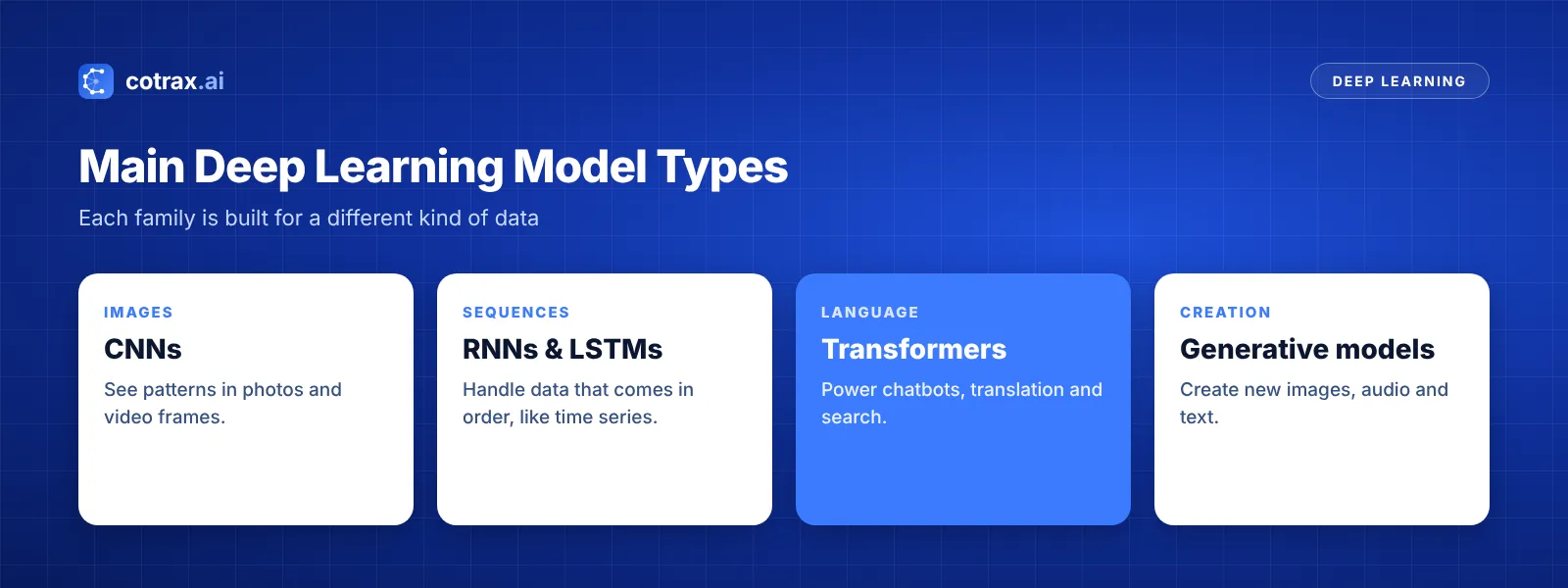
There is no single deep learning model. Instead, there are several families, and each one suits a different kind of data.
Convolutional neural networks (CNNs)
CNNs are built for images. They scan a picture in small patches, which helps them find edges, textures and shapes. For example, they power face unlock and medical scan analysis.
Recurrent neural networks (RNNs) and LSTMs
RNNs handle data that comes in order, such as sensor readings or stock prices. LSTMs are a smarter version that can remember longer patterns. Today, however, transformers have replaced them in many language tasks.
Transformers
Transformers use a trick called attention. It lets the model weigh which words in a sentence matter most. This design powers large language models such as GPT, Claude and Gemini.
Generative models
Generative models create new content. Diffusion models make images from text prompts, while other models generate music or voice. In other words, they don’t just recognize patterns; they produce them.
Want to see deep learning in your business?
Tell the cotrax team what you want to automate, and we’ll suggest a simple starting point.
Real Examples of Deep Learning You Use Every Day
You probably use this technology dozens of times a day without noticing. Here are some common examples:
- Voice assistants: Siri and Alexa turn your speech into text with deep speech models.
- Photo apps: Google Photos groups pictures by face, place and object.
- Recommendations: Netflix, YouTube and Spotify predict what you will enjoy next.
- Chatbots: tools like ChatGPT answer questions and draft content.
- Healthcare: models help doctors spot signs of disease in X-rays and scans.
- Self-driving features: cars use cameras and neural networks to detect lanes and people.
Business use is growing fast, too. According to the Stanford AI Index 2025, 78% of organizations reported using AI in 2024, up from 55% a year earlier. For more use cases, check our list of applications of machine learning.
Benefits and Limits of Deep Learning
Like any tool, it has clear strengths and real weak spots. Knowing both helps you decide when to use it.
Benefits
- Handles messy data: it works directly with images, sound and free text.
- Less manual work: it learns features on its own, so you spend less time on feature design.
- Keeps improving: more data usually means better accuracy.
- Reusable models: pretrained models can be fine-tuned for new tasks.
Limits
- Data hungry: it often needs thousands of labeled examples.
- Costly to train: large models need powerful GPUs and lots of energy.
- Hard to explain: it can be tough to see why a model made a choice.
- Bias risk: if the training data is biased, the model will be too.
The good news is that costs keep falling. The same Stanford report found that the price of running a GPT-3.5-level model dropped more than 280-fold in about two years.
Deep learning isn’t magic. It’s pattern-finding at scale, and the quality of your data decides the quality of your results.
cotrax.ai Editorial Team
Get practical AI guides every week
Join the cotrax newsletter for simple, no-jargon lessons on deep learning and AI.
How to Get Started With Deep Learning
You don’t need a PhD to begin. In fact, a simple plan and a few weekends are enough to build your first model.
- Learn basic Python. Most tools and tutorials use it.
- Pick a framework. PyTorch and TensorFlow are the two most popular options.
- Use free GPUs. Google Colab lets you train small models in your browser.
- Start with a classic project. For instance, classify handwritten digits or cat vs dog photos.
- Try a pretrained model. Then fine-tune it on your own small dataset.
Our list of the best Python libraries for machine learning is a good next stop. It covers the tools you will use most.
Conclusion
So, what is deep learning in one line? It’s a way for computers to learn from examples using many layers of neural networks. That simple idea powers face unlock, chatbots, smart search and much more.
It works best with large, messy data, and it keeps getting cheaper to use. Start small with Python and a pretrained model, and you will understand it faster than you expect.
Ready to put AI to work? Explore more guides on cotrax.ai, or reach out to our team to plan your first project.
Build smarter with AI
Share your idea with the cotrax team and get a clear, simple plan to start.
Sources
Frequently asked questions
What is deep learning in simple words?
Is deep learning the same as AI?
Why is it called deep learning?
Is ChatGPT a deep learning model?
Do I need a GPU to learn deep learning?
Want more guides like this?
Get clear, practical AI explainers from Cotrax AI in your inbox every Friday.