Key Takeaways
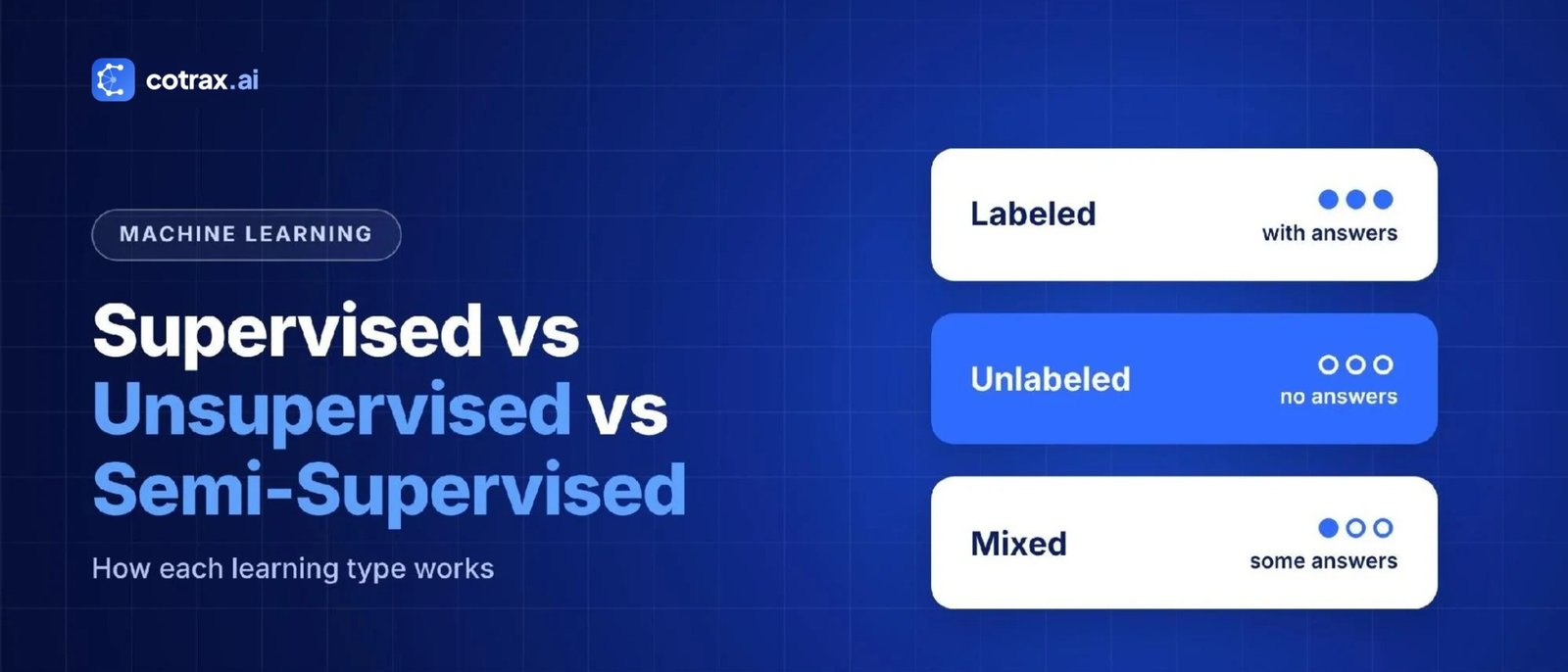
- Supervised learning trains on labeled data, where every example has a correct answer. It is used for prediction and classification.
- Unsupervised learning works with unlabeled data and finds hidden patterns, groups or outliers on its own.
- Semi-supervised learning mixes a small set of labeled data with a large set of unlabeled data to cut labeling costs.
- The main difference between them is how much labeled data you have and what question you want to answer.
- Labeling data is often the most expensive part of a machine learning project, which is why semi-supervised methods are growing fast.
- Many real systems combine all three approaches in one pipeline.
First of all, every machine learning model learns from data. But not all data looks the same. Some data comes with clear answers attached. Other data comes with no answers at all. And most real-world data sits somewhere in between. That is exactly why the debate of supervised vs unsupervised vs semi-supervised learning matters so much.
The type of data you have decides how your model can learn. So if you pick the wrong approach, you waste weeks of work. However, if you pick the right one, even a small team can build models that save real time and money.
In this guide, the cotrax team explains all three learning types in simple words. Along the way, you will see how each one works, the most common algorithms, real examples, the pros and cons, and a simple checklist for choosing the right method.
First, What Is Labeled vs Unlabeled Data?
Before comparing the three methods, you need to understand one simple idea: labels.
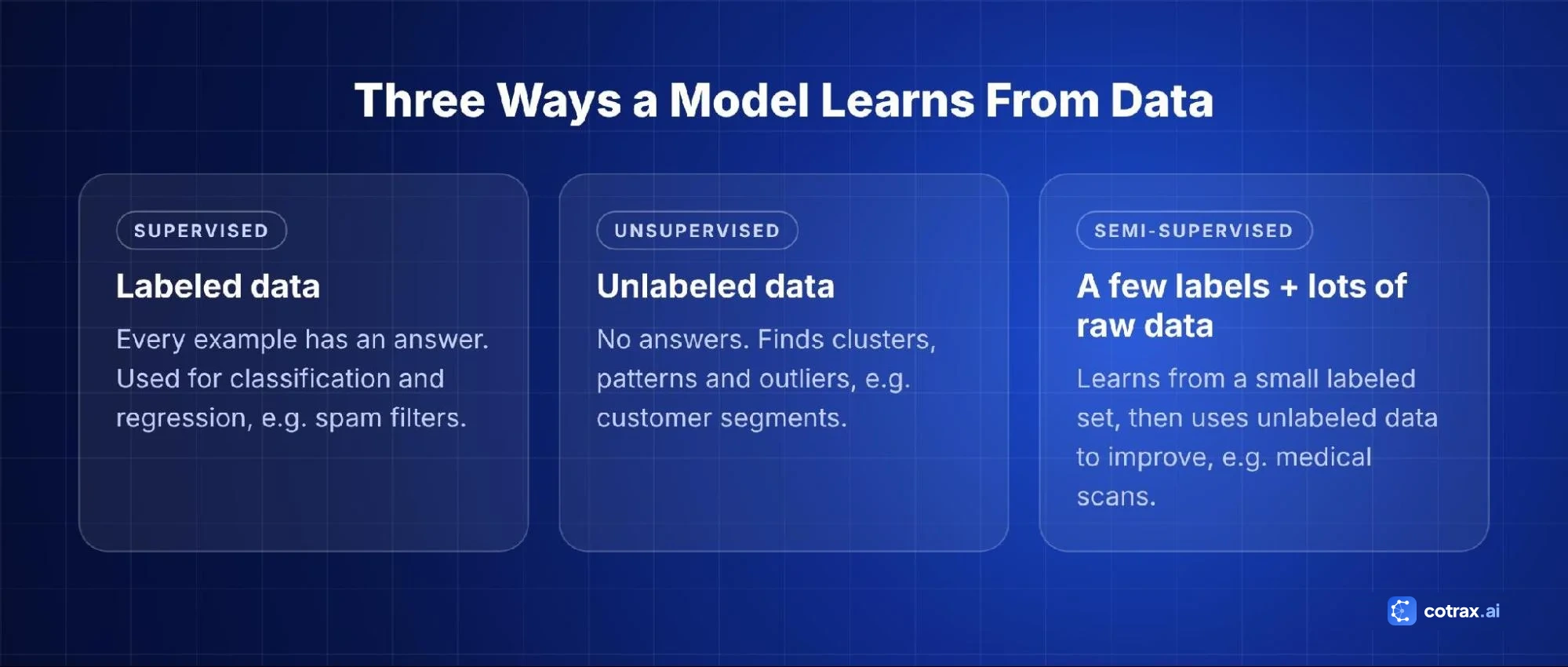
A label is the correct answer attached to an example. For instance, a photo tagged “cat” is labeled data. Similarly, an email marked “spam” is labeled data. Also, a house sale record with the final price is labeled data.
Unlabeled data is raw data with no answer attached. A folder of 100,000 untagged photos is unlabeled. So is a list of website visits or a pile of customer reviews nobody has rated yet.
In general, unlabeled data is cheap and everywhere. Labeled data is valuable but expensive, because a human often has to create each label by hand. In medical imaging, for example, labels may need a trained doctor. As a result, this cost is the key reason three different learning methods exist.
Data is cheap. Labels are expensive. Your learning method should respect that.
cotrax.ai Editorial Team
What Is Supervised Learning?
Supervised learning is the most common type of machine learning. In other words, the model learns from examples where the right answer is already known. It is called “supervised” because the labels act like a teacher checking the model’s work.
During training, the model makes a guess, compares it with the correct label, measures the error and adjusts itself. It repeats this thousands or millions of times until its guesses become accurate. Then it can predict labels for new data it has never seen.
Two main tasks in supervised learning
- Classification: predicting a category. Examples: spam or not spam, fraud or not fraud, cat, dog or bird.
- Regression: predicting a number. Examples: house price, next month’s sales, delivery time.
Common supervised learning algorithms
- Linear regression and logistic regression
- Decision trees and random forests
- Gradient boosting (XGBoost, LightGBM, CatBoost)
- Support vector machines (SVMs)
- k-nearest neighbors (k-NN)
- Neural networks and deep learning models
Real-world examples of supervised learning
- Email spam filters trained on emails users have marked as spam.
- Credit scoring that predicts loan default from past borrower data.
- Medical diagnosis tools trained on scans labeled by doctors.
- Sentiment analysis that tags reviews as positive or negative. For more real uses like this, see our list of applications of machine learning.
- Price prediction for real estate, flights or used cars.
Pros and cons of supervised learning
Pros: high accuracy when labels are good, easy to measure performance, clear goals and many proven algorithms.
Cons: needs lots of labeled data, labeling is slow and costly, and the model can only learn what the labels teach it. Also, if labels contain human bias, the model will copy that bias.
What Is Unsupervised Learning?
Unsupervised learning works with data that has no labels at all. In this case, there is no teacher and no “right answer”. Instead, the model explores the data on its own and looks for structure: groups, patterns, relationships or unusual points.
To illustrate, think of it like sorting a box of mixed buttons without being told the categories. For example, you might group them by color, size or number of holes. Similarly, unsupervised algorithms do the same thing with data.
Main tasks in unsupervised learning
- Clustering: grouping similar items together. Example: grouping customers by shopping behavior.
- Dimensionality reduction: shrinking many features into fewer, more useful ones while keeping the important information.
- Anomaly detection: spotting data points that don’t fit the normal pattern. Example: strange network traffic that may signal a cyberattack.
- Association rules: finding items that often appear together. Example: “people who buy bread often buy butter”.
Common unsupervised learning algorithms
- k-means clustering
- Hierarchical clustering
- DBSCAN
- Principal Component Analysis (PCA)
- t-SNE and UMAP (for visualizing high-dimensional data)
- Isolation Forest (for anomaly detection)
- Autoencoders (neural networks that learn compressed representations)
Real-world examples of unsupervised learning
- Customer segmentation for targeted marketing campaigns.
- Fraud and intrusion detection that flags unusual behavior.
- Topic discovery in large sets of documents or support tickets.
- Product recommendations based on items often viewed together.
- Data exploration before building a supervised model.
Pros and cons of unsupervised learning
Pros: no labeling costs, works with huge raw datasets and can reveal patterns humans did not expect.
Cons: results are harder to measure, groups may not match business needs and a human still has to interpret what each pattern means.
Not sure which learning type fits your data?
Share your use case with the cotrax team and get a simple recommendation.
What Is Semi-Supervised Learning?
As the name suggests, semi-supervised learning sits between the other two. It uses a small amount of labeled data together with a large amount of unlabeled data. In short, the goal is to get close to supervised accuracy without paying to label everything.
For instance, imagine you have 1,000 labeled X-ray images and 50,000 unlabeled ones. However, labeling all 50,000 would take doctors months. A semi-supervised model learns from the 1,000 labeled scans, then uses the shape of the unlabeled data to improve further.
How semi-supervised learning works
Generally, most methods rely on a simple idea: data points that are close together probably share the same label. Below are the most common techniques, such as:
- Self-training (pseudo-labeling): train a model on labeled data, use it to predict labels for unlabeled data, keep the most confident predictions and retrain on the bigger set.
- Co-training: train two models on different views of the data, and let each one label examples for the other.
- Label propagation: spread labels from known points to nearby unknown points through a similarity graph.
- Consistency regularization: teach the model to give the same answer for slightly changed versions of the same input. Methods such as FixMatch use this idea.
Real-world examples of semi-supervised learning
- Medical imaging, where expert labels are scarce and expensive.
- Speech recognition, using a small set of transcribed audio and a huge set of raw recordings.
- Web content classification, where only a fraction of pages are tagged.
- Fraud detection, where only a few confirmed fraud cases exist.
- Text classification for support tickets or legal documents.
Pros and cons of semi-supervised learning
Pros: big savings on labeling costs, uses data you already have and often beats supervised learning when labels are few.
Cons: wrong pseudo-labels can spread errors, results depend on data quality and it is harder to set up and debug.
Semi-supervised learning lets a few good labels go a very long way.
cotrax.ai Editorial Team
Supervised vs Unsupervised vs Semi-Supervised Learning: Comparison Table
| Feature | Supervised | Unsupervised | Semi-Supervised |
|---|---|---|---|
| Data used | Fully labeled | Unlabeled | Few labels + many unlabeled |
| Main goal | Predict known outcomes | Find hidden structure | Predict outcomes with fewer labels |
| Typical tasks | Classification, regression | Clustering, dimensionality reduction, anomaly detection | Classification with limited labels |
| Labeling cost | High | None | Low to medium |
| Accuracy measurement | Easy (compare with labels) | Hard (no ground truth) | Moderate |
| Human role | Create labels | Interpret results | Label a small sample, check outputs |
| Example algorithms | Random forest, XGBoost, logistic regression | k-means, PCA, DBSCAN | Self-training, label propagation, FixMatch |
| Example use | Spam filtering | Customer segmentation | Medical image classification |
Supervised vs Unsupervised vs Semi-Supervised Learning: Key Differences
1. The data you start with
This is the biggest difference. First, supervised learning needs labels for nearly everything. Unsupervised learning needs no labels. Meanwhile, semi-supervised learning needs only a small labeled sample.
2. The question you’re asking
Supervised learning answers “What is this?” or “How much will it be?” Unsupervised learning answers “What patterns or groups exist here?” Semi-supervised learning answers the same questions as supervised learning, but with fewer labels.
3. How you measure success
With supervised learning, you compare predictions with true labels and get clear scores like accuracy or error. Unsupervised learning has no answer key, so you rely on measures like cluster quality and on human review. Finally, semi-supervised learning is usually tested on a small labeled test set.
4. Cost and speed
For instance, supervised projects often spend most of their budget on labeling. Unsupervised projects skip labeling but spend more time interpreting results. In contrast, semi-supervised projects try to balance both.
What About Self-Supervised and Reinforcement Learning?
In addition, two more terms often come up in this discussion.
Self-supervised learning creates its own labels from the data. For example, a language model hides a word in a sentence and learns to predict it. In fact, large language models like GPT and Claude are pre-trained this way on huge amounts of text. It is often grouped with unsupervised learning, because no human labels are needed.
Reinforcement learning is different again. An agent learns by taking actions and getting rewards or penalties, like a game player improving through practice. Today, it powers game-playing AI, robotics and also some fine-tuning of chatbots. For an overview of every approach, read our guide to the types of machine learning. To see how all these types fit into the bigger picture, read Machine Learning vs AI vs Deep Learning.
Related Ideas: Active Learning and Weak Supervision
Two more techniques help when labels are hard to get, and they often work alongside semi-supervised learning.
Active learning lets the model choose which examples a human should label next. Instead of labeling data at random, the model asks about the cases it is least sure of. This way, every label teaches it as much as possible. For example, a document classifier might ask a lawyer to review only the 200 contracts it finds most confusing, rather than 5,000 random ones.
Weak supervision uses rough, cheap labels instead of perfect ones. These might come from simple rules (“emails with an invoice number are billing emails”), keyword lists or older models. The labels are noisy, but combining many weak sources can still train a useful model quickly.
Both ideas share the same goal as semi-supervised learning: get strong results without paying to hand-label every example.
How to Choose Between Supervised vs Unsupervised vs Semi-Supervised Learning
Use this simple checklist when starting a project.
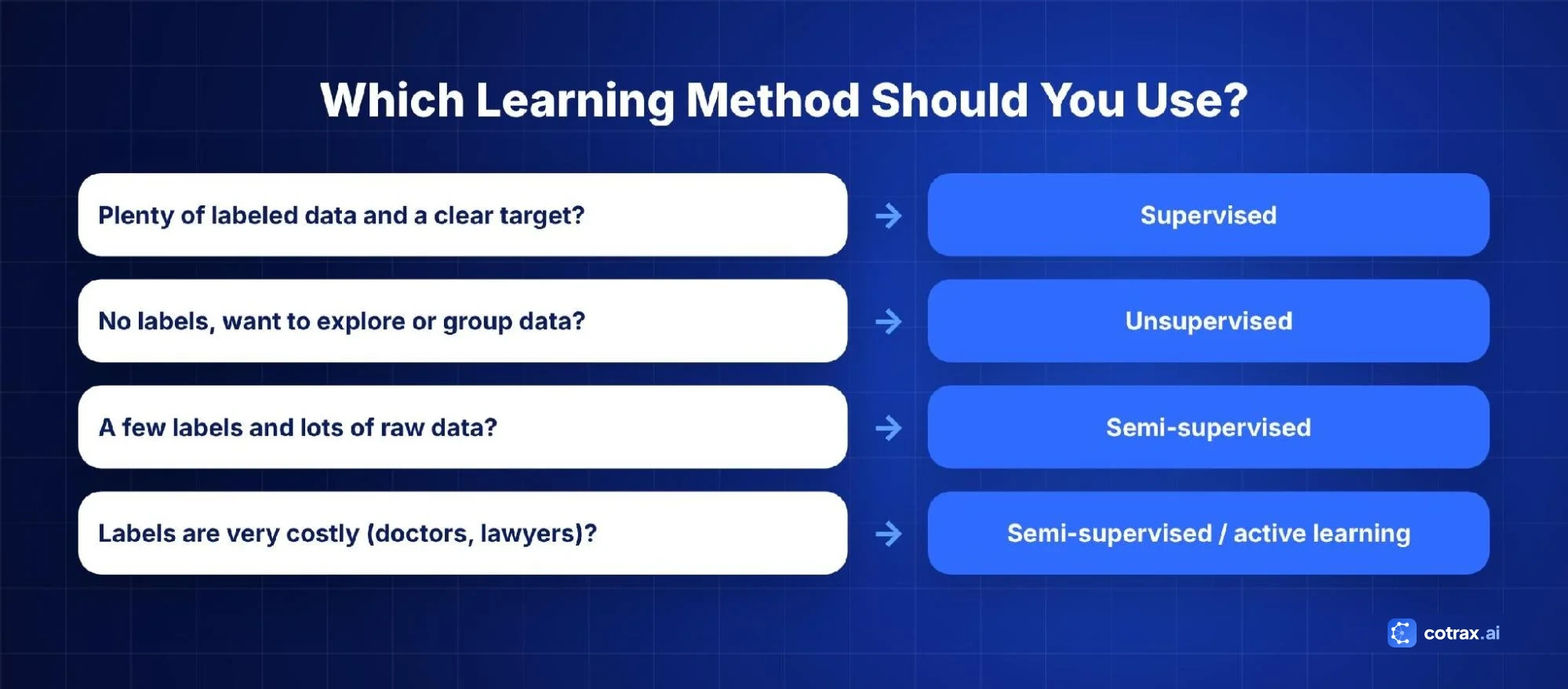
- Do you have plenty of labeled data? Use supervised learning.
- Do you have no labels and want to explore? Use unsupervised learning.
- Do you have a few labels and lots of raw data? Try semi-supervised learning.
- Is labeling very expensive (doctors, lawyers, engineers)? In that case, semi-supervised learning or active learning can save a lot.
- Do you need to explain results to customers or regulators? Then start with simple supervised models such as decision trees or logistic regression.
In practice, many teams also combine methods. For example, they might first use clustering to explore customer data, then label a sample from each cluster, then train a semi-supervised model, and finally deploy a supervised model once enough labels exist.
Get practical ML guides every week
Join the cotrax newsletter for simple, no-jargon lessons on machine learning and AI agents.
A Simple Example: One Problem, Three Approaches
For example, imagine an online store that wants to understand its product reviews.
- Supervised: the team labels 20,000 reviews as positive, neutral or negative, then trains a classifier to tag every new review.
- Unsupervised: the team runs topic clustering on all reviews and discovers groups such as “late delivery”, “size issues” and “great quality”, with no labels needed.
- Semi-supervised: the team labels just 1,000 reviews, then uses pseudo-labeling on 200,000 unlabeled reviews to build a strong classifier at a fraction of the cost.
Each approach gives different value. Together, they give a full picture of what customers think and also why.
Tools to Try Each Learning Type
- Supervised: scikit-learn (logistic regression, random forests), XGBoost and LightGBM for tabular data, and PyTorch or Keras for images and text.
- Unsupervised: scikit-learn’s KMeans, DBSCAN and PCA, plus UMAP for visualizing high-dimensional data.
- Semi-supervised: scikit-learn’s SelfTrainingClassifier and LabelPropagation are an easy starting point. For deep learning, however, open-source libraries implement methods like FixMatch.
Start with small, public datasets so you can compare all three approaches on the same problem and see the differences for yourself. For a full tool list, see our guide to the best Python libraries for machine learning.
Common Mistakes to Avoid
- Using poor labels: a supervised model is only as good as its labels. Check them carefully.
- Over-trusting clusters: unsupervised groups are suggestions, not facts. So always review them with domain experts.
- Ignoring confidence in pseudo-labels: in semi-supervised learning, only keep high-confidence predictions to avoid spreading errors.
- Skipping a test set: always keep some labeled data aside to measure real performance.
- Forgetting bias: all three methods can learn unfair patterns from biased data.
The right learning method isn’t the fanciest one. Instead, it’s the one that fits your data and your budget.
cotrax.ai Editorial Team
Conclusion
The choice of supervised vs unsupervised vs semi-supervised learning comes down to one practical question: how much labeled data do you have? Supervised learning is best when labels are plentiful and you want accurate predictions. On the other hand, unsupervised learning is best for exploring raw data and finding hidden patterns. Semi-supervised learning is the smart middle path when labels are scarce and expensive.
To sum up, start by looking at your data, your budget and your goal. Then pick the method that fits, and don’t be afraid to combine them as your project grows.
Build smarter with cotrax
At cotrax, we turn complex AI topics into simple, practical guides. From your first machine learning model to full AI agent workflows, we help you learn faster and build with confidence.
Sources
- scikit-learn: Supervised learning
- scikit-learn: Unsupervised learning
- scikit-learn: Semi-supervised learning
- IBM: What is semi-supervised learning?
Frequently asked questions
What is the main difference between supervised and unsupervised learning?
When should I use semi-supervised learning?
Is clustering supervised or unsupervised?
Is ChatGPT supervised or unsupervised?
Which learning type is best for beginners?
Can I combine supervised and unsupervised learning in one project?
How much labeled data do I need for supervised learning?
Want more guides like this?
Get clear, practical AI explainers from Cotrax AI in your inbox every Friday.