Key Takeaways
- AI is the broad field of making machines perform tasks that normally need human intelligence.
- Machine learning is a subset of AI where systems learn patterns from data instead of following hand-written rules.
- Deep learning is a subset of machine learning that uses many-layered neural networks to learn from huge amounts of data.
- All deep learning is machine learning, and all machine learning is AI, but not all AI is machine learning.
- Classic ML works well with smaller, structured data. Deep learning shines with images, audio and text, but needs more data and computing power.
- Tools like ChatGPT, Claude, face unlock and self-driving systems are all powered by deep learning.
AI, machine learning and deep learning are three of the most used terms in tech today. However, people often use them as if they mean the same thing. They don’t. If you have ever been confused by machine learning vs AI vs deep learning, this guide will clear it up for good.
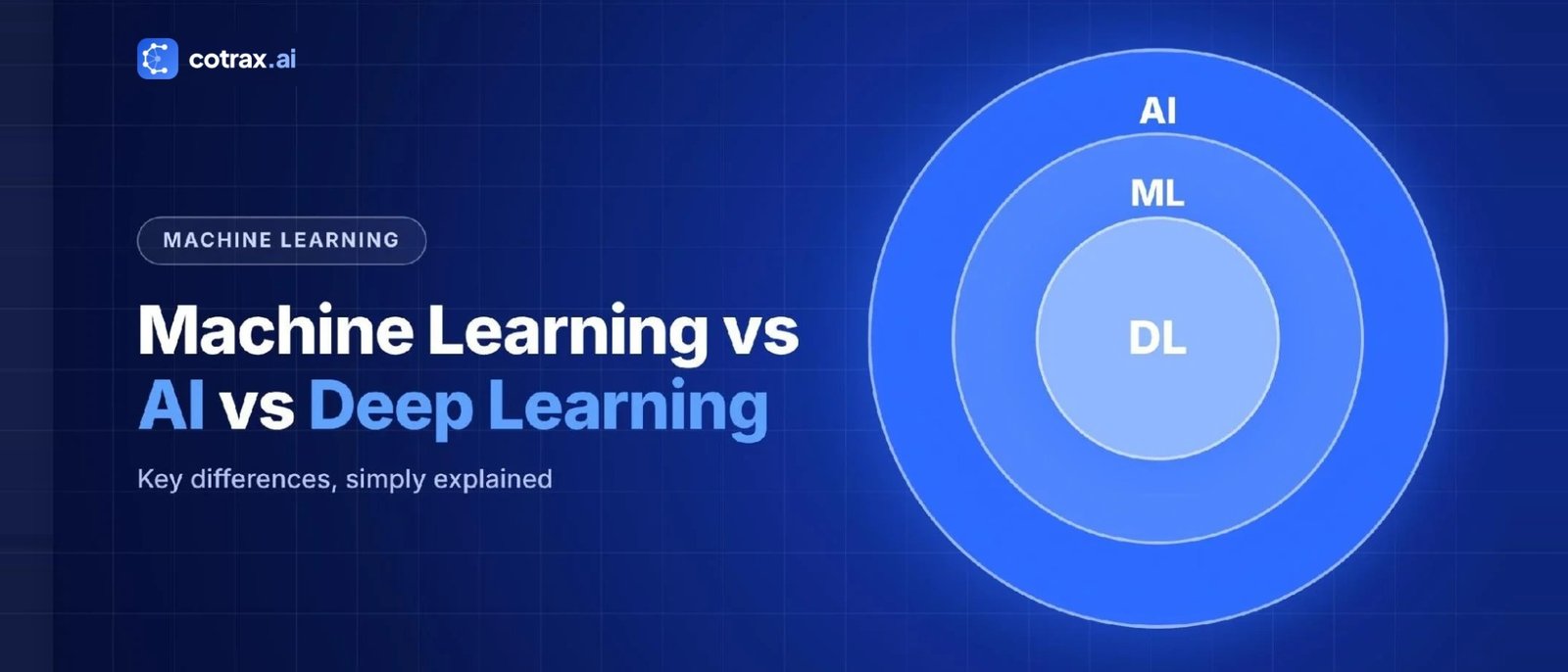
Here is the short version. Artificial intelligence (AI) is the big goal: machines that act smart. Machine learning (ML) is one way to reach that goal: machines that learn from data. Deep learning (DL) is one type of machine learning: learning with large neural networks. In other words, each one sits inside the other, like a set of nesting dolls.
In this guide, the cotrax team breaks down each term in plain English, shows how they connect, compares them side by side and shares real examples you already use every day.
What Is Artificial Intelligence (AI)?
In short, artificial intelligence is the science of building machines that can do things we normally link with human thinking. For example, that includes understanding language, recognizing images, solving problems, planning and making decisions.
AI is an old idea. The term was coined in 1956 at the Dartmouth workshop, long before modern computers became powerful. At first, AI systems did not learn at all. Instead, programmers wrote thousands of “if this, then that” rules by hand. These are called rule-based systems or expert systems.
For example, a simple chess program can follow fixed rules to pick moves. Similarly, a basic customer service bot can match keywords to set answers. Both count as AI, even though neither one learns anything on its own.
Types of AI by ability
- Narrow AI (weak AI): built for one job, such as recommending movies or translating text. In fact, every AI system in use today is narrow AI.
- General AI (AGI): a system that could learn and reason across any task like a human. It is still a research goal.
- Superintelligent AI: a theoretical system smarter than humans in every area. Therefore, it exists only in theory and science fiction for now.
AI is the destination. Machine learning and deep learning are the vehicles that got us most of the way there.
cotrax.ai Editorial Team
What Is Machine Learning (ML)?
Machine learning is a branch of AI where computers learn from data rather than from hand-coded rules. First, you give the system lots of examples. Then it finds the patterns by itself. Then it uses those patterns to make predictions on new data.
Think about spam filters. After all, writing a rule for every possible spam email is impossible. So instead, you show a machine learning model thousands of emails labeled “spam” or “not spam”. Over time, it learns which words, senders and patterns point to spam. As a result, it can flag new spam it has never seen before.
How machine learning works
- Collect data: gather examples, such as past sales, emails or customer records.
- Prepare features: clean the data and pick the useful inputs (for example, price, location, size).
- Train a model: an algorithm adjusts itself to fit the patterns in the data.
- Evaluate: test the model on data it has not seen to check accuracy.
- Deploy and improve: use it in the real world and retrain it as new data arrives.
Main types of machine learning
- Supervised learning: learns from labeled data. Example: predicting house prices from past sales.
- Unsupervised learning: finds hidden groups in unlabeled data. Example: grouping customers by buying habits.
- Semi-supervised learning: uses a small amount of labeled data with a lot of unlabeled data.
- Reinforcement learning: learns by trial and error with rewards. Example: a robot learning to walk.
To see how these types compare in detail, read our guide to supervised vs unsupervised vs semi-supervised learning.
Popular classic ML algorithms include linear regression, logistic regression, decision trees, random forests, k-means clustering and gradient boosting. Also, many of these run fast on a normal laptop.
New to machine learning?
Get the free cotrax AI starter guide and learn the core ideas in 10 minutes a day.
What Is Deep Learning (DL)?
Deep learning is a special type of machine learning that uses artificial neural networks with many layers. The word “deep” refers to the number of layers, not to how deep the thinking is.
In simple terms, a neural network is loosely inspired by the human brain. Also, it has layers of connected “neurons” that pass numbers to each other. Each layer learns something a little more complex than the one before it. In an image model, for example, early layers spot edges, middle layers spot shapes like eyes and wheels, and later layers recognize whole faces or cars.
The biggest difference from classic machine learning is feature learning. For instance, with classic ML, a human often has to decide which features matter. In contrast, with deep learning, the network figures out the useful features by itself, straight from raw pixels, sound waves or text.
Common deep learning architectures
- Convolutional Neural Networks (CNNs): great for images and video, such as medical scans and face recognition.
- Recurrent Neural Networks (RNNs) and LSTMs: built for sequences like speech and time-series data.
- Transformers: the architecture behind modern large language models such as GPT and Claude.
- Diffusion models and GANs: used to generate images, video and audio.
Neural networks vs deep learning
These two terms are also mixed up a lot. To clarify, a neural network is the model structure itself. On the other hand, deep learning is the practice of training neural networks that have many hidden layers. A small network with one hidden layer is still a neural network, but most people would not call it deep learning. So, every deep learning model is a neural network, but not every neural network is “deep”.
Deep learning took off in the 2010s thanks to three things: huge datasets, powerful GPUs and better training methods. A key moment came in 2012, when a deep network called AlexNet won the ImageNet image recognition challenge by a wide margin.
Deep learning didn’t replace machine learning. It gave machine learning a much bigger engine.
cotrax.ai Editorial Team
How AI, Machine Learning and Deep Learning Fit Together
The easiest way to understand machine learning vs AI vs deep learning is to picture three circles, one inside the other.
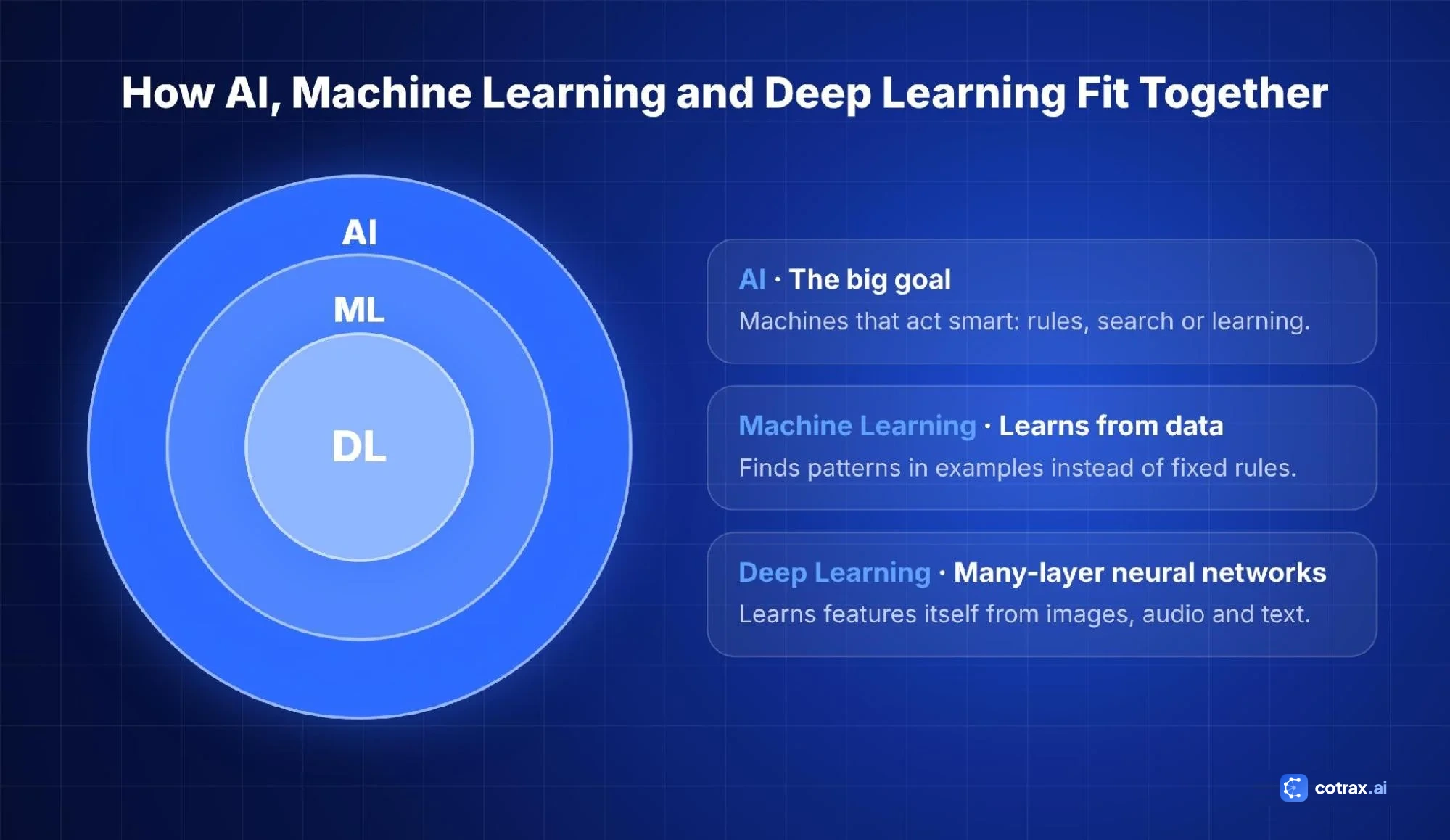
- The outer circle is AI: every technique that makes machines act intelligently.
- Inside it, the middle circle is machine learning: AI that learns from data.
- At the center, the inner circle is deep learning: machine learning that uses deep neural networks.
So, deep learning is always machine learning, and machine learning is always AI. However, the reverse is not true. A rule-based chess engine is AI but not machine learning. A random forest that predicts customer churn is machine learning but not deep learning.
A Short History: From Rules to Deep Learning
The three fields grew in waves, and each wave solved a problem the last one couldn’t.
- 1950s–1980s, rule-based AI: researchers tried to write intelligence down as logic and rules. This worked for narrow tasks, but rules broke easily in the messy real world.
- 1990s–2000s, machine learning: instead of writing rules, engineers let models learn them from data. Spam filters, search ranking and fraud detection became practical.
- 2010s–today, deep learning: with more data and GPUs, deep neural networks started beating older methods at vision, speech and language. As a result, this led to today’s chatbots, image generators and AI agents.
Today all three live side by side. In fact, most real products mix rules, classic ML and deep learning, picking whichever fits each part of the job.
Machine Learning vs AI vs Deep Learning: Side-by-Side Comparison
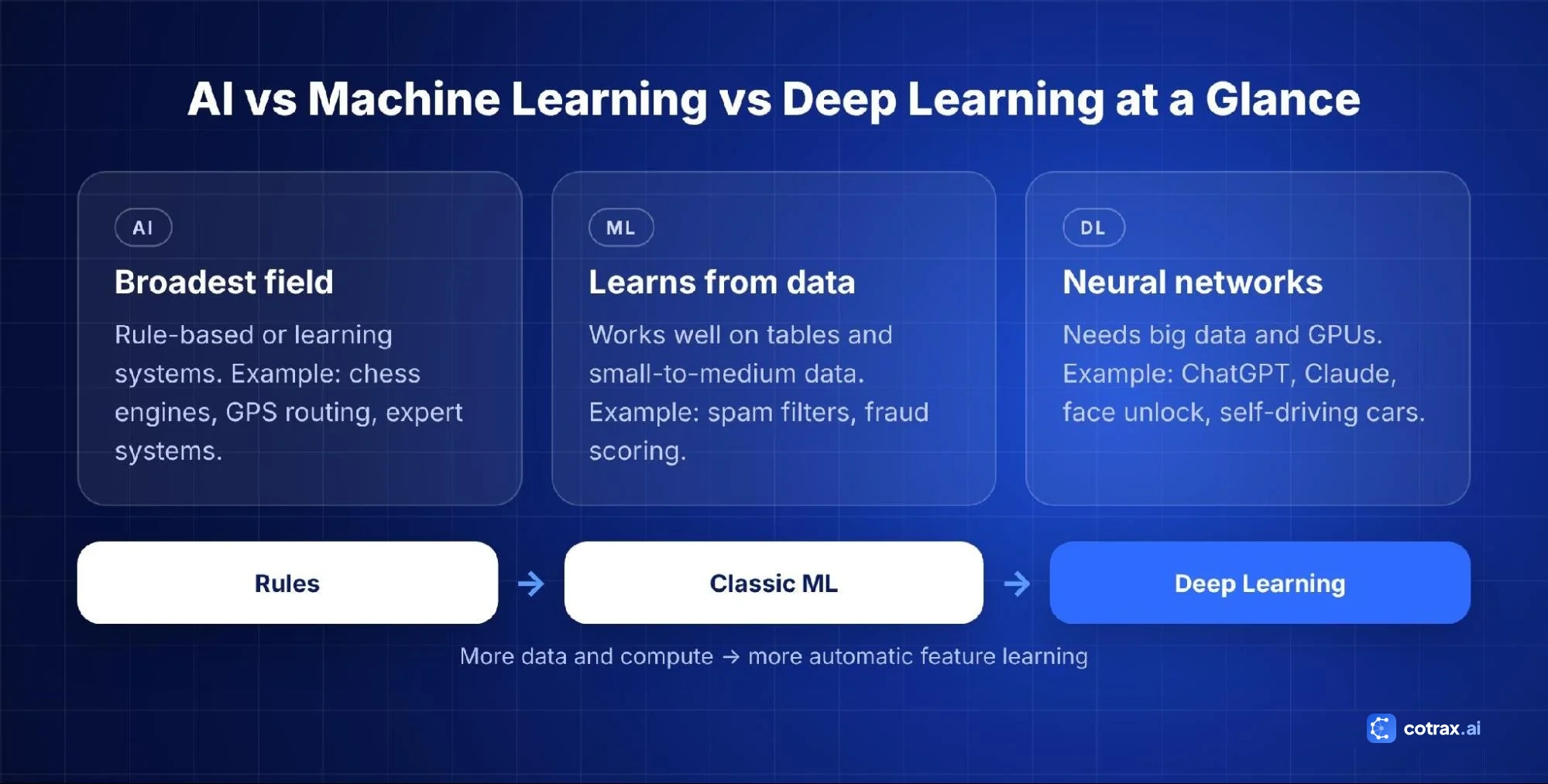
| Feature | Artificial Intelligence | Machine Learning | Deep Learning |
|---|---|---|---|
| Definition | Machines that mimic human intelligence | Systems that learn patterns from data | ML using many-layered neural networks |
| Scope | Broadest field | Subset of AI | Subset of ML |
| How it works | Rules, logic, search or learning | Algorithms trained on data | Neural networks trained on large data |
| Data needed | Can work with none (rule-based) | Small to medium datasets | Large datasets (often millions of examples) |
| Feature engineering | Done by experts as rules | Often done by humans | Learned automatically |
| Hardware | Varies | Standard CPUs are often enough | Usually needs GPUs or TPUs |
| Explainability | High for rule-based systems | Medium to high | Low (“black box”) |
| Examples | Chess engines, expert systems | Spam filters, fraud scoring, price prediction | ChatGPT, Claude, face unlock, self-driving cars |
Key Differences Between AI, ML and Deep Learning
1. Scope
AI is the widest umbrella. Machine learning is one approach under it, and deep learning is one approach under machine learning. When someone says “we use AI”, they could mean any of the three.
2. Human involvement
Rule-based AI needs humans to write every rule. Meanwhile, classic machine learning needs humans to pick and shape the features. Deep learning needs the least hand-crafting, because the network learns the features on its own. However, it still needs humans to design, train and check the model.
3. Data requirements
Classic ML can give good results with a few thousand rows of clean, structured data. However, deep learning usually needs far more data to beat simpler models. So with small datasets, a well-tuned gradient boosting model often wins.
4. Computing power
For example, many ML models train in seconds or minutes on a laptop. Deep learning models, especially large language models, can need clusters of GPUs running for weeks.
5. Explainability
A decision tree can show exactly why it made a prediction. In contrast, a deep neural network with millions or billions of parameters is much harder to explain. That matters in fields like banking and healthcare, where decisions must be justified.
6. Type of data
Classic ML is strongest with structured data in rows and columns, such as spreadsheets and databases. Deep learning is strongest with unstructured data, such as images, audio, video and free text.
Want to use AI in your business?
The cotrax team can help you pick the right approach, whether that’s simple ML or a deep learning model.
Real-World Examples of Each
AI examples (including non-learning AI)
- GPS route planning that searches for the fastest path.
- Game AI in video games that follows scripted behavior.
- Expert systems that guide technicians through fixed troubleshooting steps.
Machine learning examples
- Email spam filters that learn from what users mark as spam.
- Credit card fraud detection that flags unusual spending.
- Product recommendations on online stores.
- Demand forecasting for stores and supply chains.
Deep learning examples
- Chatbots and AI assistants like ChatGPT, Claude and Gemini.
- Face unlock on smartphones.
- Voice assistants that turn speech into text.
- Medical imaging tools that spot signs of disease in scans.
- Self-driving cars that detect lanes, people and signs in real time.
- AI image and video generators that create visuals from text prompts.
Moreover, many of today’s AI agents combine all three. For instance, an agent may use a deep learning language model to understand a request, classic ML to score options and simple rules to stay within safe limits. If you want to see this in action, read our guide on how to connect Claude to n8n and build your first AI agent.
For 20 more real-world uses across healthcare, finance, retail and transport, see our guide to the applications of machine learning.
When Should You Use Machine Learning vs Deep Learning?
If you are building a project, here is a simple way to choose.
Choose classic machine learning when:
- Your data is structured, like sales tables or customer records.
- There is only a limited amount of data.
- You need to explain each decision clearly.
- You want fast training and low costs.
Choose deep learning when:
- Your data is images, audio, video or long text.
- You have lots of data or can use a pre-trained model.
- Top accuracy matters more than explainability.
- You have access to GPUs or cloud computing.
Choose rule-based AI when: the logic is clear, stable and easy to write down, such as tax rules or simple routing.
Start with the simplest model that solves the problem. Reach for deep learning when simple stops working.
cotrax.ai Editorial Team
Common Myths About AI, ML and Deep Learning
Myth 1: AI and machine learning are the same thing
In fact, machine learning is only one part of AI. Plenty of AI systems use rules or search instead of learning.
Myth 2: Deep learning is always better
Not true. On small or tabular datasets, simpler models like gradient boosting often match or beat deep networks, and they are cheaper and easier to explain.
Myth 3: AI understands things like humans do
In reality, today’s AI finds patterns in data. For example, even advanced language models predict likely text based on what they learned. They can be very useful, but they can also make confident mistakes.
Myth 4: You need a PhD to use machine learning
Today, libraries like scikit-learn, PyTorch and TensorFlow, plus no-code tools, make it possible for beginners to build useful models in days, not years. To pick your tools, see our list of the best Python libraries for machine learning.
The Future of AI, ML and Deep Learning
Overall, the lines between these fields will keep blurring. For instance, large deep learning models now act as general-purpose engines that can write, code, see and speak. At the same time, classic machine learning is still the workhorse behind fraud checks, forecasts and pricing in most companies.
Next, expect more AI agents that combine language models with tools and memory, smaller and cheaper models that run on phones, and stronger rules around safety and fairness. Learning the difference between these terms today will help you make smarter choices as the technology grows.
Conclusion
The debate around machine learning vs AI vs deep learning becomes simple once you see the nesting circles. AI is the big goal of smart machines. Machine learning is how most modern AI learns from data. Deep learning is the most powerful kind of machine learning, driving today’s chatbots, image tools and self-driving systems.
Use classic ML for structured data and clear decisions. Use deep learning for images, audio and language. And remember that the best solution is often the simplest one that works.
Understanding the difference isn’t just theory. It’s how you pick the right tool and avoid wasting time and money.
cotrax.ai Editorial Team
Ready to put AI to work?
At cotrax, we make AI, machine learning and AI agents simple and practical. Whether you’re exploring your first model or planning a full AI workflow, our guides and team are here to help.
Sources
- IBM: AI vs. Machine Learning vs. Deep Learning vs. Neural Networks
- Dartmouth: Artificial Intelligence Coined at Dartmouth
- Goodfellow, Bengio and Courville: Deep Learning (MIT Press)
Frequently asked questions
Is deep learning a type of machine learning?
Can AI exist without machine learning?
Is ChatGPT AI, machine learning or deep learning?
Which should a beginner learn first: AI, ML or deep learning?
Why does deep learning need so much data?
Want more guides like this?
Get clear, practical AI explainers from Cotrax AI in your inbox every Friday.